Use Artificial Intelligence (AI) to Generate, Improve, and Validate Non-Functional Requirements (NFRs) - Non-Functional Requirements (NFRs) Framework for Software Systems
Use Artificial Intelligence (AI) to Generate, Improve, and Validate Non-Functional Requirements (NFRs)
(Chapter 43 of Non-Functional Requirements (NFRs) Framework for Software Systems)
Executive Summary: Chapter Overview
IF4ITThe Bottom Line
Core Concepts
| Concept | Definition & Strategic Role |
|---|---|
| AI-Assisted Discovery | Uses AI to accelerate identification of missing, weak, vague, or unvalidated NFRs across the framework categories. |
| Human Review and Accountability | Ensures AI-generated requirements, validation methods, designs, tests, and code are reviewed, tailored, approved, and governed by qualified stakeholders. |
| Evidence and Governance | Connects AI-assisted outputs to validation evidence, traceability, standards alignment, exception handling, and lifecycle governance. |
Quick Q&A
Question: Can AI be treated as the authority for NFR decisions?
Read More Below
Overview
Artificial Intelligence (AI) can help teams use this framework to generate candidate NFRs, identify missing categories, improve vague requirements, create NFR templates, generate Agile backlog entries, suggest validation methods, identify evidence expectations, and map NFRs to standards, lifecycle phases, and environments. AI is especially useful when the complete universe of NFRs is too broad for one stakeholder group to identify from memory.
AI should be treated as an accelerator and reviewer, not as the final authority. AI-generated NFRs, validation methods, designs, tests, templates, backlog entries, and code must be reviewed by qualified stakeholders before they are accepted or implemented.
Solution context for Artificial Intelligence (AI)
AI works best when it is given specific solution context. Teams should describe the system purpose, users, business processes, data, integrations, platform, deployment model, environments, criticality, regulatory context, operational model, expected load, dependencies, and known risks. The richer the context, the more useful the candidate NFRs will be.
Useful context examples:
system description,
user groups,
data classifications,
hosting model,
integrations,
uptime expectations,
compliance drivers,
deployment pipeline,
support model, and
release timeline.
Platform and environment context for Artificial Intelligence (AI)
Platform and environment context helps AI identify NFRs related to cloud regions, on-premises platforms, hybrid connectivity, multi-cloud patterns, vendor-hosted systems, shared environments, coexisting systems, Disaster Recovery (DR), promotion paths, observability, and operational controls. Without this context, AI may generate generic NFRs that are not specific enough to guide implementation.
Lifecycle phase context for Artificial Intelligence (AI)
Lifecycle context helps AI generate NFRs that are appropriate for discovery, architecture, development, testing, deployment, operations, improvement, and retirement. For example, discovery may need candidate requirements and open questions, while Systems Integration Testing (SIT) may need validation methods, data scenarios, and evidence expectations.
Candidate non-functional requirements by category
AI can use the NFR category structure in this framework to generate candidate NFRs across deployment, availability, reliability, recoverability, resilience, safety, performance, scalability, security, software supply chain security, responsible AI, privacy, compliance, data quality, retention, observability, operability, maintainability, deployability, testability, usability, accessibility, interoperability, portability, configurability, auditability, cost, sustainability, localization, and governance.
Missing non-functional requirements
AI can compare existing requirements, architecture descriptions, backlog items, or design documents against the framework and identify missing NFR categories. This helps teams find gaps before they become design defects, production failures, audit findings, or late-stage rework.
Measurable and testable non-functional requirements
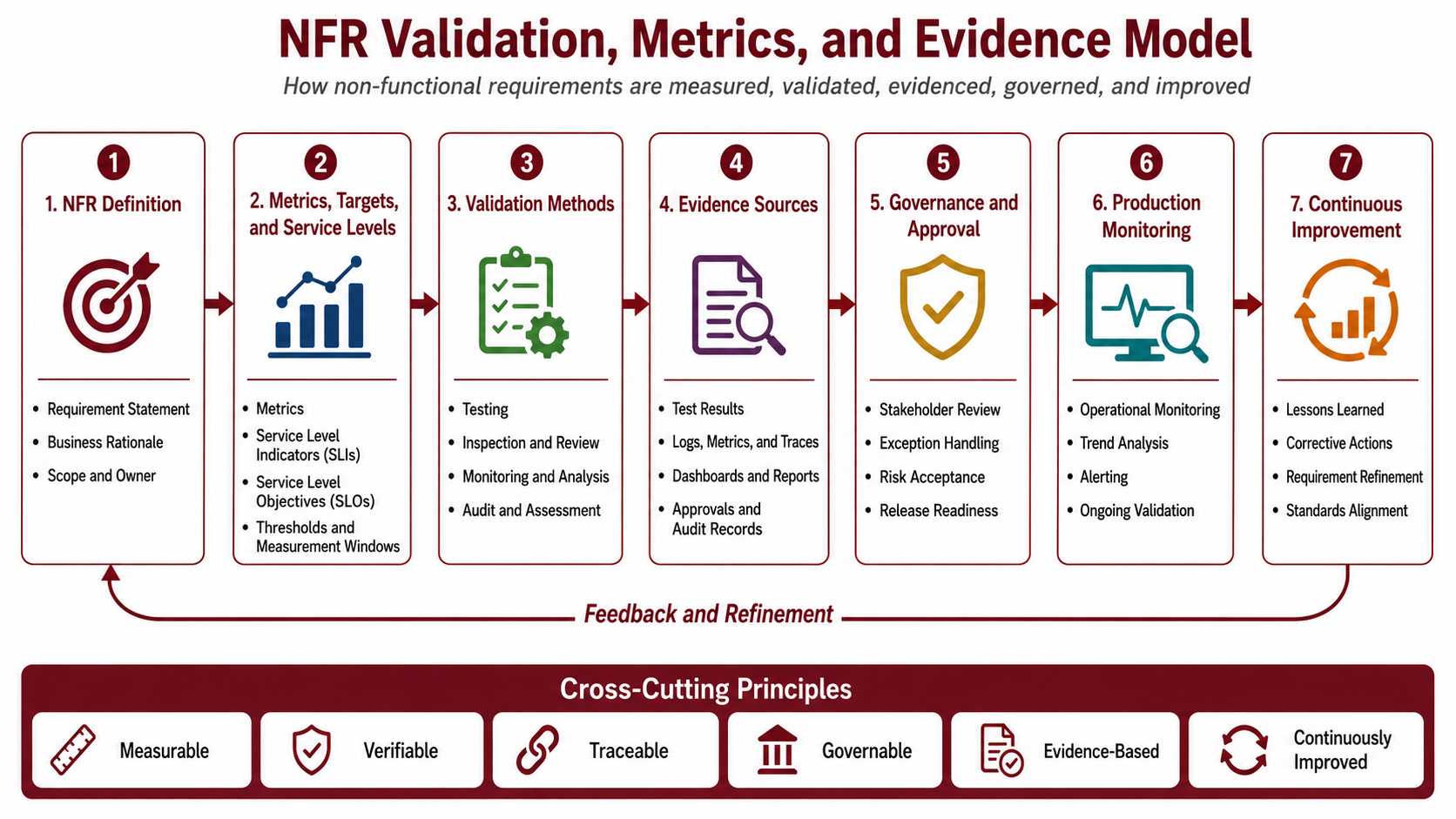
AI can help convert vague NFRs into measurable and testable statements. It can propose metrics, thresholds, measurement windows, validation methods, evidence sources, and owner questions. Human review is still required because targets must reflect business risk, technical feasibility, cost, regulatory obligations, and stakeholder priorities.
Mapping non-functional requirements to tests, validation methods, evidence, and lifecycle phases
AI can map NFRs to validation phases and evidence types. For each NFR, it can suggest whether validation should occur through requirements review, architecture review, unit testing, Systems Integration Testing (SIT), User Acceptance Testing (UAT), performance testing, security testing, accessibility testing, software supply chain validation, Disaster Recovery (DR) testing, production monitoring, audit review, or governance approval.
Artificial Intelligence (AI) for generating Non-Functional Requirements (NFRs) templates for formal requirements documents
AI can generate reusable templates for formal requirements documents. These templates can include categories, fields, guidance notes, validation expectations, evidence fields, stakeholder approvals, standards alignment, and traceability links. This helps organizations improve consistency across Business Requirements Documents (BRDs), Software Requirements Specifications (SRSs), Solution Requirements Documents, Architecture Decision Records (ADRs), design documents, and governance artifacts.
Artificial Intelligence (AI) for generating Non-Functional Requirements (NFRs) entries for Agile work management systems
AI can convert NFRs into Agile-ready work items, including epics, features, user stories, tasks, acceptance criteria, validation methods, evidence expectations, Definition of Done (DoD) items, labels, owners, and dependencies. This is useful when NFR work must be implemented and tracked in systems such as Jira, Azure DevOps, Rally, VersionOne, or other Agile work management systems.
Artificial Intelligence (AI) for generating enterprise non-functional requirements templates by software-system type
Artificial Intelligence (AI) can help Enterprise Architects and Solution Architects generate reusable enterprise NFR templates for specific software-system types. These templates can include candidate NFRs, measurable targets, Service Level Indicators (SLIs), Service Level Objectives (SLOs), validation methods, evidence expectations, lifecycle phases, environment expectations, stakeholder responsibilities, standards alignment, and approval checkpoints.
AI-generated enterprise NFR templates should be treated as draft architecture and requirements assets. They should be reviewed by appropriate stakeholders, including architecture, security, privacy, compliance, operations, quality assurance, data governance, platform engineering, and product ownership representatives. Once approved, these templates can be reused as starting points for formal requirements documents, Agile backlog entries, architecture reviews, design reviews, vendor assessments, and delivery governance.
Baseline prompts for using Artificial Intelligence (AI) to generate, improve, and validate Non-Functional Requirements (NFRs)
The following baseline prompts can be adapted by readers. They are intentionally detailed so AI has enough context to generate structured, reviewable outputs. Teams should tailor them to the system, organization, standards, regulatory context, delivery method, and governance process.
Prompt example: Generate an enterprise Non-Functional Requirements (NFRs) template for a software-system type
Act as an Enterprise Architect and Solution Architect. Generate a reusable enterprise Non-Functional Requirements (NFRs) template for the following software-system type. The template should help Product Owners, Business Analysts, Requirements Managers, architects, engineers, testers, operations teams, security stakeholders, privacy stakeholders, compliance stakeholders, and governance stakeholders start from an enterprise-aligned baseline.
For each relevant NFR category, include candidate NFR statements, rationale, measurable targets, Service Level Indicators (SLIs), Service Level Objectives (SLOs), measurement windows, validation methods, validation evidence, lifecycle phases, environment expectations, related risks, related controls, standards alignment, responsible stakeholders, approval checkpoints, and tailoring questions. Identify which NFRs are likely to be mandatory enterprise defaults, which should be tailored by solution context, and which may require exception handling or risk acceptance.
Software-system type: <insert software-system type>
Enterprise context, standards, policies, or constraints: <insert enterprise context, standards, policies, or constraints>
Prompt example: Generate a Non-Functional Requirements (NFRs) template for a formal requirements document
Using the following software system description, generate a comprehensive Non-Functional Requirements (NFRs) template for a formal requirements document. Organize the template by NFR category, including availability, reliability, recoverability, Disaster Recovery (DR), resilience, safety, performance, scalability, security, software supply chain security, responsible AI, privacy, compliance, data quality, retention, observability, operability, maintainability, deployability, testability, usability, accessibility, interoperability, portability, compatibility, configurability, auditability, cost, sustainability, localization, and governance. For each category, provide fields for requirement statement, rationale, measurable target, Service Level Indicator (SLI), Service Level Objective (SLO), measurement window, owner, acceptance criteria, validation method, validation evidence, test approach, lifecycle phase, environment, related risks, related controls, standards alignment, and approval status. Identify assumptions and questions that require stakeholder review.
If the software system includes Artificial Intelligence (AI), machine learning, generative AI, AI agents, retrieval, embeddings, automated decisioning, or AI-assisted workflows, include NFRs for AI validity, reliability, safety, misuse prevention, prompt injection resistance, insecure output handling, sensitive-data protection, transparency, explainability, interpretability, harmful-bias management, human review, escalation, override, model drift, output monitoring, retrieval-source governance, tool-use governance, and AI validation evidence.
If the software system collects, processes, stores, analyzes, shares, transfers, logs, or generates personal, sensitive, confidential, regulated, or protected data, include NFRs for data classification, processing purpose, lawful use, privacy risk assessment, Data Protection Impact Assessment (DPIA), consent, notice, preference management, subject-rights fulfillment, masking, tokenization, anonymization, pseudonymization, data residency, data sovereignty, cross-border processing, privacy logging, privacy incident detection, privacy validation, and privacy evidence.
If the software system includes user interfaces, documents, portals, mobile screens, dashboards, visualizations, forms, media, reports, or user-facing workflows, include NFRs for accessibility standards, accessibility conformance level, Web Content Accessibility Guidelines (WCAG), perceivable content, operable interaction, keyboard navigation, understandable content, error messages, robust semantic implementation, screen reader compatibility, assistive technology test coverage, captions, transcripts, audio descriptions, color, contrast, accessibility exceptions, remediation, validation evidence, and release-readiness approval.
Identify candidate external standards, internal standards, quality models, architecture frameworks, security frameworks, privacy frameworks, accessibility standards, regulatory obligations, audit/control frameworks, and reference architectures that may apply to each NFR category. For each candidate alignment, explain why it may apply, identify the NFRs it affects, and list validation evidence that could prove alignment. Do not treat a candidate standard as mandatory unless it is provided in the system context or confirmed by stakeholders.
Software system description: <insert system description>
Prompt example: Generate Agile backlog entries for Non-Functional Requirements (NFRs)
Using the following software system description and NFR categories, generate Agile backlog entries for Non-Functional Requirements (NFRs). Create epics, features, user stories, acceptance criteria, validation methods, validation evidence, test notes, Definition of Done items, monitoring expectations, evidence expectations, and escalation criteria. Make each backlog entry measurable, testable, traceable, and governable. Include tags or labels for NFR category, lifecycle phase, owning team, environment, affected system component, Service Level Indicator (SLI), Service Level Objective (SLO), measurement window, risk level, standards alignment, and approval status. Highlight any NFRs that require architecture, security, privacy, compliance, operations, accessibility, responsible AI, software supply chain, or executive review.
Software system description: <insert system description>
Prompt example: Review an existing requirements document for missing Non-Functional Requirements (NFRs)
Review the following requirements content and identify missing, weak, vague, unmeasurable, unvalidated, or untestable Non-Functional Requirements (NFRs). Compare the content against common NFR categories, including availability, reliability, recoverability, Disaster Recovery (DR), resilience, safety, performance, scalability, security, software supply chain security, responsible AI, privacy, compliance, data quality, retention, observability, operability, maintainability, deployability, testability, usability, accessibility, interoperability, portability, compatibility, configurability, auditability, cost, sustainability, localization, and governance. For each gap, recommend a clearer requirement statement, measurable target, Service Level Indicator (SLI), Service Level Objective (SLO), measurement window, acceptance criteria, validation method, validation evidence, test approach, lifecycle phase, environment, responsible stakeholder, related risks, related controls, standards alignment, and approval status. Do not invent final requirements where business or technical context is missing; instead, list questions that must be answered by stakeholders.
Identify any NFRs that lack a measurable indicator, service level target, measurement window, validation method, evidence source, owner, validation phase, validation environment, governance response, or traceability to applicable standards, controls, obligations, and evidence.
Requirements content: <insert requirements content>
Implementation approaches for non-functional requirements capabilities
AI can suggest implementation approaches for NFR capabilities such as logging, monitoring, alerting, retries, timeouts, throttling, access controls, encryption, validation rules, accessibility patterns, test automation, evidence collection, policy-as-code controls, and deployment safeguards. These suggestions should be treated as candidate approaches and reviewed against architecture standards, security standards, cost constraints, operations requirements, and enterprise patterns.
AI coding tools for accelerating non-functional requirements implementation
AI coding tools can accelerate implementation of repeatable NFR capabilities, including telemetry, validation tests, configuration checks, documentation, infrastructure code, accessibility fixes, test harnesses, and monitoring queries. However, AI-generated code does not prove NFR satisfaction. The generated code must still be reviewed, tested, scanned, validated, and evidenced through the same governance process as human-written code.
Human review, refinement, approval, and governance of AI-generated non-functional requirements, templates, backlog entries, validation methods, tests, designs, and code
Human review is mandatory because AI may omit context, overgeneralize standards, invent unsupported obligations, produce unrealistic targets, or recommend validation methods that are not feasible. Qualified stakeholders should review AI outputs for correctness, completeness, risk, feasibility, cost, alignment with standards, and evidence expectations before any AI-generated NFR artifact is accepted.
How to cite this page
When referencing this page in academic work, internal standards, or external publications, include the page title, IF4IT as author and publisher (The International Foundation for Information Technology (IF4IT), LLC), the URL, and your access date.
Example (informal web citation):
The International Foundation for Information Technology (IF4IT), LLC. Use Artificial Intelligence (AI) to Generate, Improve, and Validate Non-Functional Requirements (NFRs) | Non-Functional Requirements (NFRs) Framework for Software Systems. https://if4it.org/best-practices/non-functional-requirements-nfrs-framework-for-software-systems/use-artificial-intelligence-ai-to-generate-improve-and-validate-non-functional-requirements-nfrs/ (accessed 2026-10-05).
See About Us for content governance and site-wide citation guidance.
Copyright for The International Foundation for Information Technology (IF4IT), LLC: 2008 - Present
Legal Disclaimers