Non-Functional Requirements (NFRs) Framework for Software Systems - Use Non-Functional Requirements (NFRs) for New and Updated Software Systems
Non-Functional Requirements (NFRs) Framework for Software Systems
Chapter 7. Use Non-Functional Requirements (NFRs) for New and Updated Software Systems
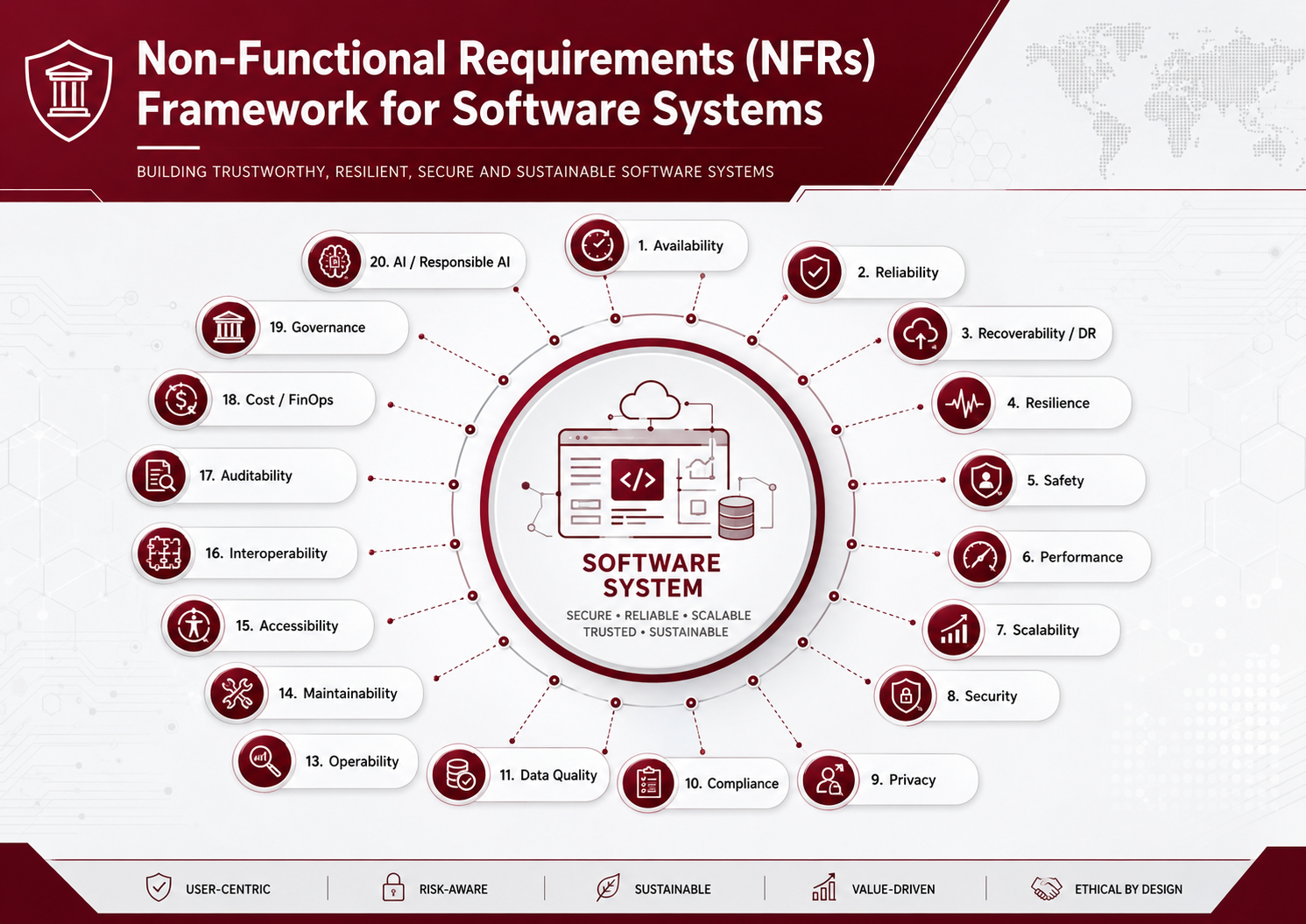
Executive Summary: Chapter Overview
IF4ITThe Bottom Line
Core Concepts
| Concept | Definition & Strategic Role |
|---|---|
| Requirement Clarity | Makes the relevant NFR expectations explicit so they can influence architecture, backlog, testing, operations, and governance. |
| Validation and Evidence | Ensures the requirement can be proven through defined validation methods and credible evidence sources. |
| Governed Tailoring | Allows teams to adapt the framework to system context while preserving ownership, traceability, review, and approval discipline. |
Quick Q&A
Question: How should readers use this chapter?
Read More Below
Overview
NFRs should be considered for all new software systems and for all meaningful updates to existing software systems. They are not limited to large enterprise applications, regulated platforms, customer-facing systems, or major transformation programs. Any software that is created, changed, configured, integrated, automated, migrated, exposed to users, connected to data, connected to other systems, or operated in a production-like environment can create quality, security, operational, compliance, cost, or governance risk.
The level of NFR detail should be proportional to the system context. A small internal utility may need fewer NFRs than a public customer platform, but it still may require basic security, maintainability, supportability, deployment, backup, monitoring, and validation expectations. A business-critical system, regulated system, AI-enabled system, externally exposed system, or high-volume system will usually require more comprehensive NFR definition and evidence.
Best Practice: Address non-functional requirements for all new software systems
Every new software system should be reviewed against the NFR framework during discovery, planning, architecture, design, backlog creation, testing strategy, and release-readiness planning. This review should identify applicable NFR categories, stakeholders, measurable targets, validation methods, evidence expectations, lifecycle phase dependencies, and operating-environment considerations.
For a new system, teams should avoid treating NFRs as a checklist at the end of delivery. Instead, NFRs should shape the architecture, delivery plan, backlog, Definition of Done (DoD), test approach, monitoring approach, support model, and governance process from the start.
Best Practice: Address non-functional requirements for all meaningful updates to existing software systems
Meaningful updates to existing systems should trigger an NFR impact review. Updates may change performance, availability, security, privacy, accessibility, recoverability, observability, cost, compliance, integration behavior, support procedures, or validation evidence. Even when the functional change appears small, the non-functional impact may be significant.
Examples of meaningful updates include new features, new integrations, new data flows, platform migrations, cloud migrations, vendor changes, authentication changes, data model changes, API changes, AI capability additions, automation changes, deployment pipeline changes, security control changes, regulatory changes, and major configuration changes. Each update should be reviewed to determine whether existing NFRs remain valid, whether new NFRs are needed, and whether prior validation evidence must be refreshed.
Examples of software systems that require non-functional requirements
Software systems that require NFR consideration include applications, web applications, mobile applications, services, microservices, APIs, integrations, event streams, data pipelines, reporting solutions, analytics solutions, Artificial Intelligence (AI) agents, AI-enabled applications, automation scripts, batch jobs, workflow solutions, cloud workloads, Software as a Service (SaaS) configurations, platform services, infrastructure automation, portals, databases, data stores, dashboards, content platforms, and externally hosted vendor solutions.
The common principle is that if software creates business value, processes data, supports users, integrates systems, automates work, affects decisions, consumes resources, or operates in an enterprise environment, it should be reviewed for NFRs. The scope and rigor may vary, but NFR consideration should not be skipped simply because the software is small, internal, vendor-hosted, low-code, automated, AI-generated, or configuration-based.
How to cite this page
When referencing this page in academic work, internal standards, or external publications, include the page title, IF4IT as author and publisher (The International Foundation for Information Technology (IF4IT), LLC), the URL, and your access date.
Example (informal web citation):
The International Foundation for Information Technology (IF4IT), LLC. Use Non-Functional Requirements (NFRs) for New and Updated Software Systems | Non-Functional Requirements (NFRs) Framework for Software Systems. https://if4it.org/best-practices/non-functional-requirements-nfrs-framework-for-software-systems/use-non-functional-requirements-nfrs-for-new-and-updated-software-systems/ (accessed 2026-08-06).
See About Us for content governance and site-wide citation guidance.
Copyright for The International Foundation for Information Technology (IF4IT), LLC: 2008 - Present
Legal Disclaimers