Using the Non-Functional Requirements (NFRs) Framework Manually and with Artificial Intelligence (AI) - Non-Functional Requirements (NFRs) Framework for Software Systems
Using the Non-Functional Requirements (NFRs) Framework Manually and with Artificial Intelligence (AI)
(Chapter 8 of Non-Functional Requirements (NFRs) Framework for Software Systems)
Executive Summary: Chapter Overview
IF4ITThe Bottom Line
Core Concepts
| Concept | Definition & Strategic Role |
|---|---|
| AI-Assisted Discovery | Uses AI to accelerate identification of missing, weak, vague, or unvalidated NFRs across the framework categories. |
| Human Review and Accountability | Ensures AI-generated requirements, validation methods, designs, tests, and code are reviewed, tailored, approved, and governed by qualified stakeholders. |
| Evidence and Governance | Connects AI-assisted outputs to validation evidence, traceability, standards alignment, exception handling, and lifecycle governance. |
Quick Q&A
Question: Can AI be treated as the authority for NFR decisions?
Read More Below
Overview
The NFR framework can be used manually by teams and as structured context for Artificial Intelligence (AI). Manual use helps stakeholders conduct disciplined reviews, ask better questions, compare systems consistently, and define requirements that can be validated. AI-assisted use helps teams accelerate discovery, generate candidate requirements, identify omissions, improve wording, propose validation methods, define evidence expectations, and create reusable templates or backlog entries.
The framework should not be used as a rigid checklist where every category must apply equally to every system. It should be used as a structured thinking tool. Teams should decide which categories apply, which require tailoring, which require stakeholder review, which require evidence, and which can be explicitly marked as not applicable with a rationale.
The framework should be used as a structured decision aid, not as a one-size-fits-all mandate. Teams should use it to identify relevant NFRs, tailor them to the system context, validate applicability with stakeholders, and document which NFRs are accepted, modified, deferred, excluded, or governed as enterprise requirements.
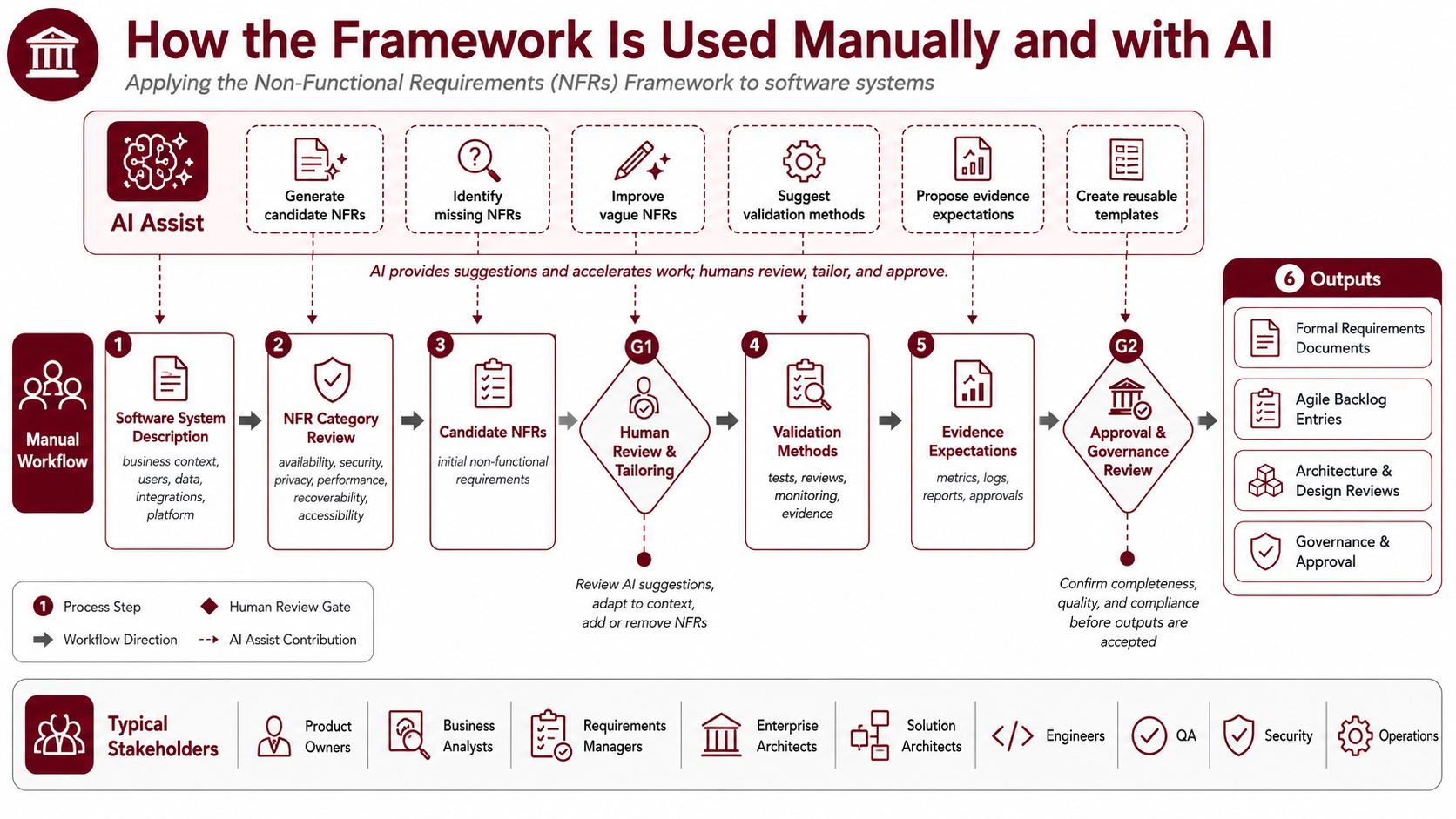
Manual use during planning, design, delivery, validation, and review
Teams can use the framework manually during planning, architecture, design, backlog refinement, testing strategy, release planning, and operational readiness reviews. A practical manual workflow is to review each NFR category, decide whether it applies, identify stakeholders, draft candidate NFRs, define measurable targets where appropriate, assign owners, define validation methods, identify evidence sources, and document open questions.
Manual use is especially valuable when stakeholder judgment is required. Teams should use workshops, architecture reviews, design reviews, threat modeling sessions, privacy reviews, accessibility reviews, operational readiness reviews, and governance forums to refine NFRs and validate that they are realistic, necessary, testable, and aligned with business priorities.
Use during architecture and design reviews
Architecture and design reviews should explicitly evaluate whether the proposed solution can satisfy its NFRs. Reviewers should ask whether the architecture supports required availability, reliability, recoverability, safety, performance, scalability, security, privacy, accessibility, integration, monitoring, maintainability, cost, and governance expectations. They should also confirm whether validation methods and evidence sources are feasible.
NFR-driven architecture reviews should produce decisions, risks, assumptions, exceptions, and action items. If a requirement cannot be satisfied without significant cost, complexity, or tradeoff, the issue should be made visible early so stakeholders can approve a change, accept a risk, adjust a target, fund remediation, or revise the solution approach.
Assessment of existing software systems and solutions
The framework can be used to assess existing software systems and identify NFR gaps. Teams can compare the current system against each category, determine which NFRs are documented, which are missing, which are obsolete, which lack measurable targets, which lack validation methods, and which lack current evidence. This assessment can support modernization planning, risk reduction, audit readiness, portfolio rationalization, incident remediation, and operational improvement.
Existing systems often contain hidden NFR assumptions that were never documented or validated. Assessment should therefore examine not only requirements documents but also architecture diagrams, backlog items, monitoring dashboards, incident history, support tickets, test evidence, audit findings, security scans, accessibility reports, cost reports, vendor contracts, and operational runbooks.
Enterprise and solution architecture use of predefined non-functional requirements
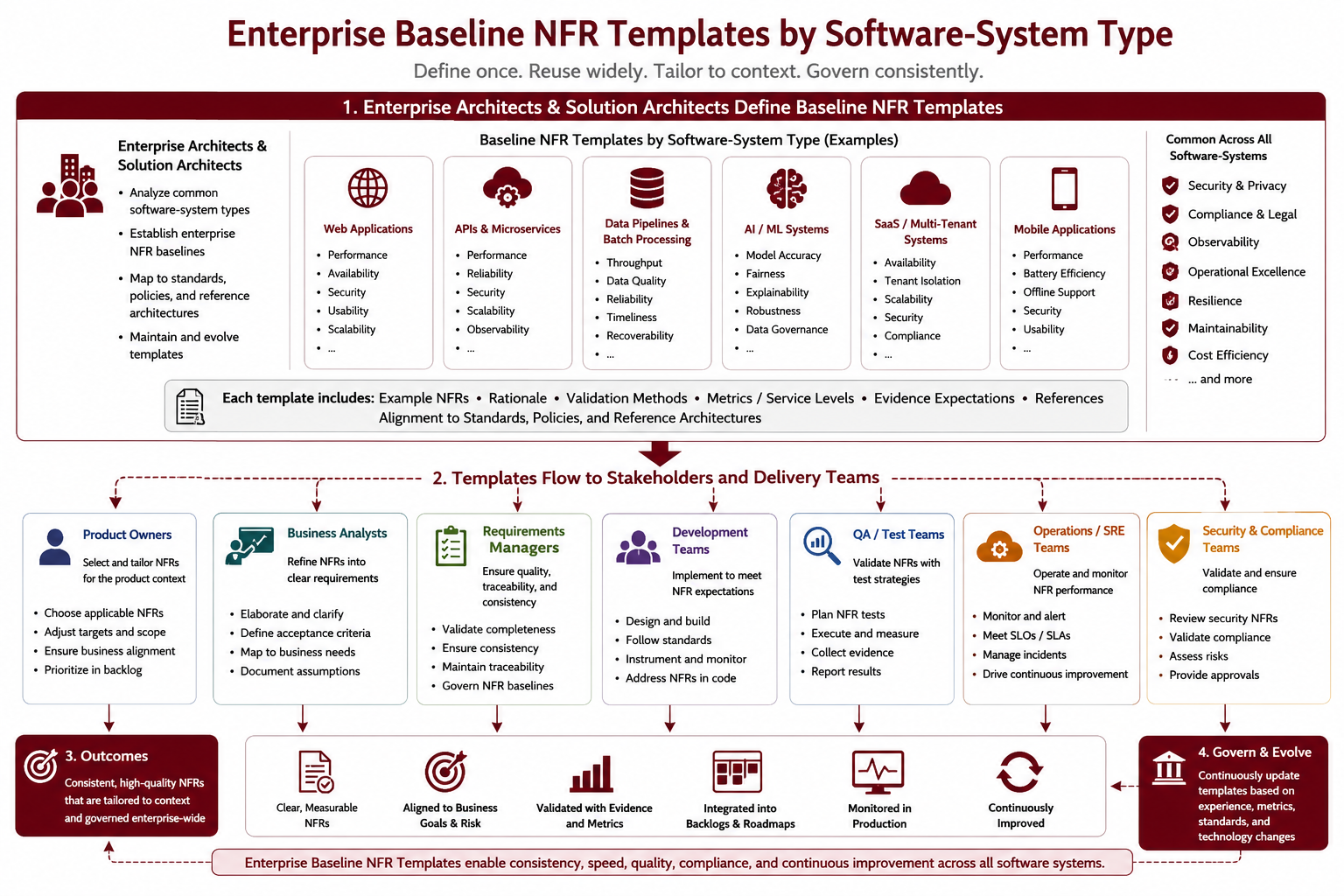
Enterprise Architects and Solution Architects can use this framework to define reusable, enterprise-aligned Non-Functional Requirements (NFRs) templates for common types of software systems. For example, an organization may define baseline NFR templates for customer-facing web applications, internal business applications, mobile applications, Application Programming Interfaces (APIs), data pipelines, reporting solutions, Artificial Intelligence (AI)-enabled systems, integration services, cloud workloads, Software as a Service (SaaS) configurations, and vendor-hosted platforms.
These predefined NFR templates can help Product Owners, Business Analysts, Requirements Managers, delivery teams, and governance stakeholders start with a consistent set of enterprise expectations instead of creating NFRs from scratch for every initiative. The templates should not replace solution-specific analysis. Instead, they should provide a starting point that is reviewed, tailored, validated, approved, and governed based on the system context, risk profile, operating environment, data classification, user population, regulatory obligations, and business criticality.
Artificial Intelligence (AI) for generating candidate non-functional requirements
AI can help generate candidate NFRs when given sufficient context about the software system, users, data, integrations, environments, business criticality, regulatory obligations, operating model, technology stack, and risk profile. AI can quickly scan NFR categories and propose requirements that teams may not have considered.
AI-generated candidate NFRs should be treated as draft inputs. Stakeholders must review them for relevance, accuracy, feasibility, priority, measurable targets, validation methods, evidence expectations, and alignment with enterprise standards. AI can improve coverage, but it cannot replace stakeholder accountability.
Artificial Intelligence (AI) for improving non-functional requirements completeness in requirements documents
AI can review formal requirements documents, architecture documents, solution designs, backlog exports, epics, features, user stories, and acceptance criteria to identify missing or weak NFRs. It can compare the content against the framework and flag categories that appear incomplete, vague, unmeasurable, untestable, unvalidated, or unsupported by evidence.
This use is valuable because many requirements documents focus heavily on functional behavior and only lightly address quality, operations, compliance, and validation. AI can help identify gaps faster, but each finding should be confirmed by stakeholders and updated based on actual system context.
Artificial Intelligence (AI) for suggesting validation methods and evidence expectations
AI can help propose validation methods for each NFR, such as load testing, failover testing, restore testing, accessibility testing, security scanning, penetration testing, code review, configuration inspection, contract testing, privacy review, Software Bill of Materials (SBOM) validation, monitoring dashboard review, or audit evidence review. It can also suggest example evidence sources that may prove the requirement has been satisfied.
AI-suggested validation methods should be reviewed by QA, architecture, engineering, operations, security, privacy, compliance, and governance stakeholders as appropriate. The team must confirm that the proposed validation method is practical, reliable, repeatable, and sufficient for the risk and criticality of the requirement.
AI-assisted coding for implementing non-functional requirements capabilities
AI-assisted coding tools can help implement NFR-related capabilities such as logging, metrics, health checks, retries, timeouts, input validation, configuration handling, automated tests, infrastructure definitions, pipeline checks, accessibility improvements, security controls, and operational scripts. These tools can accelerate implementation and reduce repetitive engineering effort.
AI-generated code must still be reviewed, tested, scanned, and validated. Teams should not assume that generated code satisfies security, performance, maintainability, accessibility, privacy, licensing, or operational requirements. AI-assisted implementation should be tied back to explicit NFRs, validation methods, and evidence expectations.
Human review and governance of AI-generated non-functional requirements, validation methods, designs, tests, and code
Human review is mandatory for AI-generated NFRs, validation methods, templates, backlog entries, designs, tests, and code. AI can generate plausible content that may be incomplete, overbroad, irrelevant, inconsistent with enterprise standards, unsupported by evidence, or inappropriate for the business context. Qualified stakeholders must decide what is accepted, changed, rejected, deferred, or escalated.
Governance should define how AI-generated NFR artifacts are reviewed, approved, versioned, traced, validated, and retained. Where AI is used to accelerate requirements work, the final requirement owner and approving stakeholders remain accountable for the quality, correctness, validation, and evidence of the resulting NFRs.
How to cite this page
When referencing this page in academic work, internal standards, or external publications, include the page title, IF4IT as author and publisher (The International Foundation for Information Technology (IF4IT), LLC), the URL, and your access date.
Example (informal web citation):
The International Foundation for Information Technology (IF4IT), LLC. Using the Non-Functional Requirements (NFRs) Framework Manually and with Artificial Intelligence (AI) | Non-Functional Requirements (NFRs) Framework for Software Systems. https://if4it.org/best-practices/non-functional-requirements-nfrs-framework-for-software-systems/using-the-non-functional-requirements-nfrs-framework-manually-and-with-artificial-intelligence-ai/ (accessed 2026-10-06).
See About Us for content governance and site-wide citation guidance.
Copyright for The International Foundation for Information Technology (IF4IT), LLC: 2008 - Present
Legal Disclaimers