Common Release Management Bad Practices and Antipatterns — A Quick-Reference Summary - Release Management Best Practices
Common Release Management Bad Practices and Antipatterns — A Quick-Reference Summary
(Chapter 32 of Release Management Best Practices)
Executive Summary: Chapter Overview
IF4ITThe Bottom Line
Core Concepts
| Concept | Definition & Strategic Role |
|---|---|
| Compiled Antipatterns | Nine antipatterns gathered from across the document. |
| Home Chapter Cross-Reference | Each entry points to its fuller treatment. |
| Quick Reference | A scannable table format. |
Quick Q&A
Question: Does this chapter introduce new antipatterns?
Question: Where should a reader go for full treatment of a listed antipattern?
Read More Below
Overview
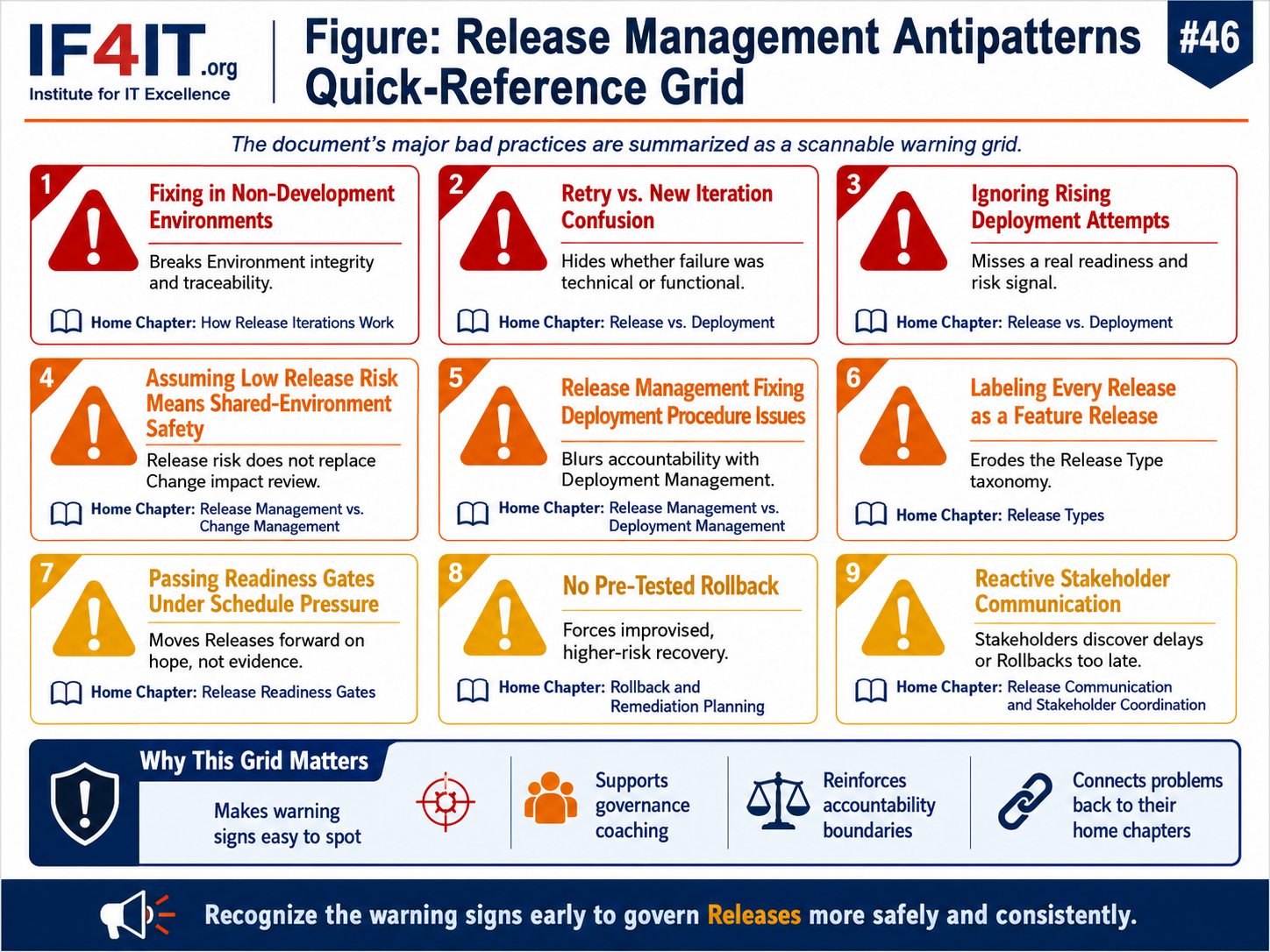
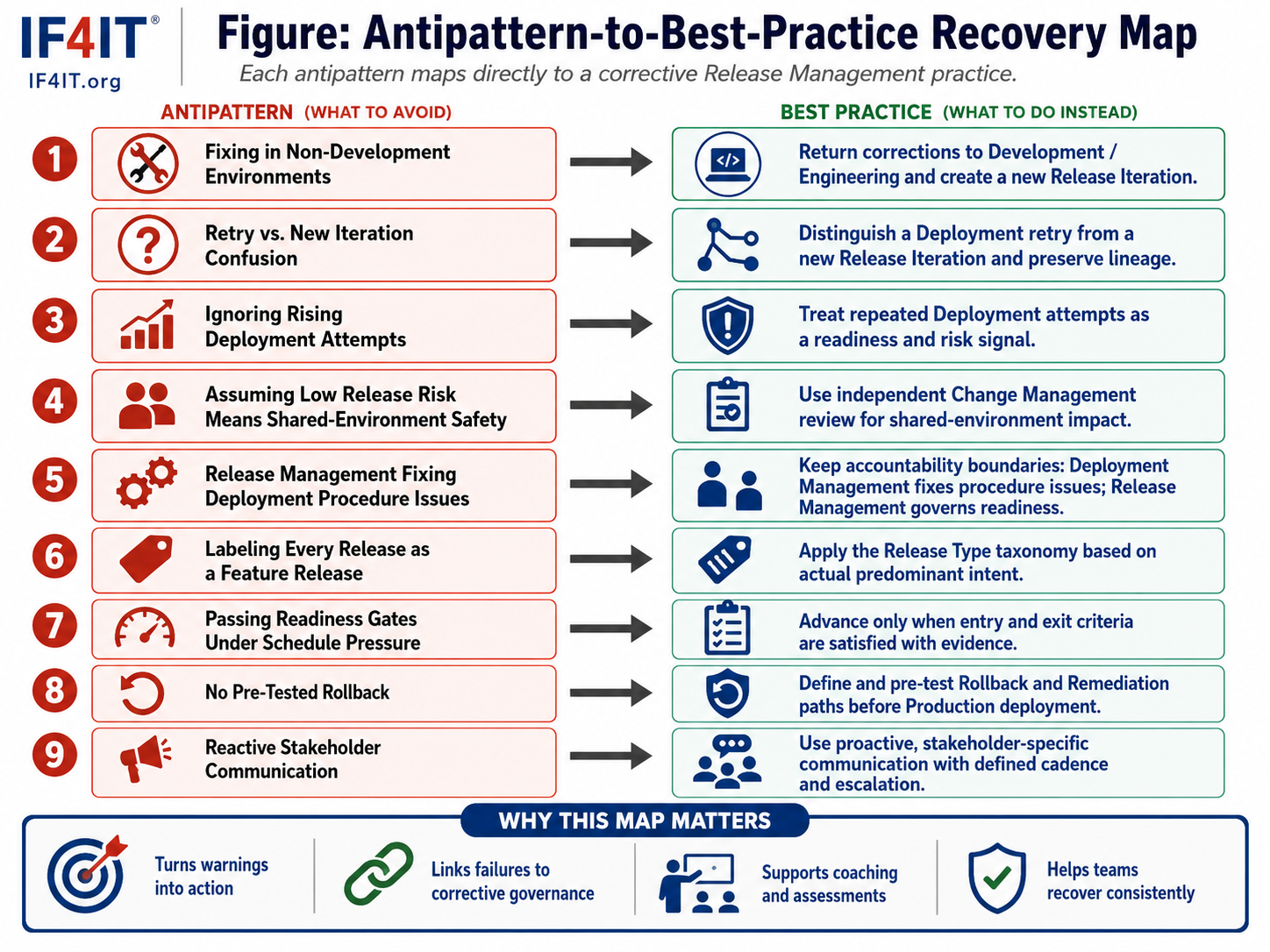
This chapter compiles the Bad Practices/Antipatterns already identified throughout this document into one scannable reference. Each entry points back to its home chapter for fuller treatment.
| Antipattern | Home Chapter | Why It’s Harmful |
|---|---|---|
| Making defect fixes or enhancements directly in non-Development/non-Engineering Environments | How Release Iterations Work | Breaks Environment integrity and produces a correction with no properly traceable new Change Set or Release Iteration. |
| Conflating a Deployment retry with a new Release Iteration | Release vs. Deployment | Obscures whether a failure was a technical execution problem or a functional/quality problem — the two require different responses. |
| Treating rising Deployment attempt counts as routine background noise | Release vs. Deployment | Ignores a real readiness/risk signal. |
| Assuming a Release’s own “Low Risk” Classification means it’s safe in a shared Environment | Release Management vs. Change Management | Release Risk Classification reflects the Release’s own view only. |
| Release Management diagnosing or fixing Deployment procedure issues itself | Release Management vs. Deployment Management | Blurs the accountability boundary between Release Management and Deployment Management. |
| Labeling every Release “Feature Release” by default regardless of actual content | Release Types | Erodes the whole Release Type taxonomy’s value. |
| Advancing a Release past a Readiness Gate despite unresolved criteria, due to schedule pressure | Release Readiness Gates | Moves a Release forward on hope rather than evidence. |
| Deploying to Production without a pre-tested, well-defined Rollback in place | Rollback and Remediation Planning | Forces an improvised, higher-risk recovery response during an actual incident. |
| Communicating with stakeholders only when things go well, or only after being asked | Release Communication and Stakeholder Coordination | Leaves stakeholders to discover a delay, rejection, or Rollback after the fact. |
How to cite this page
When referencing this page in academic work, internal standards, or external publications, include the page title, IF4IT as author and publisher (The International Foundation for Information Technology (IF4IT), LLC), the URL, and your access date.
Example (informal web citation):
The International Foundation for Information Technology (IF4IT), LLC. Common Release Management Bad Practices and Antipatterns — A Quick-Reference Summary | Release Management Best Practices. https://if4it.org/best-practices/release-management/common-release-management-bad-practices-and-antipatterns-a-quick-reference-summary/ (accessed 2026-10-05).
See About Us for content governance and site-wide citation guidance.
Copyright for The International Foundation for Information Technology (IF4IT), LLC: 2008 - Present
Legal Disclaimers