Define Enterprise Release Management and How It Differs from Release Management - Release Management Best Practices
Define Enterprise Release Management and How It Differs from Release Management
(Chapter 5 of Release Management Best Practices)
Executive Summary: Chapter Overview
IF4ITThe Bottom Line
Core Concepts
| Concept | Definition & Strategic Role |
|---|---|
| Release Management | The discipline as applied to a single Release, or to the Releases of a single Asset, governing it from scoping through its arrival as a stable Version. Each Release keeps its own Release Owner and Release Manager, and Enterprise Release Management neither replaces this discipline nor adds a second process. |
| Enterprise Release Management | Release Management applied consistently to every Release of every Asset the enterprise owns, operates, licenses, or depends upon, using the same practices, standards, templates, and policies for all of them. It is the same discipline, practiced the same way everywhere, which makes Releases comparable across Assets. |
| Cross-Release Coordination | Sequencing, dependency, scheduling, and visibility work that spans many concurrent Releases, such as sequencing Releases that depend on one another or target the same Environments, maintaining an enterprise view of Release Calendars and Freeze Windows, and rolling every Release up into the Enterprise Release Dashboard. No single Release can perform it on its own. |
Quick Q&A
Question: Is Enterprise Release Management a separate discipline from Release Management?
Question: Does Enterprise Release Management require a dedicated enterprise-level team?
Read More Below
Overview
Enterprise Release Management is Release Management applied consistently to every Release of every Asset the enterprise owns, operates, licenses, or depends upon, using the same practices, standards, templates, and policies for all of them. Release Management, as defined in the previous chapter, governs a Release, or the sequence of Releases of a single Asset, from scoping through its arrival as a stable Version. Enterprise Release Management does not replace it or add a second process; it is the same discipline, practiced the same way, everywhere.
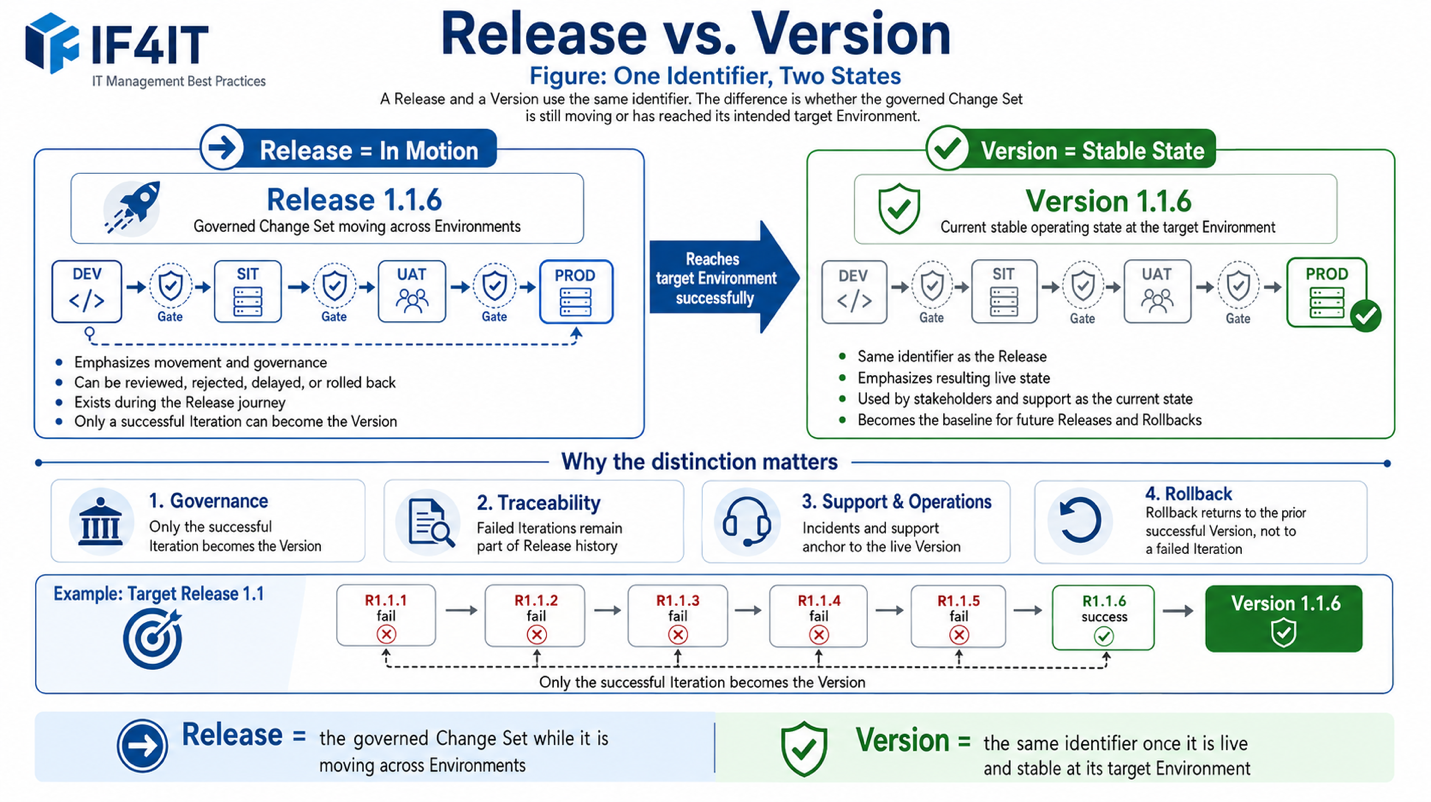
When every Release uses the same Release Types, Risk Classification tiers, Readiness Gate criteria, labeling convention, Release Documentation, and evidence policy, Releases become comparable across Assets. Leadership can see in one view which Releases are in flight, where each one stands, and which carry the most risk, and auditors can examine any Release against the same expectations. When each team defines these for itself, every Release may be well managed on its own, yet the enterprise still cannot see or compare its Releases as a whole.
Consistency also enables coordination that no single Release can perform on its own: sequencing concurrent Releases that depend on one another or target the same Environments (see “Release Scheduling” and “Release Management vs. Environment Management”), with the impact on other Assets in a shared Environment assessed by Change Management (see “Release Management vs. Change Management”); maintaining an enterprise view of Release Calendars and Freeze Windows, where the enterprise uses them; applying common Release Types and Risk Classification tiers (see “Release Types — A Flexible Baseline, Not a Fixed Taxonomy” and “Release Risk Classification”); rolling every Release up into one view (see “The Enterprise Release Dashboard”); and holding every Release to the same documentation and evidence policy (see “Release Documentation” and “Release Evidence and Audit Trail”). In industry usage, “Enterprise Release Management” often names a central function that performs this cross-Release coordination; that usage is consistent with this definition, which also requires the consistency that makes such coordination possible.
Enterprise Release Management does not move accountability for any individual Release. Each Release keeps its own Release Owner and Release Manager, as described in “The Release Owner” and “The Release Manager.” In most enterprises, Enterprise Release Management is carried by shared standards, templates, and the Enterprise Release Dashboard rather than by a separate team; only the largest enterprises typically staff a dedicated enterprise-level release coordination function, and even then that function coordinates across Releases rather than taking over the Releases themselves.
Enterprise Release Management follows the same pattern as Enterprise Application Management, which applies Application Management consistently to every Application. Releases are one of the main ways Applications and other Assets change, so the two reinforce each other: consistent Release records feed each Application’s Release and Change History, and consistent Application records tell Enterprise Release Management which Assets, owners, and Instances each Release affects.
Best Practice
Apply the same Release Management practices, standards, templates, and policies (including Release Types, Risk Classification tiers, Readiness Gate criteria, labeling convention, Release Documentation, and evidence policy) to every Release of every Asset, customizing them once at the enterprise level rather than separately by each team.
Benefit(s)
Makes Releases comparable across Assets, so status, risk, and history can be read the same way everywhere.
Gives the Enterprise Release Dashboard consistent data to roll up, instead of a different vocabulary for each team.
Lets auditors and stakeholders examine any Release against the same expectations.
Best Practice
Coordinate concurrent Releases at the enterprise level (their dependencies, sequencing, use of shared Environments, and, where used, Release Calendars and Freeze Windows) while keeping accountability for each individual Release with its own Release Owner and Release Manager.
Benefit(s)
Surfaces conflicts between Releases before they collide in a shared Environment.
Adds enterprise-level coordination without blurring who is accountable for each Release.
How to cite this page
When referencing this page in academic work, internal standards, or external publications, include the page title, IF4IT as author and publisher (The International Foundation for Information Technology (IF4IT), LLC), the URL, and your access date.
Example (informal web citation):
The International Foundation for Information Technology (IF4IT), LLC. Define Enterprise Release Management and How It Differs from Release Management | Release Management Best Practices. https://if4it.org/best-practices/release-management/define-enterprise-release-management-and-how-it-differs-from-release-management/ (accessed 2026-11-09).
See About Us for content governance and site-wide citation guidance.
Copyright for The International Foundation for Information Technology (IF4IT), LLC: 2008 - Present
Legal Disclaimers