Define Release Management and Why It Matters as a Governance Discipline - Release Management Best Practices
Define Release Management and Why It Matters as a Governance Discipline
(Chapter 4 of Release Management Best Practices)
Executive Summary: Chapter Overview
IF4ITThe Bottom Line
Core Concepts
| Concept | Definition & Strategic Role |
|---|---|
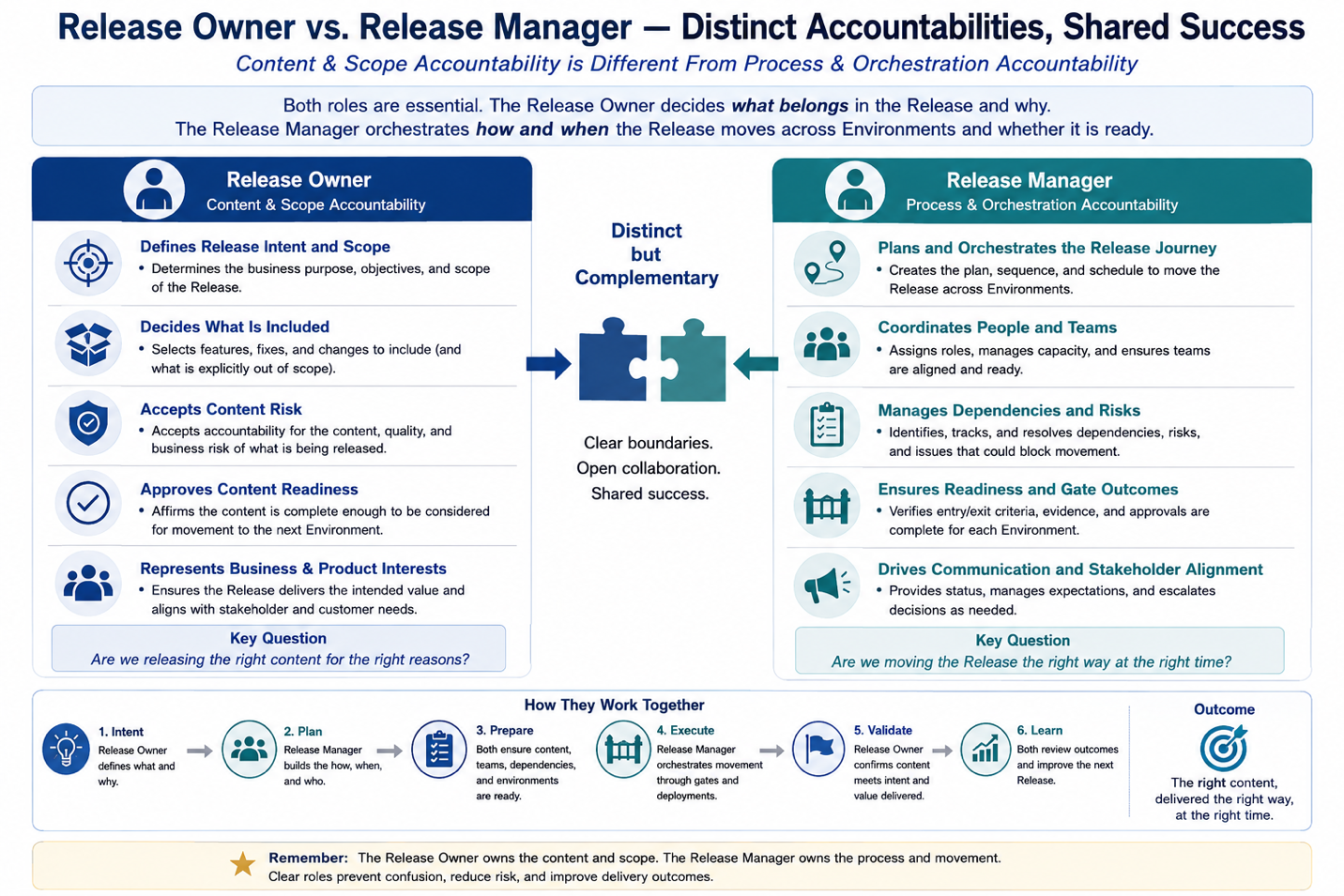
| Release Owner | Accountable for a Release’s content and scope. |
| Release Manager | Accountable for a Release’s process and orchestration. |
| Adjacent Disciplines | Environment, Deployment, Change, Product, Service, and Project Management, which Release Management relies on but does not perform. |
Quick Q&A
Question: Who is accountable for what goes into a Release vs. how it moves?
Question: Does Release Management execute the technical deployment work itself?
Read More Below
Overview
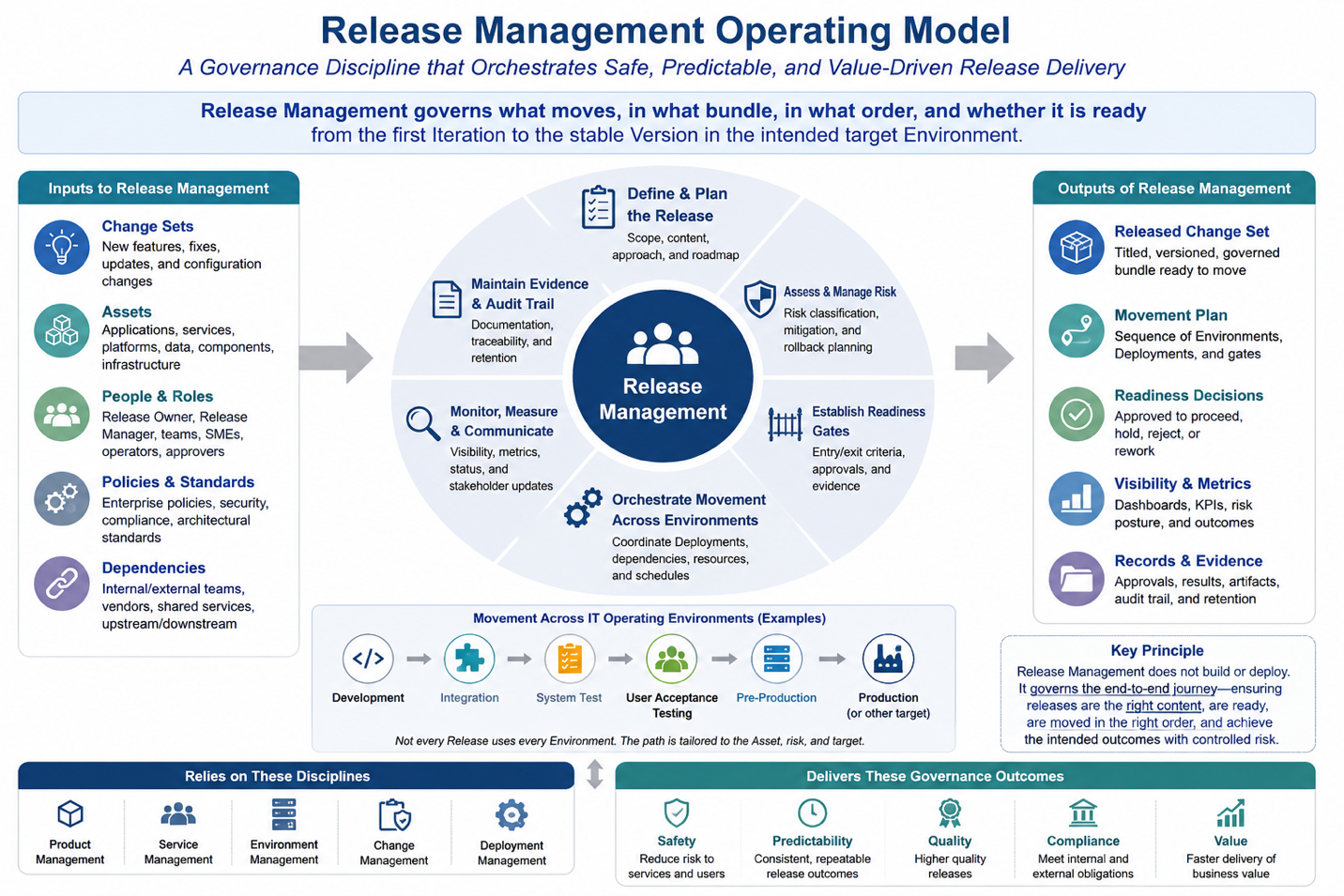
Release Management is the governance, management, and execution discipline responsible for defining, scoping, sequencing, coordinating, and controlling the movement of a Release across IT Operating Environments toward its intended target Environment. It ensures that each Release is clearly defined, versioned and labeled, correctly sequenced against other concurrent Releases, validated for readiness at each Environment it passes through, properly documented, communicated to affected stakeholders, and risk-managed across its full Release Lifecycle.
Release Management accountability divides between two roles: the Release Owner, who is accountable for a Release’s content and scope (what changes belong in this Release, and why) — most often the Asset Owner (Product Owner, Service Owner, etc.) acting in that capacity — and the Release Manager, who is accountable for a Release’s process and orchestration, typically by defining and facilitating the execution of all work by the appropriate Release-associated team members, though in smaller enterprises the Release Manager may personally perform that execution work as well, given fewer dedicated resources.
Release Management governs what is moving, in what bundle, in what order, and whether it is ready to advance — but it relies on, and must stay aligned with, several adjacent disciplines to do so: Environment Management (which plans, builds, and secures the Environments a Release moves through), Deployment Management (which executes the technical work of installing and configuring a Release within an Environment), Change Management (which governs a Release’s production-impact and capacity readiness), Product Management and Service Management (which govern the Asset a Release delivers changes to), and Project Management (which governs the broader initiative a Release may be part of).
How to cite this page
When referencing this page in academic work, internal standards, or external publications, include the page title, IF4IT as author and publisher (The International Foundation for Information Technology (IF4IT), LLC), the URL, and your access date.
Example (informal web citation):
The International Foundation for Information Technology (IF4IT), LLC. Define Release Management and Why It Matters as a Governance Discipline | Release Management Best Practices. https://if4it.org/best-practices/release-management/define-release-management-and-why-it-matters-as-a-governance-discipline/ (accessed 2026-10-05).
See About Us for content governance and site-wide citation guidance.
Copyright for The International Foundation for Information Technology (IF4IT), LLC: 2008 - Present
Legal Disclaimers