Defining What a Release Is - Release Management Best Practices
Defining What a Release Is
(Chapter 3 of Release Management Best Practices)
Executive Summary: Chapter Overview
IF4ITThe Bottom Line
Core Concepts
| Concept | Definition & Strategic Role |
|---|---|
| Change Set | The bundle of one or more changes to one or more governed Assets that a Release carries, titled and correlated to a specific version identifier. It is what the Release actually delivers, and it remains the same governed Change Set whether it is called a Release while moving or a Version once deployed. |
| Governed Asset | Something the enterprise owns, operates, or depends on that is important enough to govern, such as a Product, Service, Application, Platform, or other Technical Asset. A Release delivers changes to one or more such Assets, so a single Release can span several of them. |
| Target Environment | The Environment a Release is coordinated and moved toward across one or more IT Operating Environments, where critical stakeholders depend on it for normal business operations. It is most commonly, but not always, Production, and reaching it is what turns a Release into a Version. |
Quick Q&A
Question: Can a Release contain changes to more than one governed Asset?
Question: Does a Release always end up in Production?
Read More Below
Overview
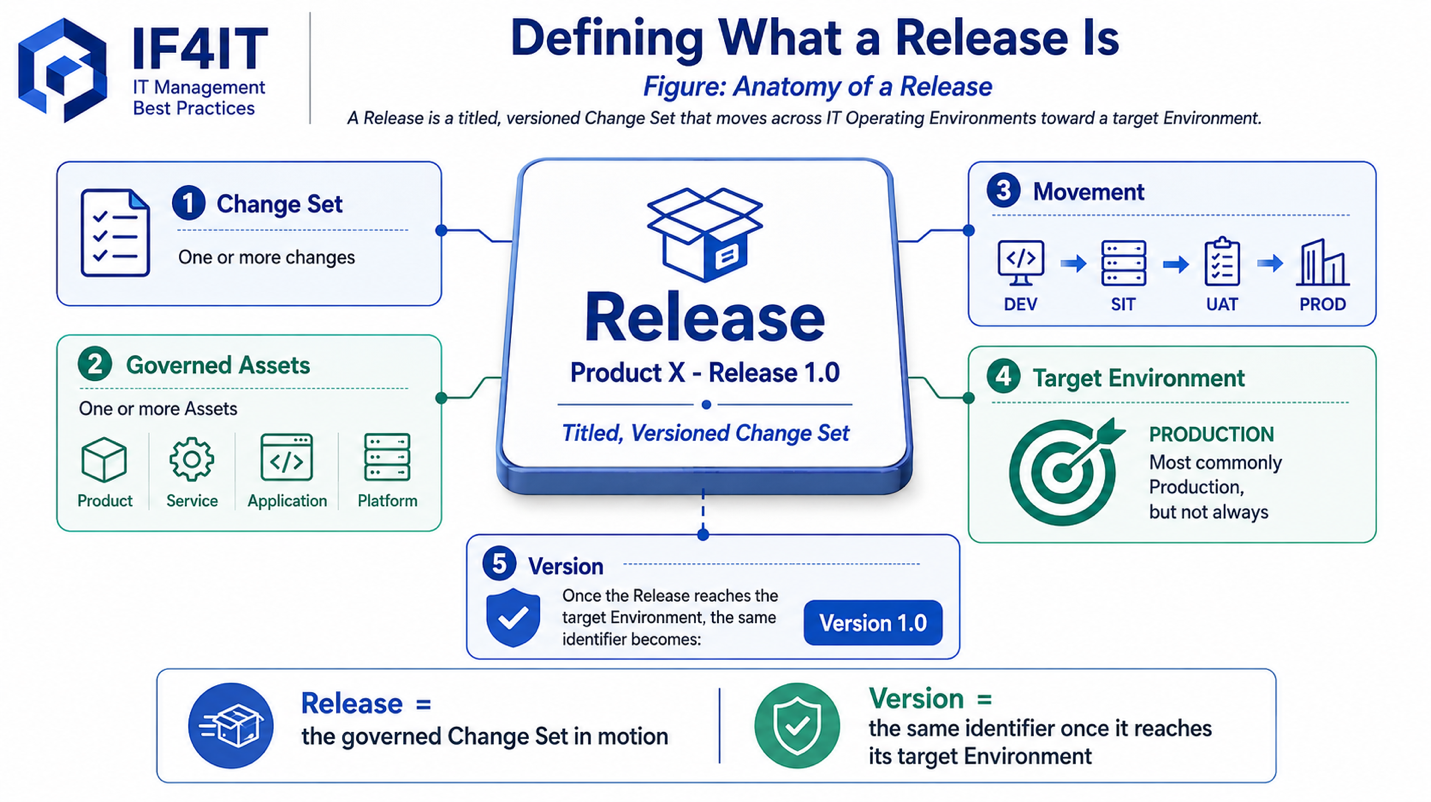
A Release is an aggregated, controlled, repeatable, uniquely identifiable, and versioned set of Changes intended to be applied, or that have been applied, to an existing construct or set of constructs, following a defined Systems Development Lifecycle (SDLC) for delivery to its intended audience. In practice, a Release is a titled, versioned Change Set — one or more changes to one or more governed Assets (something the enterprise owns, operates, or depends on that is important enough to govern, such as a Product, Service, Application, Platform, or other Technical Asset) bundled together and correlated to a specific version identifier (e.g., “Product X – Release 1.0,” “Service Y – Release 2.3,” “Platform Z – Release 5.0”).
A Release is coordinated and moved, in a governed and sequenced manner, across one or more IT Operating Environments (a.k.a. IT Environments, a.k.a. Environments) toward its intended target Environment — most commonly, but not always, Production — where critical stakeholders depend on it for normal business operations.
Once a Release reaches its intended target Environment and becomes the current operating state of the Asset(s) it contains, it is commonly referred to as a Version rather than as a Release. Both terms refer to the same governed Change Set, but “Release” emphasizes its movement and governance across Environments, while “Version” emphasizes its resulting state once deployed.
The term Release is also used in related senses. It names the Project Management unit of delivery through which an IT Organization delivers Products, Services, Systems, Applications, and other Solutions under a Systems Development Lifecycle (see “Release Management as a Specialized Form of Project Management”); software and product developers use it for a packaged, versioned deliverable intended to be deployed to a final consumer or Environment; and as a verb, to release is to make a Release available to its intended audience. Some infrastructure and support organizations also use “release” for what this document calls a Deployment; this document keeps the two terms distinct (see “Release vs. Deployment — How a Single Release Is Deployed Many Times on Its Way to Production”).
How to cite this page
When referencing this page in academic work, internal standards, or external publications, include the page title, IF4IT as author and publisher (The International Foundation for Information Technology (IF4IT), LLC), the URL, and your access date.
Example (informal web citation):
The International Foundation for Information Technology (IF4IT), LLC. Defining What a Release Is | Release Management Best Practices. https://if4it.org/best-practices/release-management/defining-what-a-release-is/ (accessed 2026-11-09).
See About Us for content governance and site-wide citation guidance.
Copyright for The International Foundation for Information Technology (IF4IT), LLC: 2008 - Present
Legal Disclaimers