How Issues Become Future Releases — The Feedback Loop from Deployment to Backlog - Release Management Best Practices
How Issues Become Future Releases — The Feedback Loop from Deployment to Backlog
(Chapter 27 of Release Management Best Practices)
Executive Summary: Chapter Overview
IF4ITThe Bottom Line
Core Concepts
| Concept | Definition & Strategic Role |
|---|---|
| Issue Types | Six categories, from incidents to enhancement requests. |
| Release Owner Triage | Accountable for capturing/routing Issues. |
| Backlog Correlation | Issues tied to a specific Release ID, Asset, Environment. |
Quick Q&A
Question: Do all Issues require a new Release?
Question: How is an Issue correlated for traceability?
Read More Below
Overview
Issue Management is the practice of capturing and addressing Issues. It is the Release Owner’s responsibility to ensure Issues are captured, triaged, and routed appropriately: some are administrative/operational problems resolved immediately within the current operating Environment, requiring no Change Set or new Release at all; others require a code/configuration change and are added to the Product’s backlog, prioritized, and addressed in a future Release — becoming the substance of a new Feature Release or Patch.
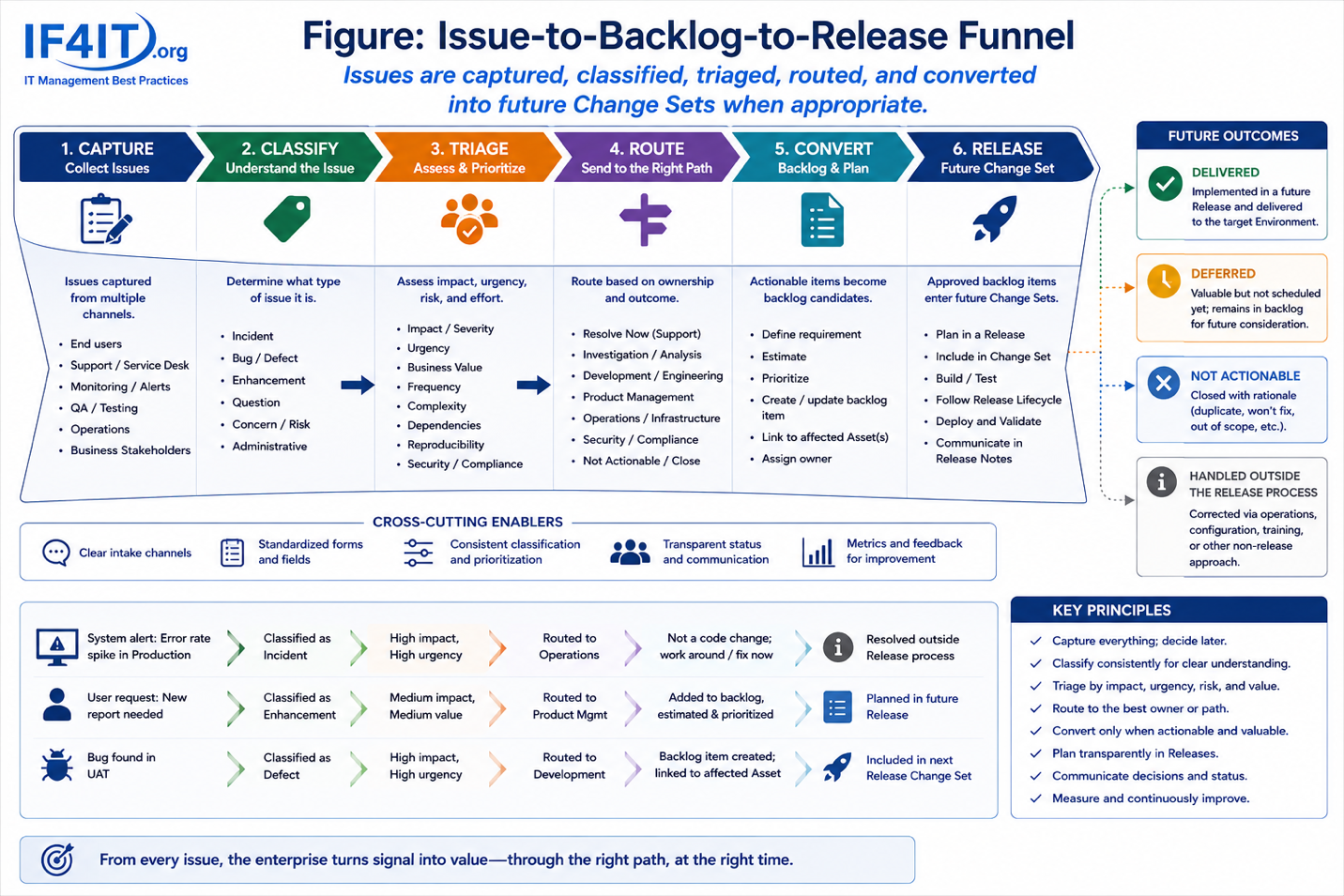
Every Issue, regardless of Type, should be captured against the specific Release ID it was found in/against, the specific Asset/Product/Service it belongs to, and the specific Environment where it was observed.
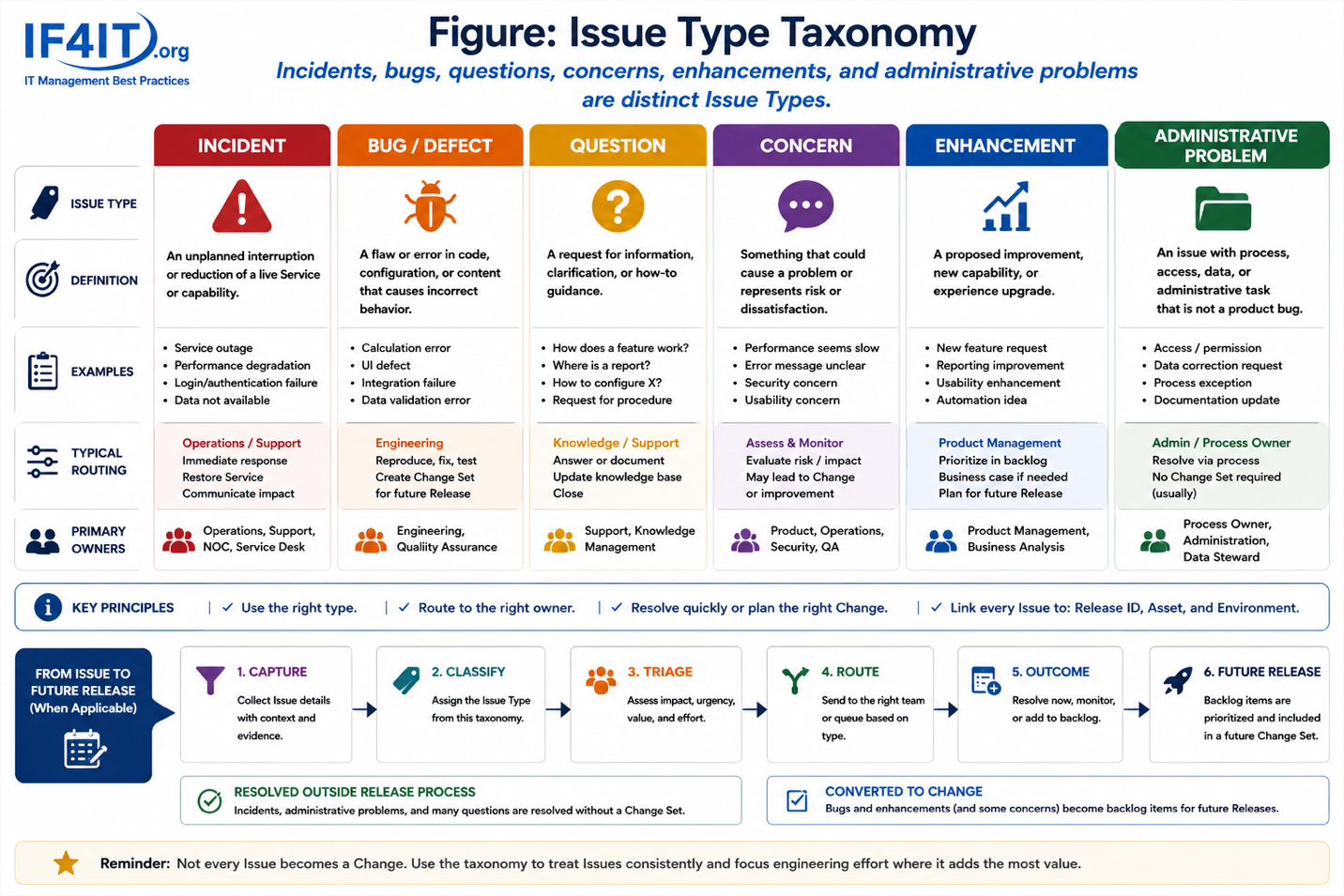
| Issue Type | Description |
|---|---|
| Incidents/Disruptions | An unplanned interruption or degradation of normal operation of an Asset in a given Environment, discovered after a Release has been deployed. |
| Bugs/Defects | A confirmed flaw in the behavior of a Release once deployed. Typically flows into the backlog and maps to a future Patch. |
| Questions/Inquiries | A stakeholder request for clarification or information. Typically resolved immediately, no Change Set or new Release required. |
| Administrative/Operational Problems | A configuration, access, data, or operational issue resolved directly within the current Environment. No Change Set or new Release required. |
| Concerns | A stakeholder-raised observation or worry not yet a confirmed Bug/Defect or Incident, but warranting tracking and possible investigation. |
| Enhancement Requests | A request for new or improved capability. Maps naturally to a future Feature Release. |
Best Practice
Treat every Issue that requires a Change Set as a candidate input to the Product/Service backlog and, ultimately, a future Release — with the Release Owner accountable for triage and prioritization.
Benefit(s)
- Keeps the Roadmap grounded in real operational feedback, not just forward-looking aspiration.
How to cite this page
When referencing this page in academic work, internal standards, or external publications, include the page title, IF4IT as author and publisher (The International Foundation for Information Technology (IF4IT), LLC), the URL, and your access date.
Example (informal web citation):
The International Foundation for Information Technology (IF4IT), LLC. How Issues Become Future Releases — The Feedback Loop from Deployment to Backlog | Release Management Best Practices. https://if4it.org/best-practices/release-management/how-issues-become-future-releases-the-feedback-loop-from-deployment-to-backlog/ (accessed 2026-10-05).
See About Us for content governance and site-wide citation guidance.
Copyright for The International Foundation for Information Technology (IF4IT), LLC: 2008 - Present
Legal Disclaimers