How Release Iterations Work — One Universal Feedback Loop, Different Change Set Sizes and Speeds in Waterfall and Agile - Release Management Best Practices
How Release Iterations Work — One Universal Feedback Loop, Different Change Set Sizes and Speeds in Waterfall and Agile
(Chapter 17 of Release Management Best Practices)
Executive Summary: Chapter Overview
IF4ITThe Bottom Line
Core Concepts
| Concept | Definition & Strategic Role |
|---|---|
| Release Lifecycle | The full arc of Iterations toward one target Release. |
| Release Iteration | A single governed attempt within that Lifecycle. |
| Dev/Engineering-Only Correction Rule | Corrections must be made only in Development/Engineering. |
Quick Q&A
Question: Can a Release Lifecycle end without ever producing a Version?
Question: Where should defect fixes be made?
Read More Below
Overview
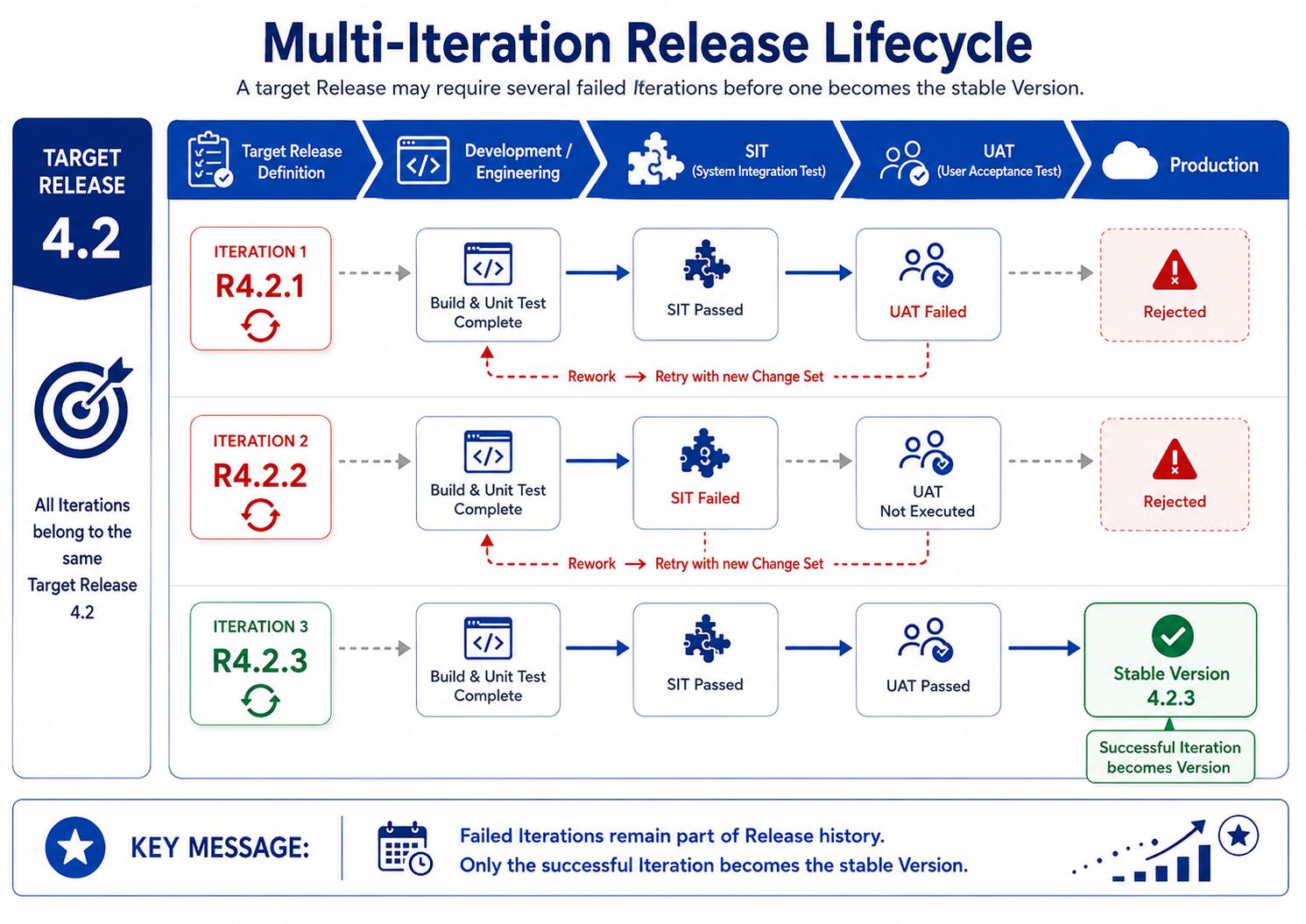
The Release Iteration feedback loop mechanism is universal across both Waterfall and Agile: an Environment rejection sends work back to Development/Engineering only, producing a new Change Set, a new Iteration, and re-entry into the pipeline at the appropriate Environment. What differs between the two models are two independent dials: Change Set size/risk (larger and higher-risk in Waterfall vs. smaller and lower-risk in Agile), and Iteration speed (slow in Waterfall vs. rapid in Agile).
A Release Lifecycle is the full collective sequence of Release Iterations pursuing a single target Release, from its first Iteration attempt through to whichever Iteration ultimately succeeds and becomes the Version. For example, for Product X targeting Release 1.1: R1.1.1 and R1.1.2 fail in SIT; R1.1.3 and R1.1.4 pass SIT but fail UAT; R1.1.5 passes SIT and UAT but fails a Production smoke test; R1.1.6 passes everywhere and becomes Version 1.1.6. Only R1.1.6 ever becomes a Version. A Release Lifecycle does not have to end in success — it can also end in Termination/Withdrawal.
It is a best practice that changes for corrections are only made in the Development/Engineering environment…
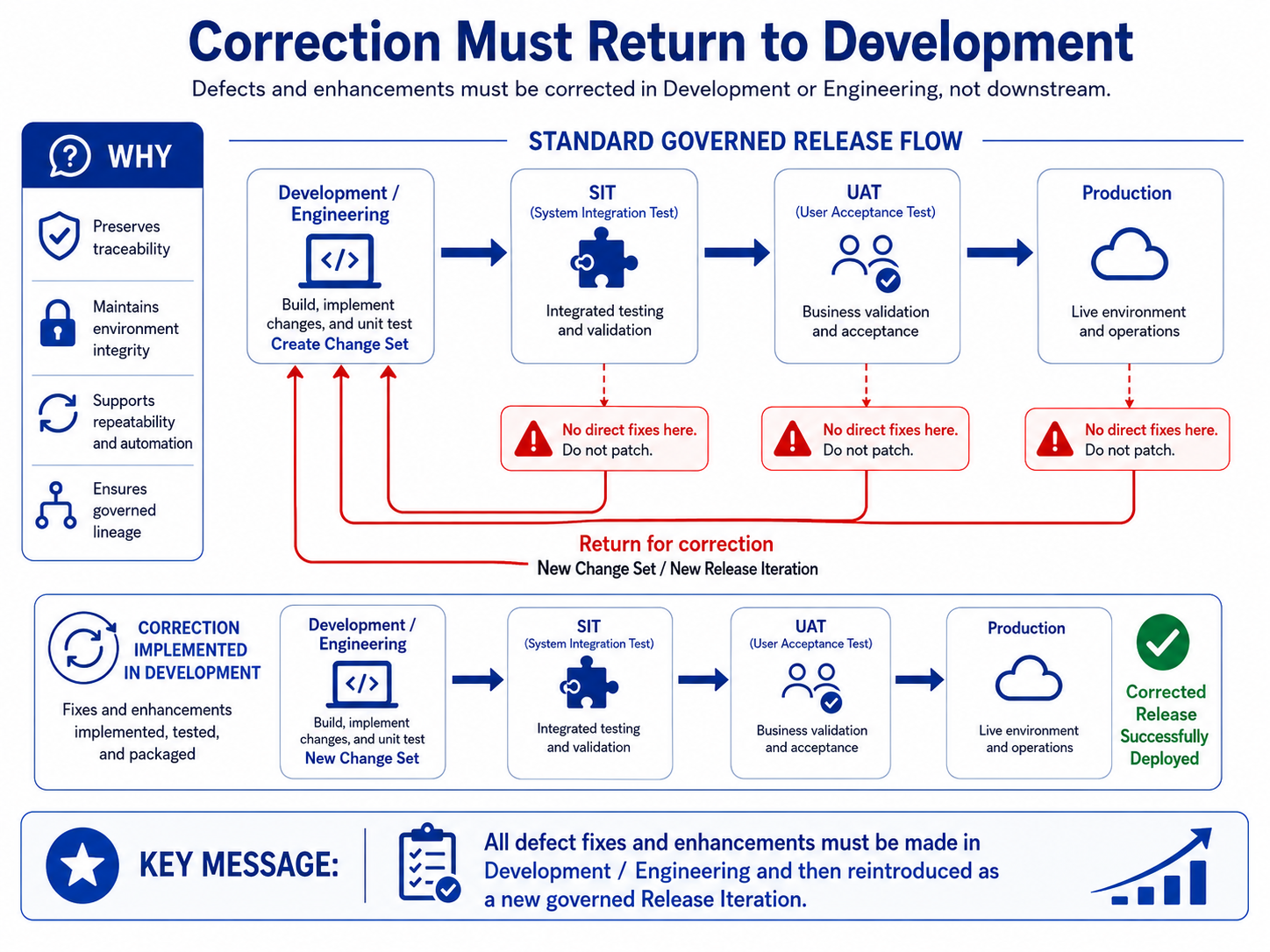
Best Practice
Never patch defects or add enhancements directly in non-Development/non-Engineering Environments (SIT, UAT, Production Staging, or Production). Corrections must always be made in Development and/or Engineering Environment(s).
Benefit(s)
- Preserves Environment integrity and ensures every correction produces a properly traceable new Change Set and Release Iteration.
How to cite this page
When referencing this page in academic work, internal standards, or external publications, include the page title, IF4IT as author and publisher (The International Foundation for Information Technology (IF4IT), LLC), the URL, and your access date.
Example (informal web citation):
The International Foundation for Information Technology (IF4IT), LLC. How Release Iterations Work — One Universal Feedback Loop, Different Change Set Sizes and Speeds in Waterfall and Agile | Release Management Best Practices. https://if4it.org/best-practices/release-management/how-release-iterations-work-one-universal-feedback-loop-different-change-set-sizes-and-speeds-in-waterfall-and-agile/ (accessed 2026-10-05).
See About Us for content governance and site-wide citation guidance.
Copyright for The International Foundation for Information Technology (IF4IT), LLC: 2008 - Present
Legal Disclaimers