Release Communication and Stakeholder Coordination - Release Management Best Practices
Release Communication and Stakeholder Coordination
(Chapter 26 of Release Management Best Practices)
Executive Summary: Chapter Overview
IF4ITThe Bottom Line
Core Concepts
| Concept | Definition & Strategic Role |
|---|---|
| Communication Tools | Roadmaps, Calendars, Release Notes. |
| Stakeholder Cadence | Different stakeholders need notice at different points. |
| Escalation Communication | Proactive notice of delays/rejections/Rollbacks. |
Quick Q&A
Question: Who is specifically accountable for Sponsor communication?
Question: Should stakeholders be told about delays proactively?
Read More Below
Overview
Communication tools: Release Roadmaps (long-horizon Past/Present/Planned view, mostly for Sponsors/leadership); Release Calendars (scheduling/freeze-window visibility, for coordinating teams and Change Management); and Release Notes (short-form per-Release communication of what’s new/changed/fixed/known issues, primarily for End Users and support/operations). Key stakeholders: Sponsors, Customers, End Users, and Change Management.

Different stakeholders need notice at different points: Sponsors via Roadmap timing, Change Management before a Production-bound Readiness Gate decision, End Users at/just after deployment. Stakeholders should also be proactively informed when a Release is delayed, rejected at a Readiness Gate, or its Rollback/Remediation path is invoked — not left to discover this after the fact. The Release Manager facilitates stakeholder communication generally; the Release Owner is specifically accountable for Sponsor-level communication.
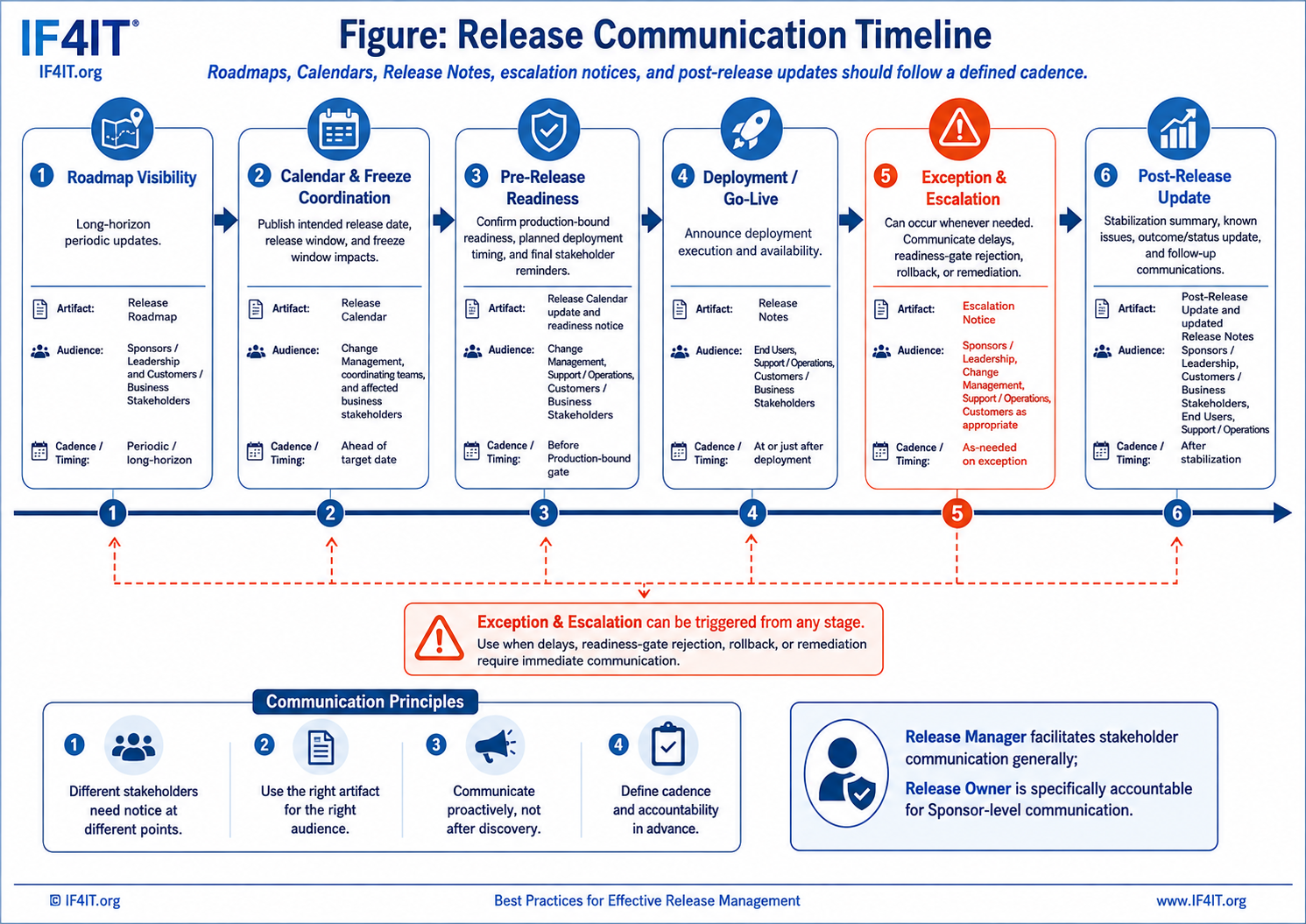
Best Practice
Ensure effective and proactive Release Communications to key stakeholders using Release Roadmaps, Release Calendars, and Release Notes, with cadence and accountability defined per stakeholder.
Benefit(s)
- Keeps stakeholders continuously informed and reduces the risk of a Release surprising someone who depended on knowing about it in advance.
Antipattern
Communicating only when things go well, or only after a stakeholder asks — leaving Sponsors, Customers, or Change Management to discover a delay, rejection, or Rollback after the fact.
How to cite this page
When referencing this page in academic work, internal standards, or external publications, include the page title, IF4IT as author and publisher (The International Foundation for Information Technology (IF4IT), LLC), the URL, and your access date.
Example (informal web citation):
The International Foundation for Information Technology (IF4IT), LLC. Release Communication and Stakeholder Coordination | Release Management Best Practices. https://if4it.org/best-practices/release-management/release-communication-and-stakeholder-coordination/ (accessed 2026-10-05).
See About Us for content governance and site-wide citation guidance.
Copyright for The International Foundation for Information Technology (IF4IT), LLC: 2008 - Present
Legal Disclaimers