Release Documentation - Release Management Best Practices
Release Documentation
(Chapter 30 of Release Management Best Practices)
Executive Summary: Chapter Overview
IF4ITThe Bottom Line
Core Concepts
| Concept | Definition & Strategic Role |
|---|---|
| Release-Level vs. Per-Environment Scope | How Documentation types are scoped. |
| Documentation Types Table | The 19-row recommended baseline. |
| Enterprise Inventory Registration | Assets registered as part of Documentation completeness. |
Quick Q&A
Question: Does Release Documentation include User Documentation?
Question: Who typically authors the Release Project Plan and Release Notes?
Read More Below
Overview
Release Documentation covers documentation of the Release process itself: planning (including the Release Project Plan itself — scope, schedule, staffing, dependencies, risk), architecture and design, configuration, build and packaging, deployment, testing, approvals, and rejections — as well as capturing and referencing the relevant Environment documentation/state for every Environment a given Release passes through. Documentation should capture what work was actually performed, who performed it, and expected versus actual outcomes at each stage — not just the plan as originally conceived.
Release Documentation also includes Release Notes, User Documentation, Reference Documentation, and Administrator Documentation. Ensuring these are properly created and/or updated is part of what a Release’s Documentation must deliver. Release Management is responsible for ensuring these get produced/updated as part of Release completeness — but the actual authoring may be performed by other functions (technical writers, Product Management, support teams). Some documentation types, particularly the Release Project Plan and Release Notes, are often created directly by the Release Manager.

Best Practice
Define and deliver strong Release Documentation.
Benefit(s)
- Provides a complete, traceable record of how a Release was planned, built, tested, and approved — or rejected — supporting both day-to-day coordination and later audit needs.
Best Practice
For every Environment a Release is deployed to, ensure that its Assets — both the Assets that constitute the Product/Service itself and all supporting/enabling Assets it leverages or depends on — are properly registered in the relevant master Enterprise Inventories. As a “Run”-maturity practice, this registration should also capture the appropriate relationships between these Assets.
Benefit(s)
- Keeps Enterprise Inventories continuously accurate and current, reflecting real deployed state across every Environment, and provides a navigable relationship graph supporting impact analysis and enterprise-wide governance.
This Run-maturity practice is a proactive “push” — the Deployment script itself actively registers Assets and their relationships into the relevant Enterprise Inventories at the moment a Release is deployed. This is distinct from Auto-Discovery, which reactively scans/harvests Assets that already exist in an Environment, independent of any specific Release.
Release Documentation Types
The following table presents a recommended baseline of Release Documentation types, organized by SDLC Phase and Scope. It is not a mandated, one-size-fits-all checklist — readers should work with their enterprise to identify which documents are genuinely appropriate for their specific Asset/Product/Service and Release.
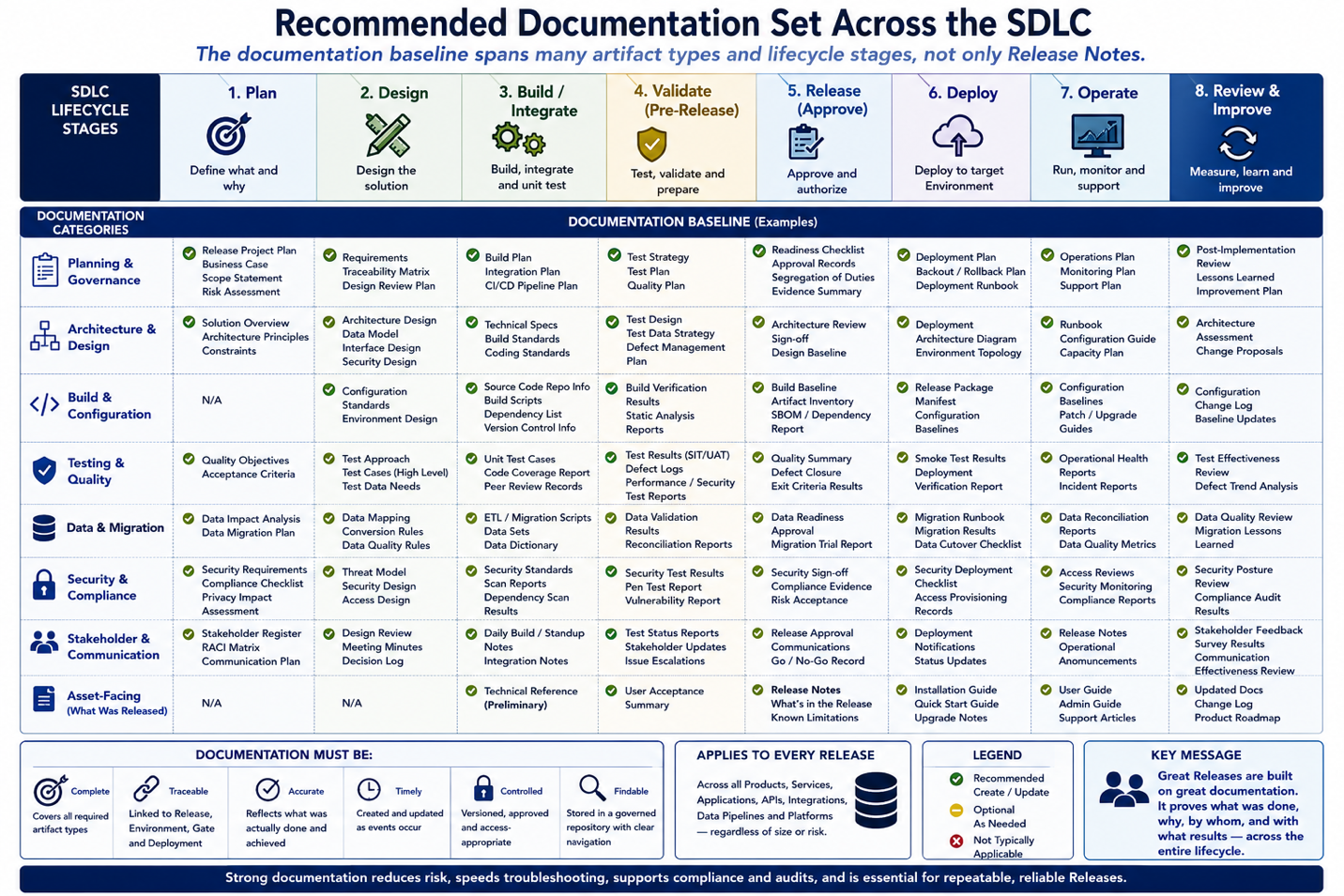
| Documentation Type | SDLC Phase(s) | Scope | Description |
|---|---|---|---|
| Release Project Plan | 3. Planning (spans through 10. Closing) | Release-Level | Scope, schedule, staffing/resourcing, dependencies, and risk for the Release. Often authored directly by the Release Manager. |
| Requirements Documentation | 4. Requirements Capture | Release-Level | Captures the functional/non-functional requirements driving this Release’s Change Set. |
| Architecture and Design Documentation | 5. Design | Release-Level | Describes the architecture and design decisions made to satisfy the Release’s requirements. |
| Risk Classification/Assessment Record | 3. Planning | Release-Level | Captures the Release’s assigned Risk Classification tier and the factors that drove it. |
| Risk Register | 3. Planning (spans through 10. Closing) | Release-Level | An ongoing record of individually identified risks, each with likelihood, impact, mitigation plan, owner, and status. |
| Build, Configuration & Packaging Documentation | 6. Implementation/Build | Release-Level | Describes how the Release’s Change Set was built, configured, and packaged for deployment. |
| Dependency/Third-Party Component Manifest | 6. Implementation/Build | Release-Level | Tracks which Version of each externally-managed dependency the Release incorporates. |
| Rollback and Remediation Plan | 6. Implementation/Build | Per-Environment | The well-defined Rollback correlating to the Deployment, plus pre-decided trigger criteria for Rollback vs. Remediation. |
| Testing Documentation/Evidence | 7. SIT, 8. UAT | Per-Environment | Records of functional/quality validation performed at each Readiness Gate. |
| Deployment Documentation | 7. SIT, 8. UAT, 9. PROD | Per-Environment | The scripted Deployment procedure, including its correlating Rollback. |
| Approval/Rejection Records | 7. SIT, 8. UAT, 9. PROD | Per-Environment | Records of the Readiness Gate decision at each specific Environment. |
| Change Record | 7. SIT, 8. UAT, 9. PROD | Per-Environment | The record submitted to the Change Management Readiness Gate. |
| Environment Documentation/State References | 7. SIT, 8. UAT, 9. PROD | Per-Environment | Cross-references to the relevant Environment documentation/state. |
| Enterprise Inventory Registration Records | 7. SIT, 8. UAT, 9. PROD | Per-Environment | Evidence that Assets were properly registered in master Enterprise Inventories. |
| Release Notes | 9. Production | Release-Level | Short-form, per-Release communication of what’s new/changed/fixed/known issues. |
| User Documentation | 9. Production | Release-Level | Comprehensive reference material for using the Asset, updated/published per Release. |
| Reference Documentation | 9. Production | Release-Level | Comprehensive technical/reference material describing the Asset, updated/published per Release. |
| Administrator Documentation | 9. Production | Release-Level | Documentation for operating/administering the Asset, updated/published per Release. |
| Issue/Backlog Correlation Record | 9. Production, 10. Post-Mortem and Closing | Release-Level | Correlates Issues discovered against this Release to its Release ID, Asset, and Environment. |
| Post-Mortem/Retrospective Report | 10. Post-Mortem and Closing | Release-Level | Captures lessons learned and expected-versus-actual outcomes. |
How to cite this page
When referencing this page in academic work, internal standards, or external publications, include the page title, IF4IT as author and publisher (The International Foundation for Information Technology (IF4IT), LLC), the URL, and your access date.
Example (informal web citation):
The International Foundation for Information Technology (IF4IT), LLC. Release Documentation | Release Management Best Practices. https://if4it.org/best-practices/release-management/release-documentation/ (accessed 2026-10-05).
See About Us for content governance and site-wide citation guidance.
Copyright for The International Foundation for Information Technology (IF4IT), LLC: 2008 - Present
Legal Disclaimers