Release Evidence and Audit Trail - Release Management Best Practices
Release Evidence and Audit Trail
(Chapter 31 of Release Management Best Practices)
Executive Summary: Chapter Overview
IF4ITThe Bottom Line
Core Concepts
| Concept | Definition & Strategic Role |
|---|---|
| Retention Duration | How long evidence must be kept. |
| Attestation Requirement | Whether formal sign-off is required. |
| Risk-Scaled Rigor | Requirements scale with Risk Classification. |
Quick Q&A
Question: Does every Release need the same evidence retention policy?
Question: Should evidence requirements be decided per Release?
Read More Below
Overview
Release Evidence and Audit Trail is a risk-scaled specialization of Release Documentation. How rigorously documentation must be retained, attested to, and made auditable scales with the criticality and regulatory exposure of the Asset involved.
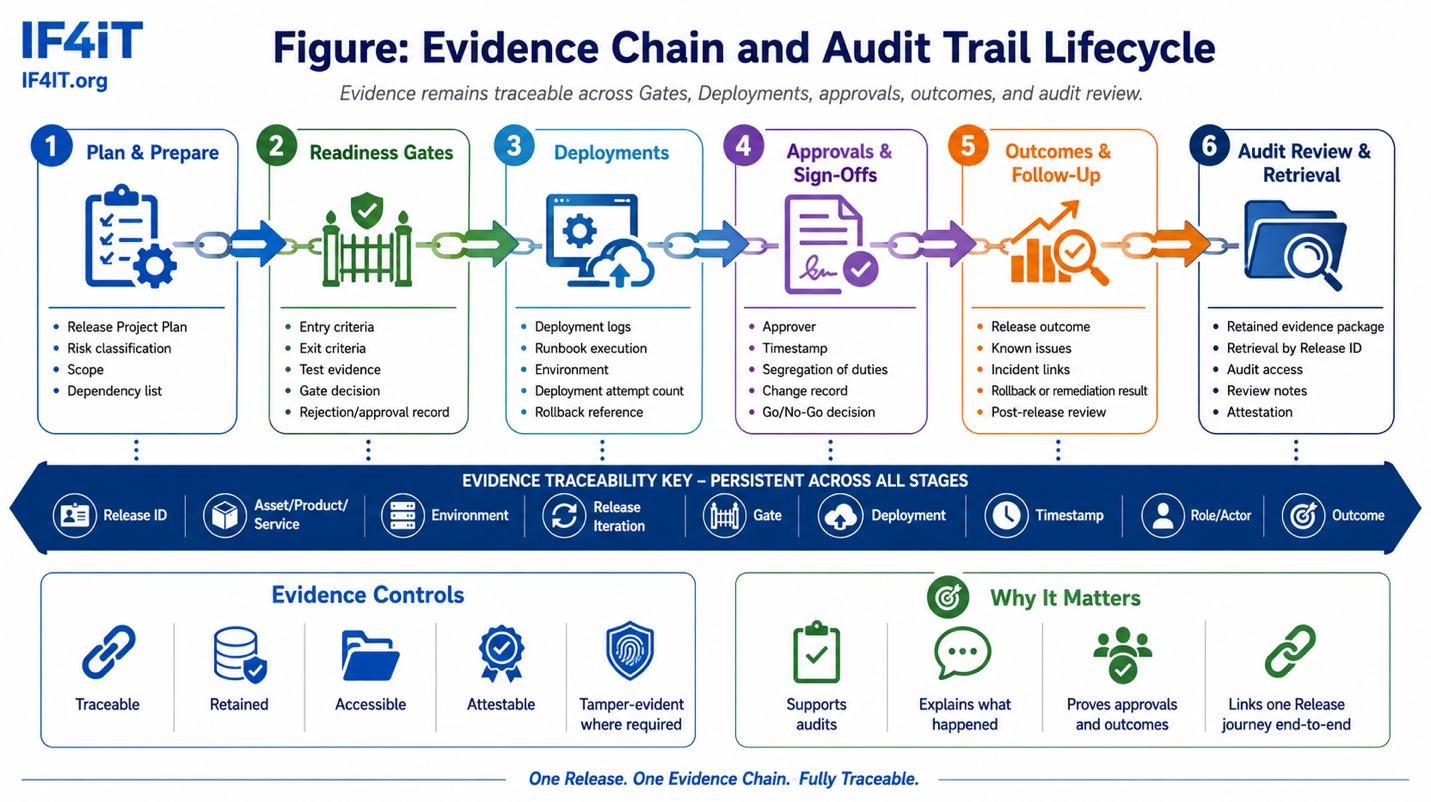
Four dimensions scale with Risk Classification: retention duration; immutability/tamper-evidence; attestation requirement; and audit accessibility.
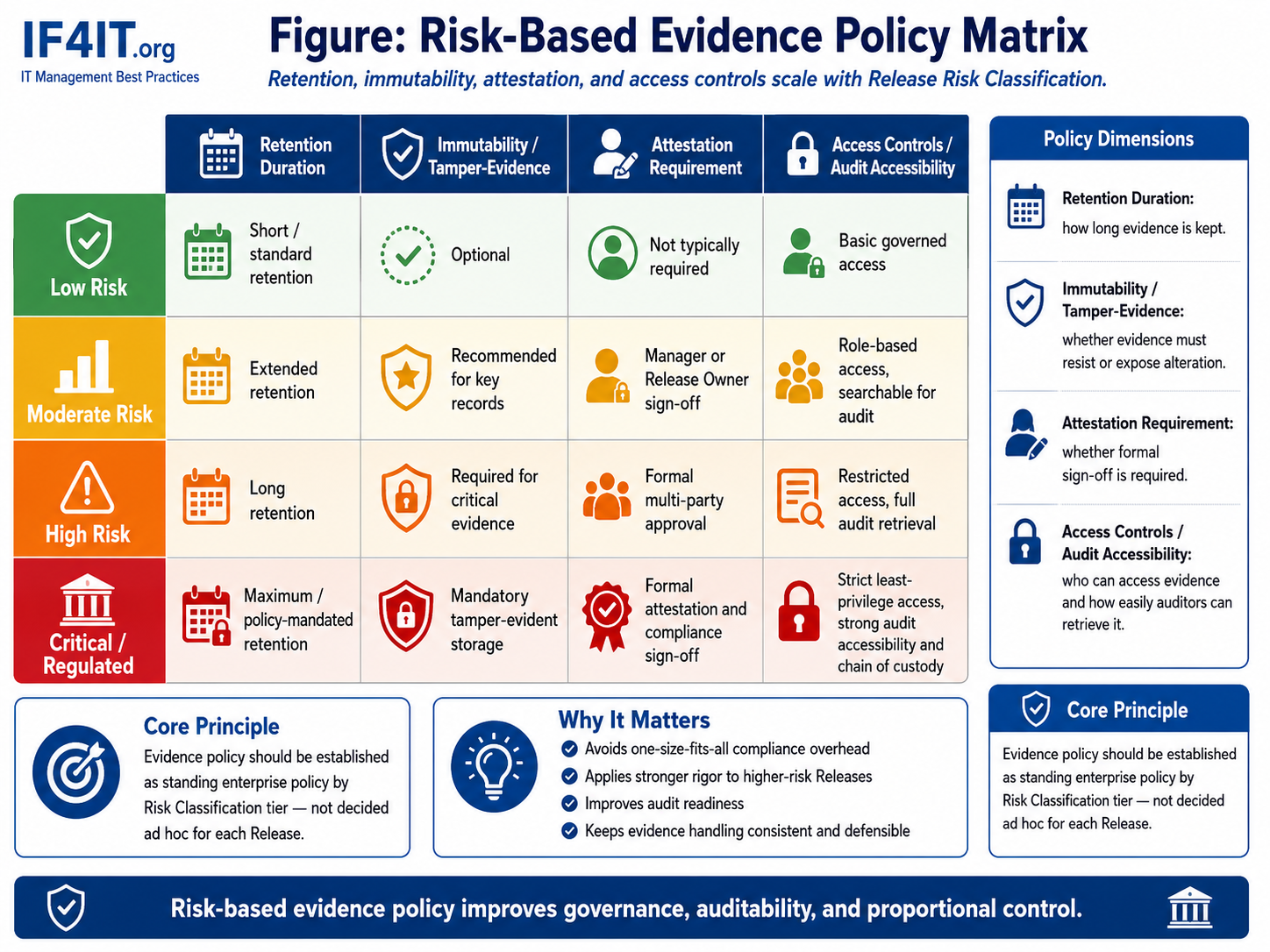
These are things the reader should work with their enterprise to establish, not a mandated checklist — a lower-complexity, lower-risk Release may require none of them; a higher-risk, higher-complexity Release may require all of them.
Best Practice
Define Evidence and Audit Trail requirements (retention duration, immutability, attestation, accessibility) explicitly per Risk Classification tier, as a standing enterprise policy — not decided ad hoc, Release by Release.
Benefit(s)
- Ensures higher-risk Assets get appropriately rigorous evidence handling automatically, without over-burdening low-risk Assets with unnecessary compliance overhead.
Antipattern
Applying uniform, one-size-fits-all evidence retention/attestation requirements across every Release regardless of Risk Classification.
How to cite this page
When referencing this page in academic work, internal standards, or external publications, include the page title, IF4IT as author and publisher (The International Foundation for Information Technology (IF4IT), LLC), the URL, and your access date.
Example (informal web citation):
The International Foundation for Information Technology (IF4IT), LLC. Release Evidence and Audit Trail | Release Management Best Practices. https://if4it.org/best-practices/release-management/release-evidence-and-audit-trail/ (accessed 2026-10-06).
See About Us for content governance and site-wide citation guidance.
Copyright for The International Foundation for Information Technology (IF4IT), LLC: 2008 - Present
Legal Disclaimers