Release Labeling and Numbering — A Common Convention, Not a Fixed Rule - Release Management Best Practices
Release Labeling and Numbering — A Common Convention, Not a Fixed Rule
(Chapter 8 of Release Management Best Practices)
Executive Summary: Chapter Overview
IF4ITThe Bottom Line
Core Concepts
| Concept | Definition & Strategic Role |
|---|---|
| X.Y.Z Convention | Illustrative major.minor.iteration labeling pattern. |
| Release ID | The label itself, interchangeable with Version. |
| Consistency | The one non-negotiable labeling principle. |
Quick Q&A
Question: Must every organization use the same X.Y.Z meaning?
Question: How is a multi-Asset Release labeled?
Read More Below
Overview
A common, illustrative labeling convention uses three positions, X.Y.Z: X represents a major architectural change; Y represents a controlled set of incremental improvements to the existing stable Release; and Z represents the nth Iteration it took that Release to make it into Production as the stable Version. For example, a Release targeting “1.1” might require several Iterations — R1.1.1, R1.1.2, and so on — before one of them, say R1.1.6, finally succeeds and becomes Version 1.1.6.
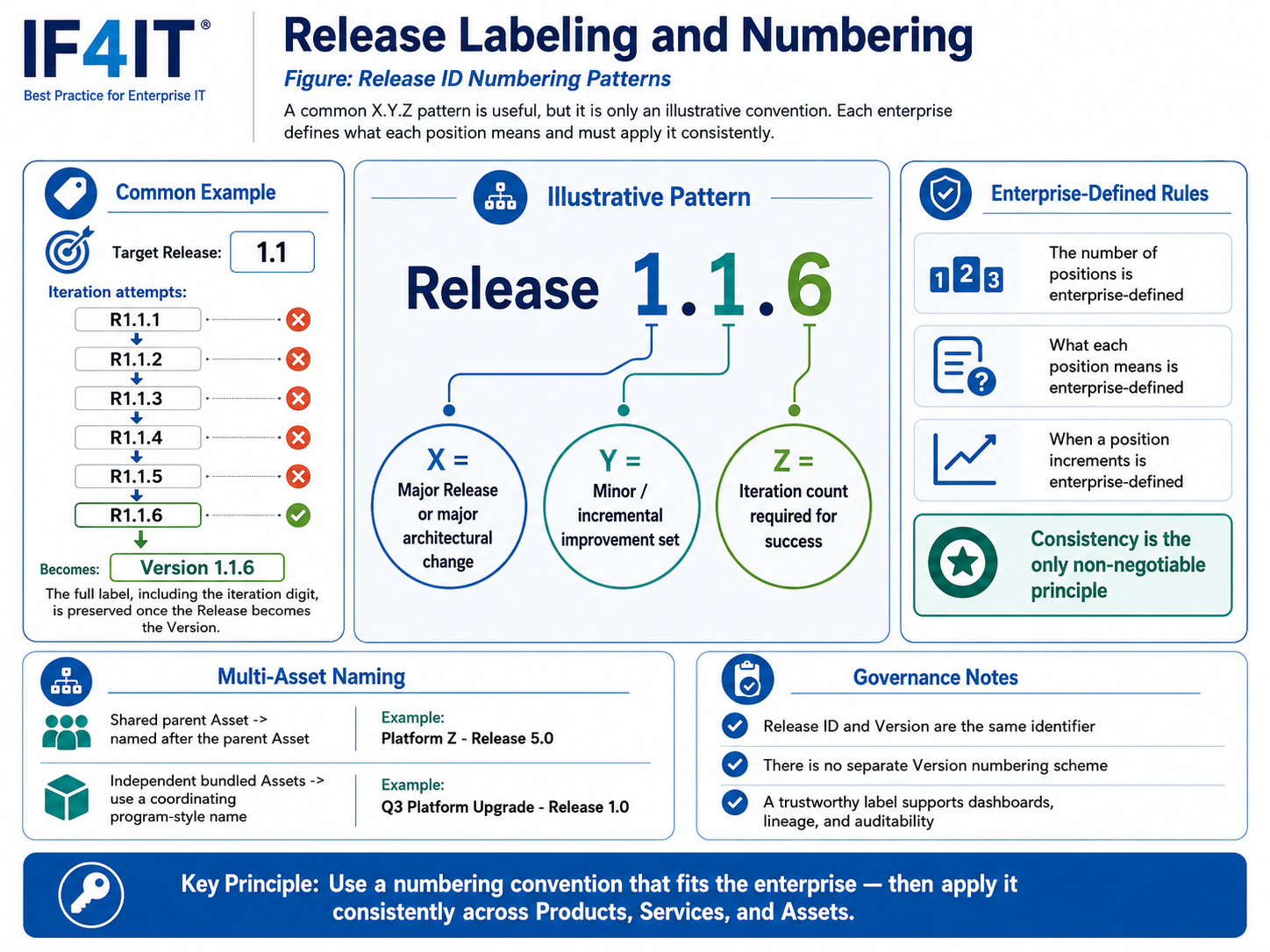
This is presented as a common, illustrative convention, not a mandated universal semantic. The number of positions, what each position represents, and when a position increments are enterprise-defined decisions. The one non-negotiable principle is consistency: once an enterprise defines what each position means, it must apply that meaning uniformly so the label remains trustworthy across Products, Services, and Assets, and interpretable on the Enterprise Release Dashboard.
Release ID and Release Version are interchangeable terms for the same label — there is no separate Version-numbering logic. The full label, including the Iteration digit, is preserved as the Version identifier once a Release Iteration succeeds.
When a Release bundles changes across multiple Assets, labeling collapses into two cases, enabled by Assets being hierarchical/compositional: if the bundled Assets share a common parent Asset, the Release is named after that parent, exactly like any single-Asset Release (e.g., “Platform Z – Release 5.0”) — no special multi-Asset convention is needed, since the parent Asset is the governing unit regardless of how many constituent Assets changed underneath it. If the bundled Assets are genuinely independent, with no shared parent, the Release requires a coordinating, program-style name instead (e.g., “Q3 Platform Upgrade – Release 1.0”).
How to cite this page
When referencing this page in academic work, internal standards, or external publications, include the page title, IF4IT as author and publisher (The International Foundation for Information Technology (IF4IT), LLC), the URL, and your access date.
Example (informal web citation):
The International Foundation for Information Technology (IF4IT), LLC. Release Labeling and Numbering — A Common Convention, Not a Fixed Rule | Release Management Best Practices. https://if4it.org/best-practices/release-management/release-labeling-and-numbering-a-common-convention-not-a-fixed-rule/ (accessed 2026-10-06).
See About Us for content governance and site-wide citation guidance.
Copyright for The International Foundation for Information Technology (IF4IT), LLC: 2008 - Present
Legal Disclaimers