Release Management vs. Change Management - Release Management Best Practices
Release Management vs. Change Management
(Chapter 14 of Release Management Best Practices)
Executive Summary: Chapter Overview
IF4ITThe Bottom Line
Core Concepts
| Concept | Definition & Strategic Role |
|---|---|
| Cross-Asset Impact | The risk a Release poses to other Assets sharing an Environment. |
| Change Advisory Board | Change Management’s own governance body, not a Release Management concept. |
| Change Readiness Gate | The distinct gate Change Management enforces. |
Quick Q&A
Question: Does a Release's own Risk Classification substitute for Change Management's review?
Question: Is the CAB a Release Management concept?
Read More Below
Overview
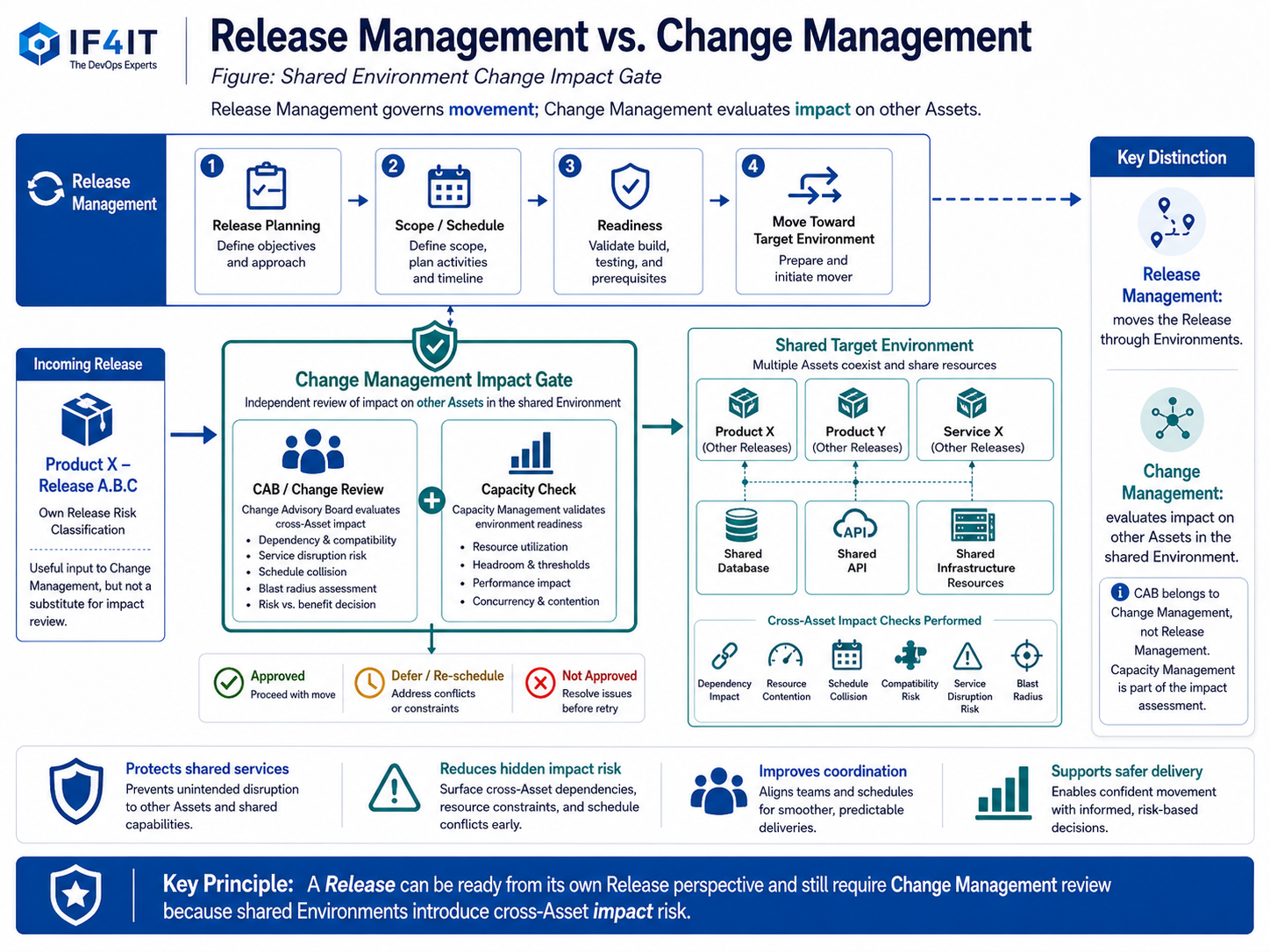
Release Management is the discipline of moving a Release into and across appropriately defined and targeted Environments. Change Management is the discipline of understanding and proactively managing the change impacts of a Release on other Assets/Products/Services that exist in the same targeted Environment(s). Good Release Management relies on good Change Management to minimize risks and impacts.
For example, when planning the Release of Product X – Release A.B.C into a specific Environment, that Release, once deployed, might leverage, depend on, change, or impact shared or common resources in that Environment. Good Change Management helps reduce and/or avoid such risks and impacts, ensuring that the Release of Product X – Release A.B.C does not negatively impact Product Y or Service X that share that same Environment.
The Change Advisory Board (CAB) is a Change Management governance body, not a Release Management concept. Change Management also includes Capacity Management of the target Environment in preparation for a change.
Best Practice
Submit every Release targeting a shared Environment to Change Management for impact assessment specifically against the other Assets/Products/Services that also operate in that Environment — not as a generic approval step, but as a cross-Asset impact check Release Management cannot fully perform on its own.
Benefit(s)
- Catches impact risk invisible from within a single Release’s own view — the whole reason Change Management exists as an independent discipline.
Best Practice
Treat a Release’s own Risk Classification (particularly its blast-radius factor) as useful input to the Change record, but never as a substitute for Change Management’s own cross-Asset assessment.
Benefit(s)
- Avoids false confidence — a Release being “Low Risk” from its own Release Management view says nothing about what else is happening in that shared Environment at the same time.
How to cite this page
When referencing this page in academic work, internal standards, or external publications, include the page title, IF4IT as author and publisher (The International Foundation for Information Technology (IF4IT), LLC), the URL, and your access date.
Example (informal web citation):
The International Foundation for Information Technology (IF4IT), LLC. Release Management vs. Change Management | Release Management Best Practices. https://if4it.org/best-practices/release-management/release-management-vs-change-management/ (accessed 2026-10-05).
See About Us for content governance and site-wide citation guidance.
Copyright for The International Foundation for Information Technology (IF4IT), LLC: 2008 - Present
Legal Disclaimers