Release Management vs. Deployment Management - Release Management Best Practices
Release Management vs. Deployment Management
(Chapter 15 of Release Management Best Practices)
Executive Summary: Chapter Overview
IF4ITThe Bottom Line
Core Concepts
| Concept | Definition & Strategic Role |
|---|---|
| Deployment | A scripted set of steps to install/configure/build/instantiate/execute an Asset. |
| Rollback Pairing | Every Deployment must have a correlating Rollback. |
| Deployment Outcomes | Success/failure/attempt counts tracked as a readiness signal. |
Quick Q&A
Question: Should every Deployment have a Rollback?
Question: Does Release Management diagnose Deployment procedure issues?
Read More Below
Overview
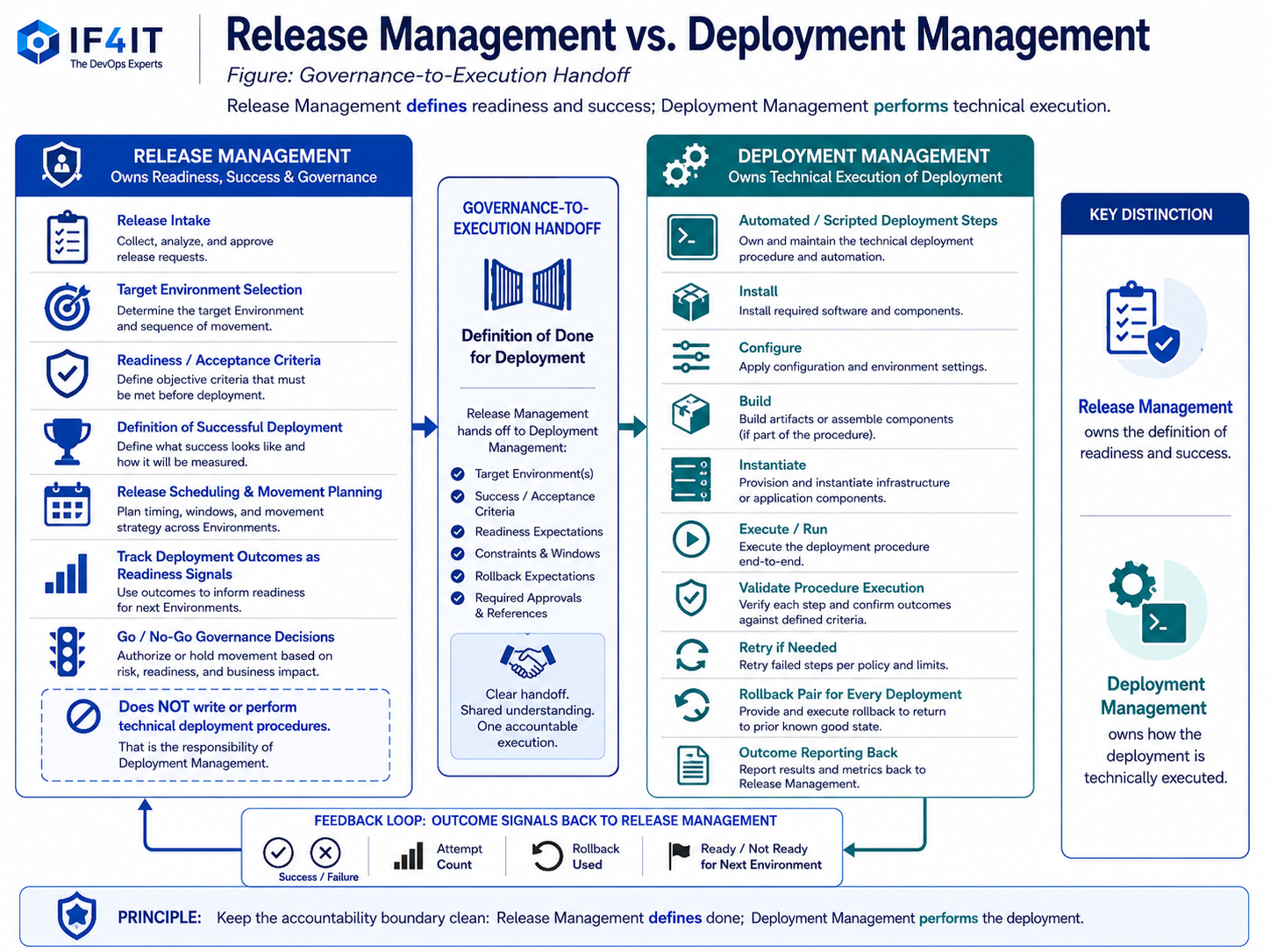
This chapter addresses the discipline-level accountability handoff between Release Management and Deployment Management. For the artifact-level distinction — one Release requires many Deployments, the rehearsal framing, Deployment-retry vs. Release-Iteration — see “Release vs. Deployment — How a Single Release Is Deployed Many Times on Its Way to Production.”
A Deployment is a scripted (preferably automated) set of steps that clearly lays out how to Install, Configure, Build, Instantiate, and Execute an instance of the Asset/Product/Service into a specific Environment. Scripting/automating a Deployment serves two purposes: (1) getting that Asset/Product/Service instance up and running, and (2) reducing or eliminating the risk of change impact. Deployment Management is the discipline responsible for creating and managing such Deployments. Good Release Management heavily relies on well-defined Deployments to reliably and repeatably execute a Release’s movement into each Environment.
Best Practice
Every defined Deployment must have a correlating, well-defined Rollback.
Benefit(s)
- Reduces risk of change impact and enables fast recovery if a Deployment — or the Release it carries — proves problematic once running, rather than leaving recovery as an improvised, unscripted response under pressure.
Best Practice
Release Management should define what “successful Deployment” means for a given Environment (the acceptance criteria a Deployment must satisfy to count as done) but should not prescribe Deployment Management’s technical execution procedures itself.
Benefit(s)
- Keeps the accountability boundary clean — Release Management owns the definition of “done,” Deployment Management owns how to get there.
Best Practice
Release Management should track Deployment outcomes (success/failure, attempt counts) as a Release readiness signal, without taking ownership of diagnosing or fixing Deployment procedure issues.
Benefit(s)
- Prevents Release Management from quietly absorbing Deployment Management’s job under pressure to “just get the Release out.”
How to cite this page
When referencing this page in academic work, internal standards, or external publications, include the page title, IF4IT as author and publisher (The International Foundation for Information Technology (IF4IT), LLC), the URL, and your access date.
Example (informal web citation):
The International Foundation for Information Technology (IF4IT), LLC. Release Management vs. Deployment Management | Release Management Best Practices. https://if4it.org/best-practices/release-management/release-management-vs-deployment-management/ (accessed 2026-10-05).
See About Us for content governance and site-wide citation guidance.
Copyright for The International Foundation for Information Technology (IF4IT), LLC: 2008 - Present
Legal Disclaimers