Release Management vs. Environment Management - Release Management Best Practices
Release Management vs. Environment Management
(Chapter 13 of Release Management Best Practices)
Executive Summary: Chapter Overview
IF4ITThe Bottom Line
Core Concepts
| Concept | Definition & Strategic Role |
|---|---|
| Environment Reusability | Environments are built once and reused across many Releases. |
| Ephemeral Environment | An Environment that shuts down when not in use, reducing waste. |
| Infrastructure-as-Code | The reusable template/definition behind ephemeral provisioning. |
Quick Q&A
Question: Does Release Management build the Environments it uses?
Question: Does ephemeral use contradict reusability?
Read More Below
Overview
Environments are not built fresh per-Release. Planning, designing, configuring, building, and securing an Environment (including role-based/designated access for appropriate stakeholders within it) is Environment Management’s job, done with deliberate intent to make the Environment reusable across many Releases over time. Release Management consumes well-governed, already-provisioned Environments; it does not create them.
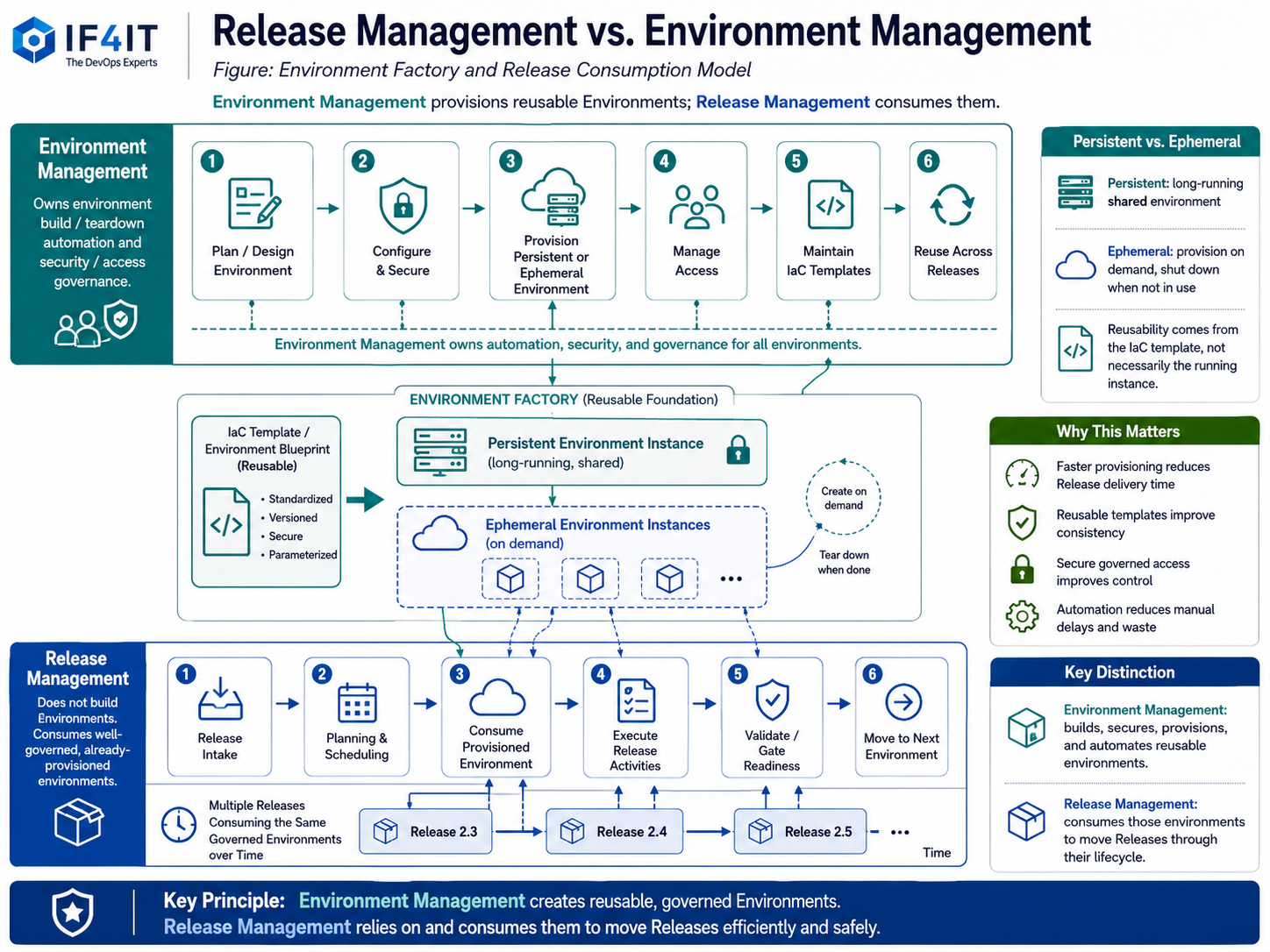
Environments required for a given Asset/Product/Service and its Releases can be persistent or ephemeral, where ephemeral is most often desired because it shuts down an Environment and everything in it when not in use, reducing waste. This is well-supported by Infrastructure-as-Code (IaC) and modern Cloud platforms, and is already fully covered in the IT Operating Environments Best Practices document. Ephemeral provisioning does not contradict reusability across Releases — what’s reusable is the IaC template/definition, not necessarily a persistently-running instance.
Best Practice
Even though Environment Management owns Environment build/teardown automation, Release Management should actively advocate for and depend on it, since slow or manual Environment provisioning directly inflates Total Release Delivery Time and Average Release Time.
Benefit(s)
- Improves Release Management’s own velocity metrics without Release Management needing to own the automation itself.
How to cite this page
When referencing this page in academic work, internal standards, or external publications, include the page title, IF4IT as author and publisher (The International Foundation for Information Technology (IF4IT), LLC), the URL, and your access date.
Example (informal web citation):
The International Foundation for Information Technology (IF4IT), LLC. Release Management vs. Environment Management | Release Management Best Practices. https://if4it.org/best-practices/release-management/release-management-vs-environment-management/ (accessed 2026-10-05).
See About Us for content governance and site-wide citation guidance.
Copyright for The International Foundation for Information Technology (IF4IT), LLC: 2008 - Present
Legal Disclaimers