Release Metrics and Measurements - Release Management Best Practices
Release Metrics and Measurements
(Chapter 28 of Release Management Best Practices)
Executive Summary: Chapter Overview
IF4ITThe Bottom Line
Core Concepts
| Concept | Definition & Strategic Role |
|---|---|
| Velocity Metrics | Deployment Frequency, Total Release Delivery Time. |
| Stability Metric | Change Failure Rate. |
| ART Disambiguation | Average Release Time vs. Agile Release Train. |
Quick Q&A
Question: Should velocity metrics be tracked without stability metrics?
Question: What does ART refer to in this chapter?
Read More Below
Overview
| Metric | Definition | Measures |
|---|---|---|
| Deployment Frequency | How often Deployments occur for a given Asset/Product/Service | Velocity |
| Total Release Delivery Time | The aggregate time across all Release Iterations in a Release’s full Lifecycle | Velocity |
| Change Failure Rate | The percentage of Releases that fail at a Readiness Gate, require Rollback, or trigger an Issue | Stability |
| Average Release Time (ART) | The average of Total Release Delivery Time across a set of Releases or a time period | Velocity (trend) |
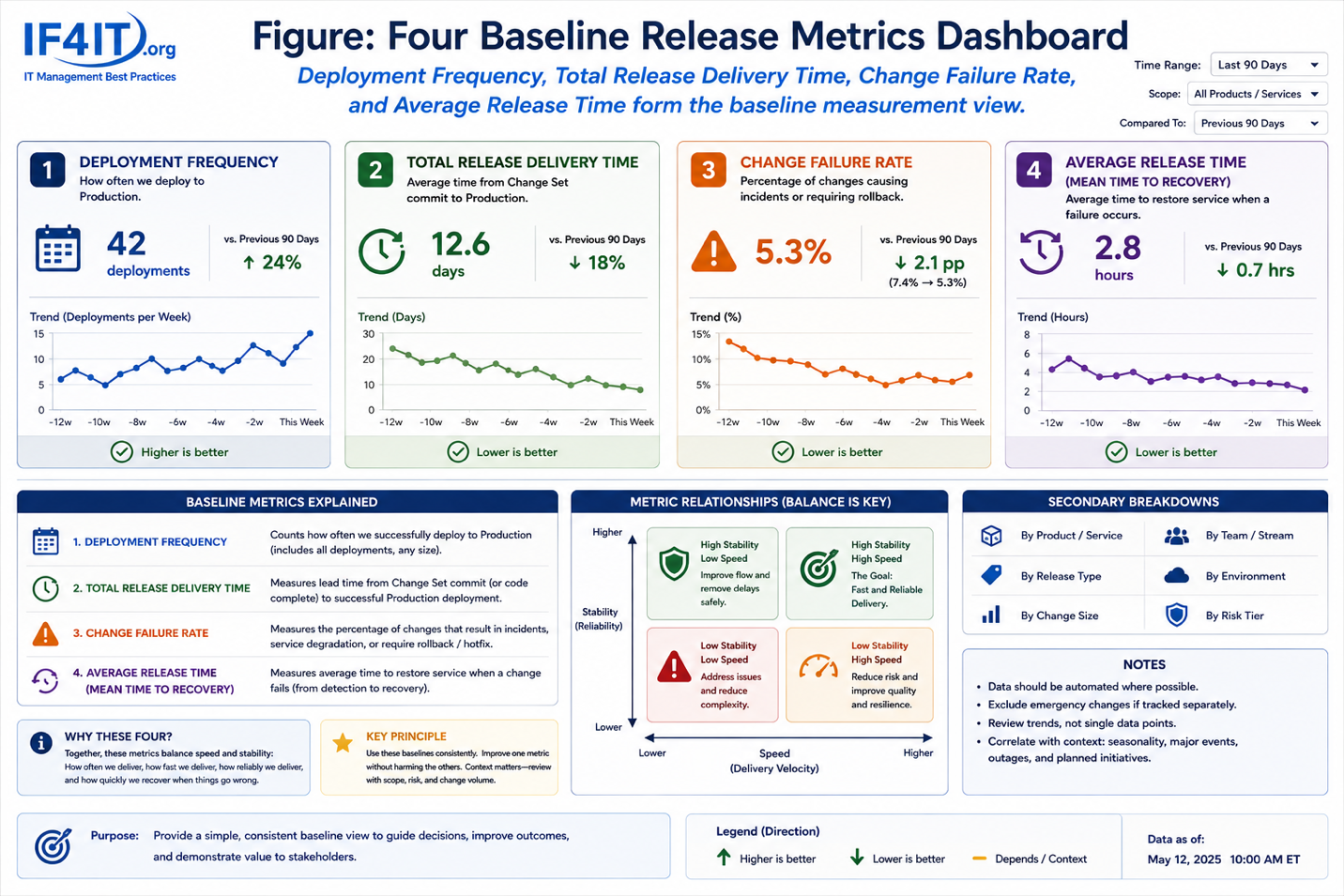
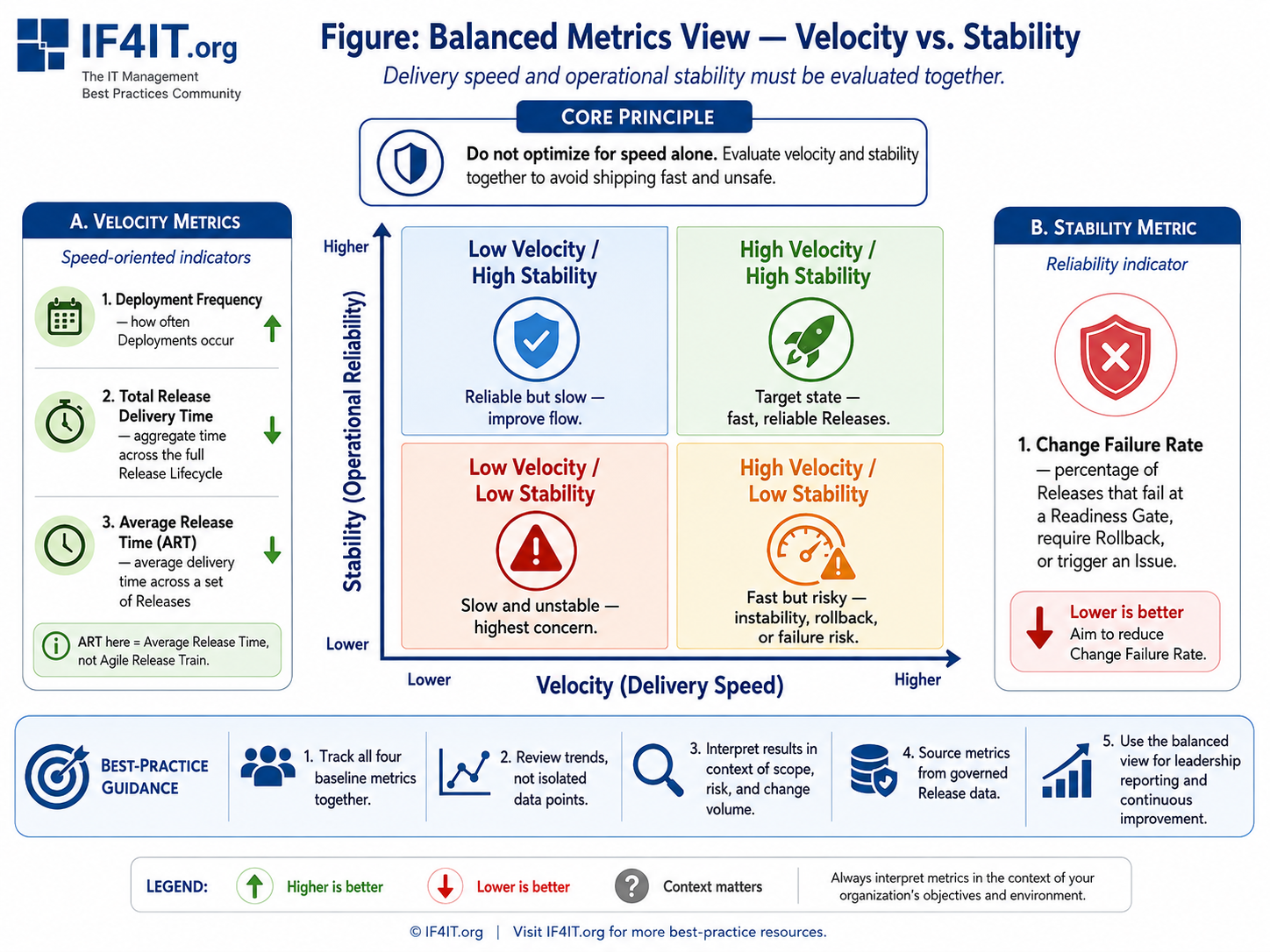
Note: “ART” is used both for Average Release Time in this chapter and for Agile Release Train elsewhere in this document — the two are distinct and should not be confused. Metrics should be sourced from data already captured elsewhere (Readiness Gate records, Deployment outcomes, Release Documentation) rather than separately estimated or manually reconstructed.
This pairing of velocity and stability metrics reflects a widely-cited industry insight from the DORA (DevOps Research and Assessment) research program, associated with Nicole Forsgren, Jez Humble, and Gene Kim’s Accelerate and Google’s ongoing DORA research: high-performing organizations tend to improve delivery speed and system stability together, rather than trading one for the other.
Best Practice
Track all four baseline metrics together, pairing the velocity metrics with the stability metric — never optimize for speed alone.
Benefit(s)
- Prevents a false optimization where velocity improves at the expense of stability; gives leadership a balanced view on the Enterprise Release Dashboard.
Antipattern
Optimizing only for Deployment Frequency or Total Release Delivery Time while ignoring Change Failure Rate — incentivizing teams to ship fast and unsafe.
How to cite this page
When referencing this page in academic work, internal standards, or external publications, include the page title, IF4IT as author and publisher (The International Foundation for Information Technology (IF4IT), LLC), the URL, and your access date.
Example (informal web citation):
The International Foundation for Information Technology (IF4IT), LLC. Release Metrics and Measurements | Release Management Best Practices. https://if4it.org/best-practices/release-management/release-metrics-and-measurements/ (accessed 2026-10-06).
See About Us for content governance and site-wide citation guidance.
Copyright for The International Foundation for Information Technology (IF4IT), LLC: 2008 - Present
Legal Disclaimers