Release Risk Classification - Release Management Best Practices
Release Risk Classification
(Chapter 22 of Release Management Best Practices)
Executive Summary: Chapter Overview
IF4ITThe Bottom Line
Core Concepts
| Concept | Definition & Strategic Role |
|---|---|
| Risk Tiers | Low, Medium, High, optionally Critical. |
| Driving Factors | Seven factors including Asset criticality, Release Type, blast radius. |
| Downstream Governance Impact | What Risk Classification actually controls. |
Quick Q&A
Question: Is Risk Classification a fixed, mandatory scale?
Question: What does Risk Classification actually control?
Read More Below
Overview
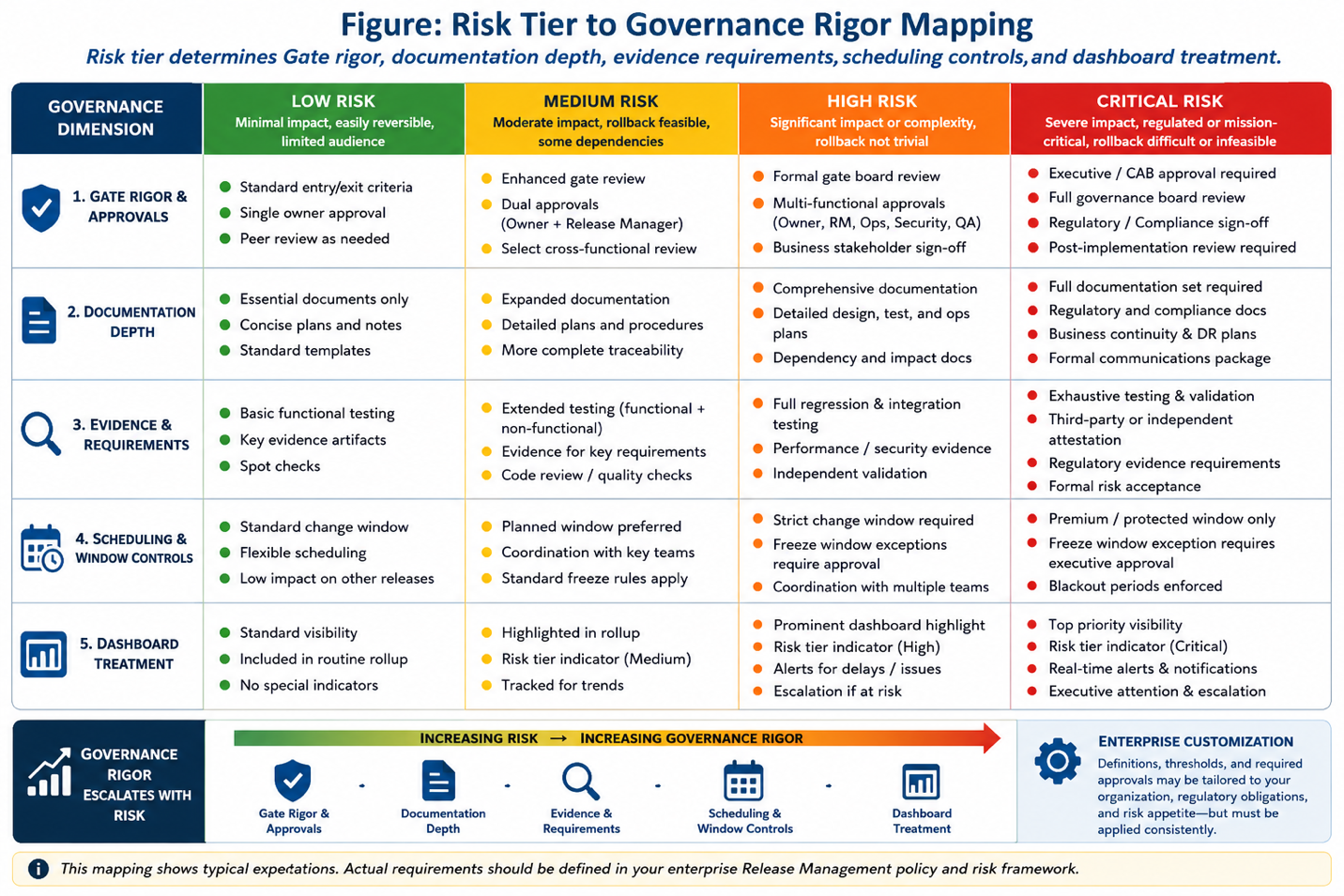
Release Risk Classification uses a recommended, customizable set of tiers — Low, Medium, High, and optionally Critical for regulated/safety-critical cases — driven by factors including: Asset criticality/regulatory exposure; Release Type; blast radius; reversibility/rollback complexity; target Environment; Waterfall vs. Agile context; and Iteration/rejection history. Risk Classification drives which readiness gates and approval rigor apply, how much Documentation/Evidence rigor is required, freeze-window exception eligibility, and how the Release surfaces on the Enterprise Release Dashboard.
First, one must determine the risk…

Once risk is determined, rigor can be determined…
How to cite this page
When referencing this page in academic work, internal standards, or external publications, include the page title, IF4IT as author and publisher (The International Foundation for Information Technology (IF4IT), LLC), the URL, and your access date.
Example (informal web citation):
The International Foundation for Information Technology (IF4IT), LLC. Release Risk Classification | Release Management Best Practices. https://if4it.org/best-practices/release-management/release-risk-classification/ (accessed 2026-10-05).
See About Us for content governance and site-wide citation guidance.
Copyright for The International Foundation for Information Technology (IF4IT), LLC: 2008 - Present
Legal Disclaimers