When a Release's Final Destination Isn't Production — and Why That's Sometimes Correct - Release Management Best Practices
When a Release's Final Destination Isn't Production — and Why That's Sometimes Correct
(Chapter 6 of Release Management Best Practices)
Executive Summary: Chapter Overview
IF4ITThe Bottom Line
Core Concepts
| Concept | Definition & Strategic Role |
|---|---|
| Target Environment | Where a Release is governed to reach. |
| Governed Intent | What determines a Release’s true final destination. |
| Non-Production Final Destination | A legitimate, deliberate end state other than Production. |
Quick Q&A
Question: Does every Release eventually reach Production?
Question: Example of a Release that legitimately never reaches Production?
Read More Below
Overview
A Release’s target Environment is defined by governed intent, not a fixed hierarchy that must always terminate in Production. Most Releases are, in fact, intended to reach Production — but not all of them are, and that is not a governance failure when the Environment is genuinely the Release’s intended home.
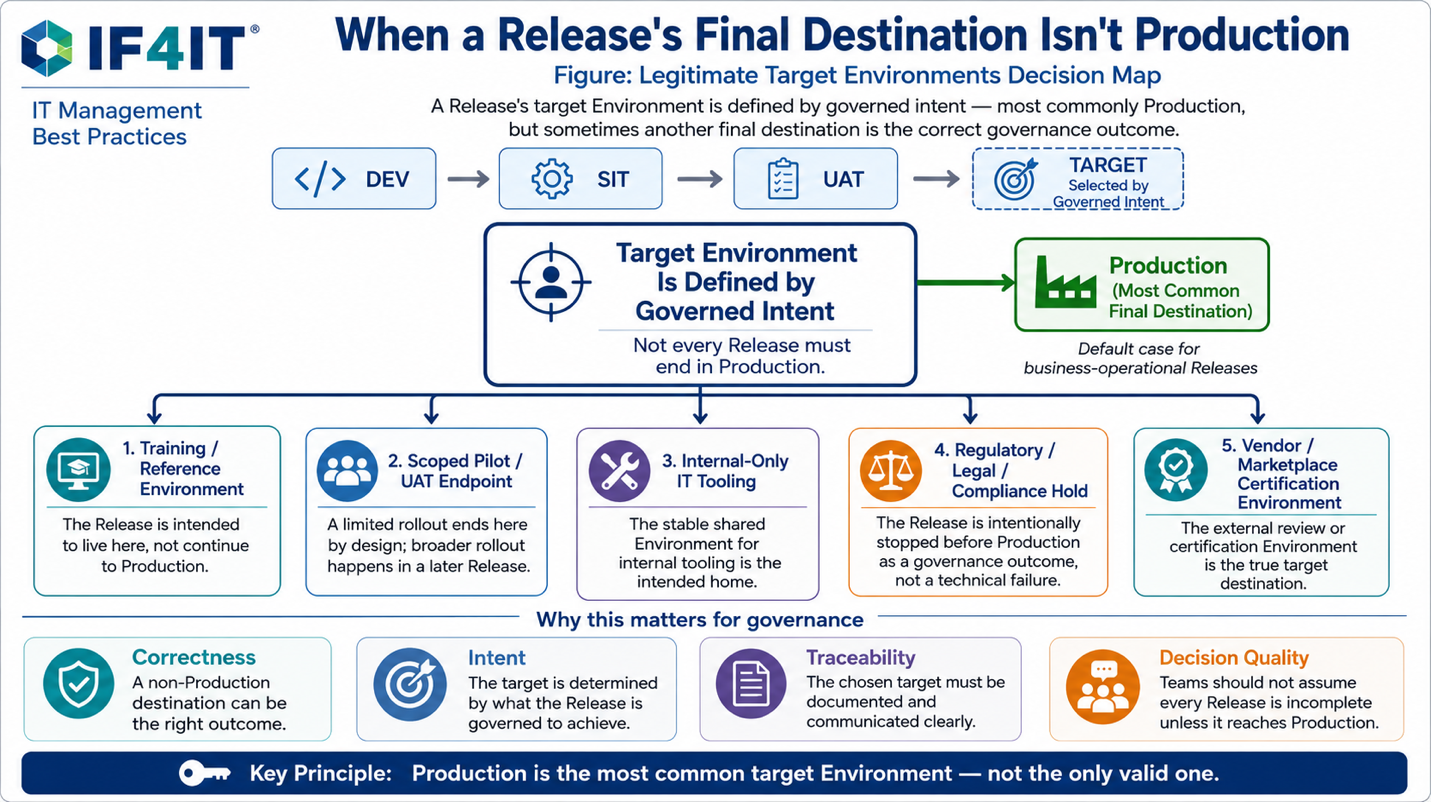
Five cases commonly explain a legitimate non-Production final destination: (1) a training or reference Environment that is the Release’s actual intended home, not a waypoint on the way to Production; (2) a deliberately scoped pilot — for example, stopping at UAT for a phased rollout to a small stakeholder group — completed by design, with full Production rollout handled as a separate, later Release; (3) internal-only IT tooling that never needs Production-grade governance, deployed to a stable shared Environment without the external stakeholder exposure that defines Production; (4) a permanent regulatory, legal, or compliance hold at a pre-Production gate, which disqualifies the Release from Production use in its current form as a governance outcome, not a technical failure; and (5) a vendor or marketplace certification/review Environment as the true target, where the vendor’s own review Environment — not the enterprise’s Production Environment — is the relevant final destination.
How to cite this page
When referencing this page in academic work, internal standards, or external publications, include the page title, IF4IT as author and publisher (The International Foundation for Information Technology (IF4IT), LLC), the URL, and your access date.
Example (informal web citation):
The International Foundation for Information Technology (IF4IT), LLC. When a Release's Final Destination Isn't Production — and Why That's Sometimes Correct | Release Management Best Practices. https://if4it.org/best-practices/release-management/when-a-release-s-final-destination-isn-t-production-and-why-that-s-sometimes-correct/ (accessed 2026-10-05).
See About Us for content governance and site-wide citation guidance.
Copyright for The International Foundation for Information Technology (IF4IT), LLC: 2008 - Present
Legal Disclaimers