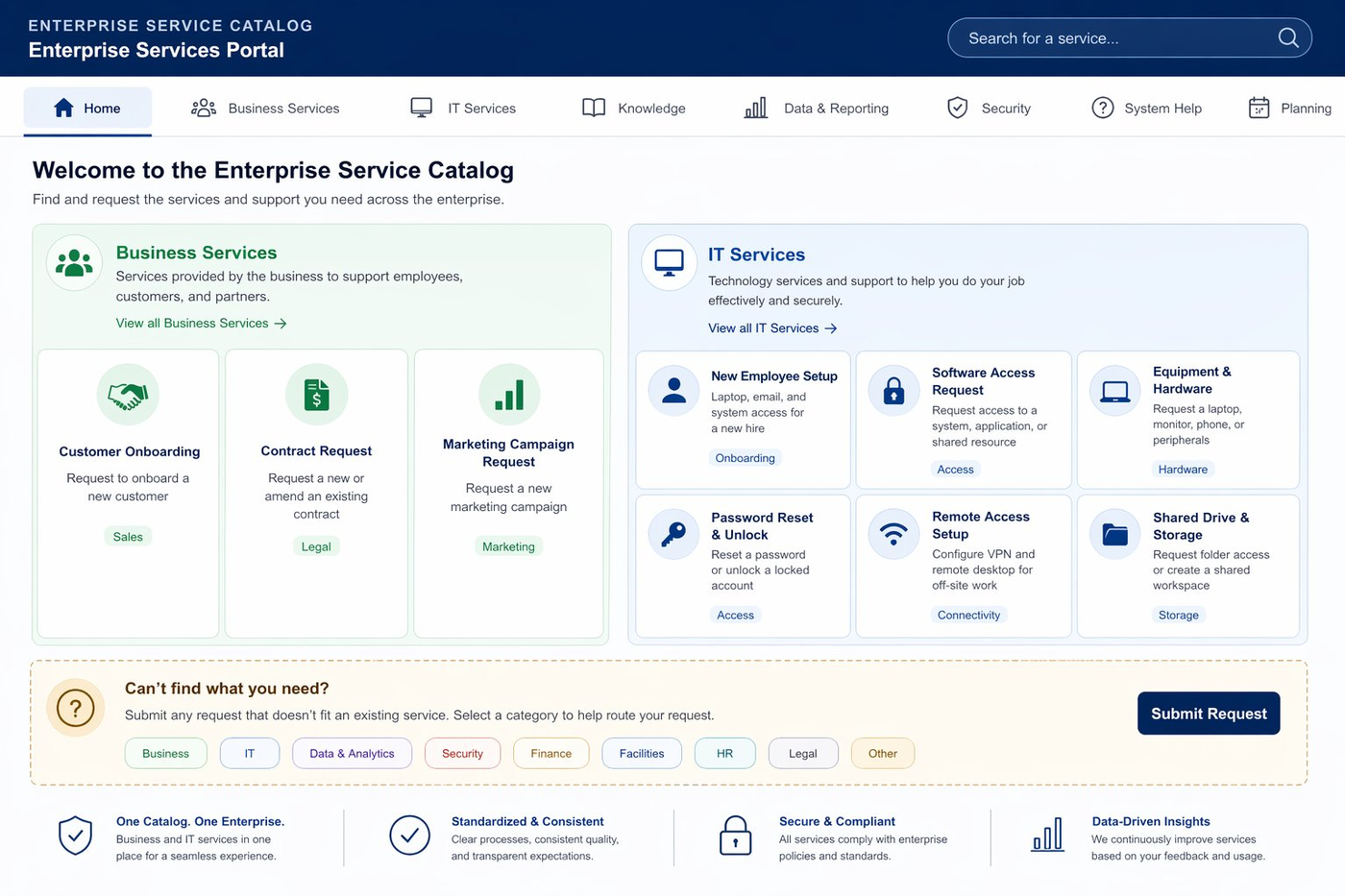
Service Catalog Best Practices
Executive Summary: Document Overview
IF4ITThe Bottom Line
A Service Catalog is the enterprise-facing service publication and request interface that makes services discoverable, understandable, requestable, governable, and continuously improvable across business and technology domains. Organizations that treat the catalog as a simple portal or departmental tool create fragmented entry points, duplicate services, unclear ownership, inconsistent fulfillment, stale service descriptions, and poor visibility into what the enterprise actually delivers. Applying these practices produces a governed Enterprise Service Catalog with clear ownership, business-aligned service definitions, reliable request channels, quality content, lifecycle discipline, metrics, automation, and continuous improvement.
Core Pillars & Document Modules
| Document Pillar / Focus Area | Strategic Business Outcome & Intent |
|---|---|
| Foundation & Strategy | Establishes what a Service Catalog is, how it differs from Service Portfolios and Service Requests, why it must support business goals, and how Business and Technical Service Catalog views serve different audiences without creating separate sources of truth. |
| Governance & Ownership | Creates the accountability model that keeps the catalog trustworthy by defining Catalog Manager responsibilities, Service Owner accountability, service lifecycle controls, ownership review, and governance processes for adding, changing, and retiring services. |
| Structure, Content & Experience | Improves discoverability and usability by organizing services through a clear taxonomy, writing customer-friendly service descriptions, publishing Service Level Agreements (SLAs), supporting search and self-service, and preventing dead ends with catch-all or Other Service options. |
| Integration, Automation & Operations | Connects the catalog to Service Management tooling, approval workflows, fulfillment processes, automation, knowledge content, mobile and accessible experiences, and operational reporting so request initiation flows reliably into delivery. |
| Measurement, Lifecycle & Continuous Improvement | Keeps the catalog current and valuable through review cadence, performance metrics, user feedback, lifecycle states, maturity assessment, AI-assisted improvement, and disciplined retirement of obsolete or duplicate catalog entries. |
Quick Q&A (Macro Executive Reference)
Question: Why is a Service Catalog more than a request portal or ticketing front end?
Answer: A request portal captures demand, but a governed Service Catalog defines what services exist, who owns them, how they are described, how customers request them, what expectations apply, and how the catalog is maintained over time. Without governance, ownership, taxonomy, lifecycle discipline, and content quality controls, the portal becomes another fragmented intake channel rather than a trusted enterprise service interface.
Question: What is the most important governance principle for a successful Enterprise Service Catalog?
Answer: Every cataloged service needs a named Service Owner, a clear service definition, an approved lifecycle state, and alignment to the organization’s broader service governance model. The catalog should expose active, requestable services to customers, while governance ensures that services remain accurate, owned, measurable, searchable, and continuously improved.
Question: How should small, midsized, and large organizations apply these Service Catalog practices?
Answer: Small organizations can start with lightweight ownership, basic service definitions, and a practical request path, while midsized organizations should formalize taxonomy, service ownership, workflows, and catalog governance. Larger enterprises should operate the catalog as an enterprise-scoped asset that integrates with Service Management, automation, knowledge, analytics, lifecycle governance, and continuous improvement across many service domains.
Read Full Table of Contents Below
Table of Contents
Overview and Glossary
Foundation and Strategy
- Design your Service Catalog to be for the broader enterprise
- Align your Service Catalog with business goals, not just technology needs
- Distinguish between the Business Service Catalog and the Technical Service Catalog
- Understand the difference between a Service Catalog, a Service Portfolio, and a Service Request
- Build a business case for your Service Catalog investment
Governance and Ownership
- Define clear Service Catalog ownership
- Define Service Catalog roles and responsibilities
- Establish a governance model for adding, changing, and retiring services
- Assign a named Service Owner to every service in the catalog
- Ensure Service Ownership is always current and never orphaned
- Assign enterprise-scoped ownership of the Service Catalog to a cross-organizational governance function
Structure and Architecture
- Define, use, and maintain a Service Catalog taxonomy
- Implement an Other service as a catch-all
- Define what constitutes a service versus a service request versus an incident
- Use service bundles to group commonly requested combinations
- Separate customer-facing service descriptions from technical fulfillment details
Content and Quality
- Write service descriptions in plain, business-friendly language
- Define and publish SLAs for every service
- Include cost and pricing transparency for every service where applicable
- Provide clear request instructions and expected fulfillment steps for every service
- Keep service content accurate, current, and reviewed on a defined schedule
User Experience and Accessibility
- Design for self-service — minimize friction from discovery to submission
- Make the catalog searchable and browsable with multiple navigation paths
- Design for mobile access — the catalog must be usable on any device
- Design the Service Catalog to be accessible to all users
- Design for global use — address language and localization needs
- Provide user training, onboarding guides, and in-catalog help content
Integration and Automation
- Automate Service Catalog services — fulfillment, approvals, and provisioning
- Consolidate tools and technologies for Service Catalog automation
- Define criteria for selecting Service Catalog tools and technologies
- Integrate the Service Catalog with your service management platform
- Connect the Service Catalog to the Configuration Management Database
- Integrate approval workflows into catalog request fulfillment
Lifecycle Management
- Define and enforce a service lifecycle — Proposed, Active, Deprecated, Retired
- Retire services properly — notify users, redirect requests, remove cleanly
- Establish a periodic review and audit cadence for all catalog entries
Measurement and Improvement
- Understand and use a Service Catalog maturity model to guide improvement
- Define metrics and KPIs for Service Catalog health and usage
- Use catalog usage data to identify service gaps, redundancies, and opportunities
- Collect and act on user feedback about the catalog experience
- Use AI to analyze catalog patterns, flag anomalies, and recommend improvements
Copyright for The International Foundation for Information Technology (IF4IT), LLC: 2008 - Present