Define and enforce a service lifecycle — Proposed, Active, Deprecated, Retired - Service Catalog Best Practices
Define and enforce a service lifecycle — Proposed, Active, Deprecated, Retired
(Chapter 36 of Service Catalog Best Practices)
Executive Summary: Chapter Overview
IF4ITThe Bottom Line
Core Concepts
| Concept | Definition & Strategic Role |
|---|---|
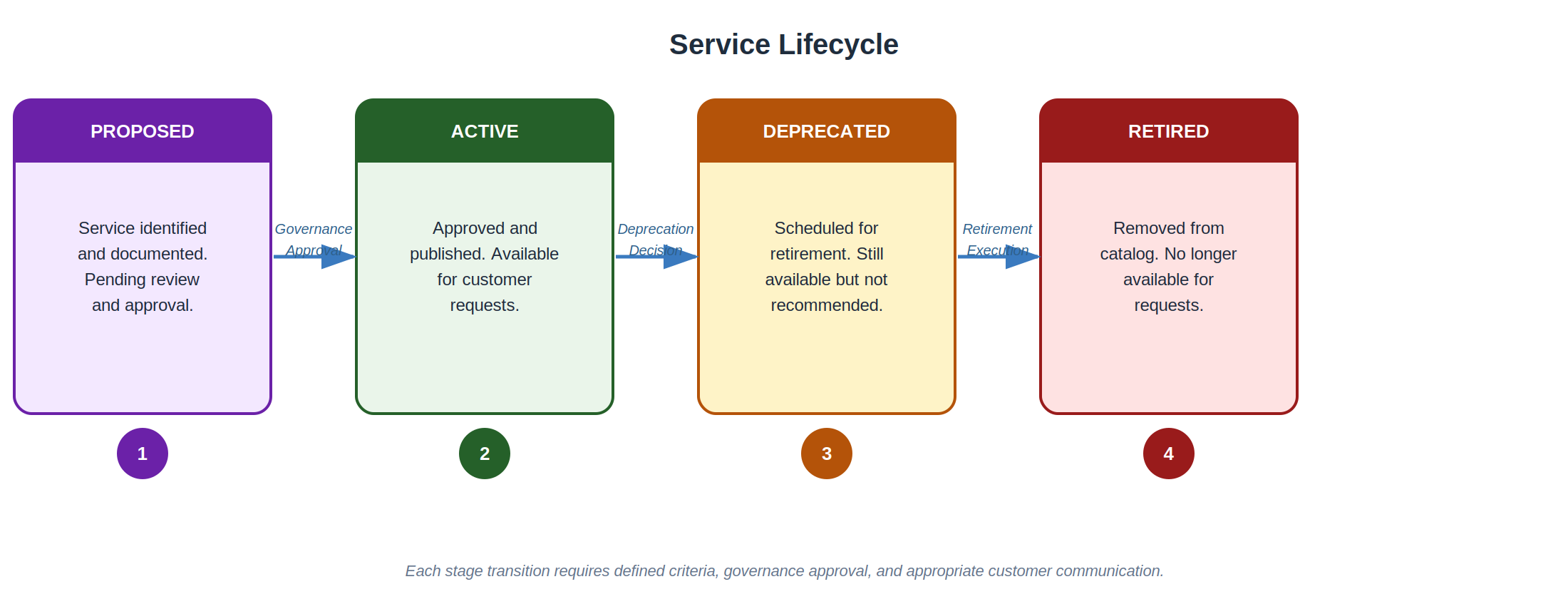
| Four-Stage Lifecycle | Proposed → Active → Deprecated → Retired — with defined criteria for each stage transition. |
| Governance-Approved Transitions | Movement between stages requires explicit approval — the governance model in Chapter 10 is what makes lifecycle enforcement work. |
| Customer Communication | Every transition — especially into Deprecated and Retired — requires customer communication proportional to the impact. |
Quick Q&A
Question: Why four stages rather than three or five?
Question: How does the lifecycle figure inform this chapter?
Read More Below
Overview
Services are not static — they are born, mature, evolve, and eventually reach the end of their useful life. Without a defined lifecycle model, services accumulate in the catalog without discipline: new services are added without proper review, outdated services linger as active entries long after they have stopped being relevant, and the catalog gradually fills with noise that undermines its reliability.
Best Practice
Define and enforce a formal service lifecycle with at least four stages: Proposed (identified but not yet approved), Active (approved, available, and requestable), Deprecated (available but being phased out), and Retired (no longer available and removed from the active catalog).
Each stage transition should have defined criteria and a defined process. Deprecation requires advance notice and a transition plan. Retirement requires clean removal from the catalog and appropriate handling of in-flight requests.
Benefit(s)
A formal service lifecycle gives the organization control over the composition and quality of its Service Catalog. Services enter only when genuinely ready and appropriately documented. Services exit in a controlled way that minimizes disruption to customers. Leadership gains visibility into the pipeline of new services being developed and those being phased out, enabling better planning and resource allocation.
How to cite this page
When referencing this page in academic work, internal standards, or external publications, include the page title, IF4IT as author and publisher (The International Foundation for Information Technology (IF4IT), LLC), the URL, and your access date.
Example (informal web citation):
The International Foundation for Information Technology (IF4IT), LLC. Define and enforce a service lifecycle — Proposed, Active, Deprecated, Retired | Service Catalog Best Practices. https://if4it.org/best-practices/service-catalog/define-and-enforce-a-service-lifecycle-proposed-active-deprecated-retired/ (accessed 2026-09-11).
See About Us for content governance and site-wide citation guidance.
Copyright for The International Foundation for Information Technology (IF4IT), LLC: 2008 - Present
Legal Disclaimers