Define, use, and maintain a Service Catalog taxonomy - Service Catalog Best Practices
Define, use, and maintain a Service Catalog taxonomy
(Chapter 14 of Service Catalog Best Practices)
Executive Summary: Chapter Overview
IF4ITThe Bottom Line
Core Concepts
| Concept | Definition & Strategic Role |
|---|---|
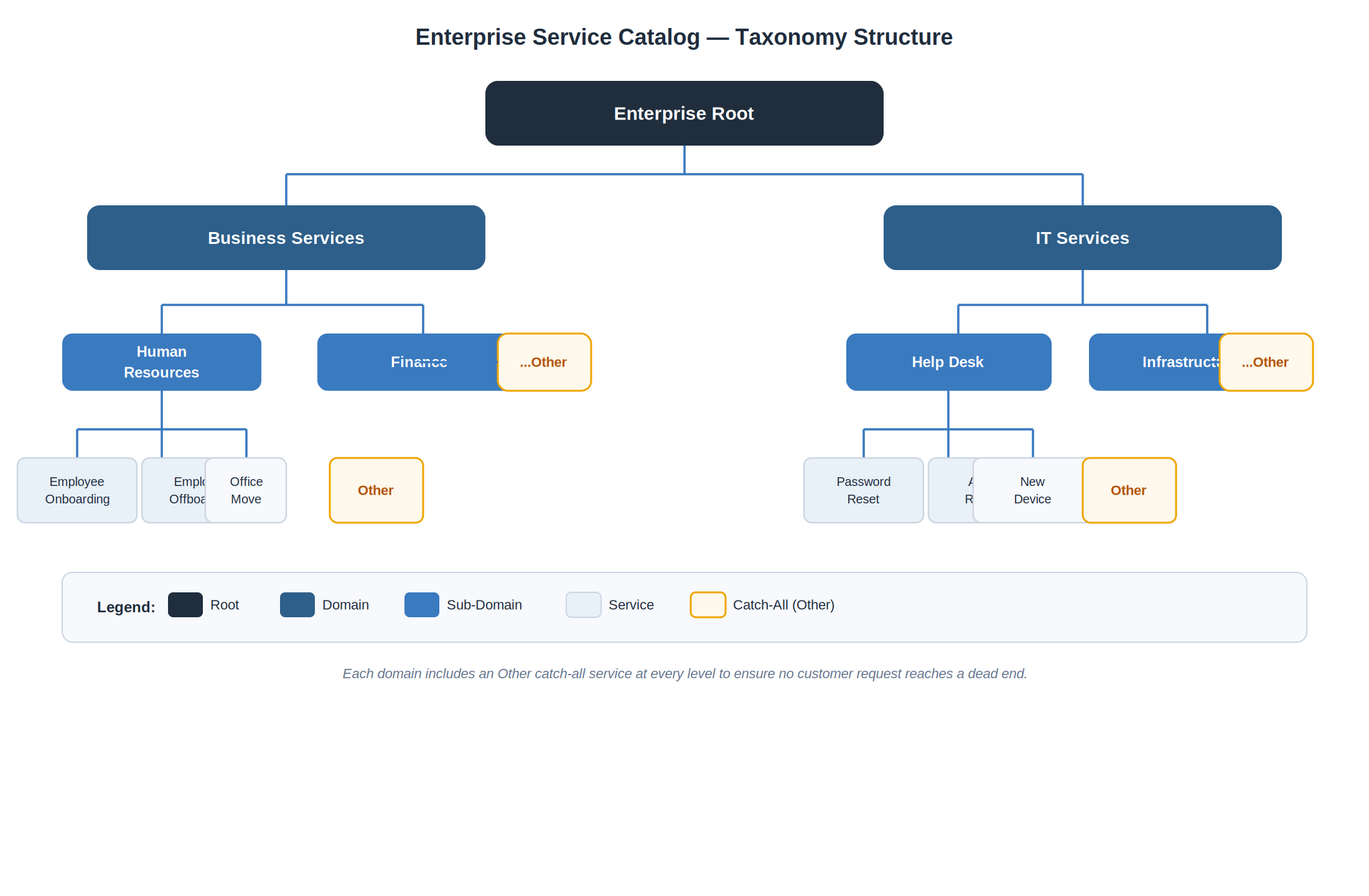
| Hierarchical Structure | Root → Domain → Sub-Domain → Service — with the Enterprise Root splitting first into Business Services and IT Services at the top. |
| Taxonomy Ownership | The Catalog Manager owns the taxonomy as an artifact — proposing changes goes through governance; changing it unilaterally is not permitted. |
| Taxonomy Evolution | The taxonomy is not static — as the enterprise evolves, so should the taxonomy, but through disciplined change management rather than ad hoc reorganization. |
Quick Q&A
Question: Why does the top level of the taxonomy split into Business Services and IT Services?
Question: How deep should the taxonomy go?
Read More Below
Overview
One of the most common problems for Service Management is the fact that enterprise services are disjoint (i.e., disconnected) across different sites. It is common for organizations to have different sites or intranet sub-sites owned by different departments, each with their own services and very different service experiences. The service management tools and technologies behind the services are often different too, creating inconsistency, confusion, poor user experiences, and frustrated customers.
Best Practice
Design, publish, and maintain a Service Catalog Taxonomy as part of your Enterprise Service Catalog.
Benefit(s)
A Service Catalog taxonomy:
Allows the design and coordination of how services are linked together and acts as a sitemap that leads customers to each service area and its underlying services.
Improves search experience, allowing for rapid and consistent indexing and searching.
Allows for easier automation — a taxonomy can be fed to an API generator that creates all APIs as stubs to be populated with backend automation code.
Service Catalog Taxonomy Example
/enterprise-root

/enterprise-root/business

/enterprise-root/business/other

/enterprise-root/business/human-resources

/enterprise-root/business/human-resources/services

/enterprise-root/business/human-resources/services/employee-onboarding

/enterprise-root/business/human-resources/services/employee-offboarding

/enterprise-root/business/human-resources/services/employee-office-move

/enterprise-root/business/human-resources/services/other

/enterprise-root/business/etc...

/enterprise-root/information-technology

/enterprise-root/information-technology/other

/enterprise-root/information-technology/helpdesk

/enterprise-root/information-technology/helpdesk/services

/enterprise-root/information-technology/helpdesk/services/change-password

/enterprise-root/information-technology/helpdesk/services/other

/enterprise-root/information-technology/etc...
How to cite this page
When referencing this page in academic work, internal standards, or external publications, include the page title, IF4IT as author and publisher (The International Foundation for Information Technology (IF4IT), LLC), the URL, and your access date.
Example (informal web citation):
The International Foundation for Information Technology (IF4IT), LLC. Define, use, and maintain a Service Catalog taxonomy | Service Catalog Best Practices. https://if4it.org/best-practices/service-catalog/define-use-and-maintain-a-service-catalog-taxonomy/ (accessed 2026-09-11).
See About Us for content governance and site-wide citation guidance.
Copyright for The International Foundation for Information Technology (IF4IT), LLC: 2008 - Present
Legal Disclaimers