Service Management Best Practices
Executive Summary: Document Overview
IF4ITThe Bottom Line
Service Management is not a ticketing tool or a help desk queue; it is the enterprise discipline for defining, owning, exposing, fulfilling, measuring, governing, and improving services as managed value-delivery assets. When organizations ignore that discipline, services become unclear, ownerless, duplicative, reactive, costly, difficult to govern, and hard for customers to discover or trust. An optimized Service Management capability gives leaders, Service Owners, Service Desks, and customers a practical operating model for clear service definitions, reliable fulfillment, accountable governance, portfolio visibility, evidence-based improvement, and scalable Crawl / Walk / Run adoption.
Core Pillars & Document Modules
| Document Pillar | Strategic Business Outcome |
|---|---|
| Service Definition and Architecture | Establishes a shared operating model for what counts as a service, how services are exposed, and how requesters, providers, records, outcomes, and expectations fit together. |
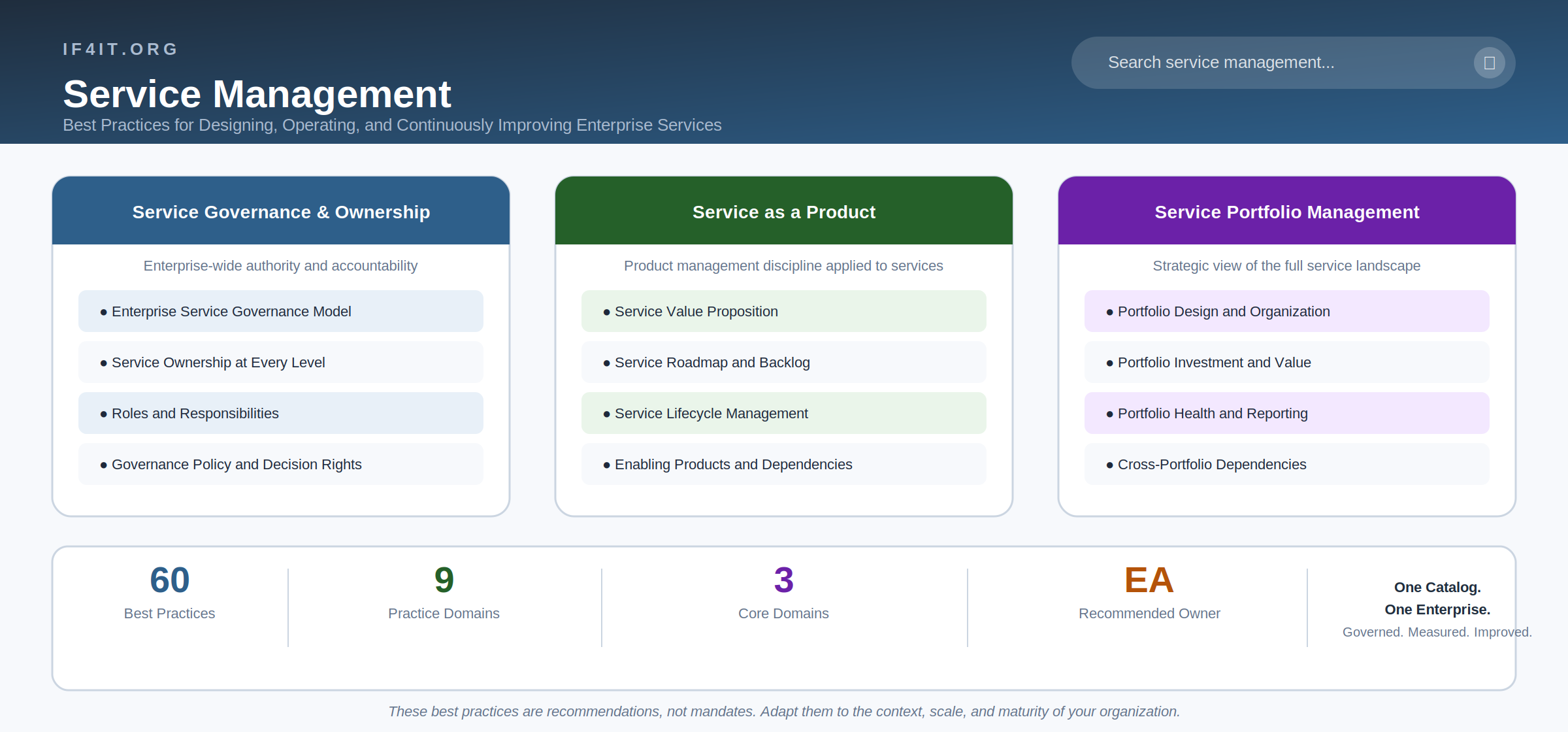
| Service Governance and Ownership | Creates accountable decision rights, current ownership, policy discipline, and evidence so services remain controlled rather than informal or orphaned. |
| Service as a Product and Portfolio | Treats services as value-delivery assets with customers, roadmaps, backlogs, dependencies, investment choices, and lifecycle states that leaders can manage deliberately. |
| Operations, Measurement, and Automation | Improves intake, routing, fulfillment, approvals, communication, knowledge, metrics, AI, and automation so service work becomes repeatable, transparent, and scalable. |
| Continuous Improvement and Adoption | Uses feedback, performance data, maturity models, implementation guidance, and practical Crawl / Walk / Run sequencing to improve Service Management without overengineering it. |
Quick Q&A (Macro Executive Reference)
Question: What is Service Management if it is not just a Help Desk or Ticketing System?
Answer: It is the broader management discipline that defines services, assigns ownership, governs service lifecycles, controls how work is requested and fulfilled, measures performance, and improves service value across the enterprise.
Question: What is the first practical milestone for improving Service Management?
Answer: Start by defining a small set of real services with clear owners, Service Details, request paths, Service Records or tickets, expected outcomes, and a lightweight review cadence before expanding into catalogs, portfolios, automation, and advanced reporting.
Question: Who should own and fund Service Management improvement?
Answer: Executive sponsors should fund it as an operating capability, while Service Owners, Portfolio Owners, Service Desk leaders, enterprise architects, and governance teams share accountability for design, adoption, measurement, and continuous improvement.
Read Full Table of Contents Below
Table of Contents
Overview and Glossary
Foundation and Strategy
- Define what a service is and what it is not
- Strive to design and implement reusable atomic services
- Design a Service Management Architecture
- Position the Service Desk or Help Desk as a Service Management operating function
- Design service discovery around the needs of the Service Requester
- Publish clear Service Details for every requestable or consumable service
- Manage Service Records as governed records of request, action, status, evidence, and outcome
- Register every governed service in the enterprise Services Inventory
- Distinguish the Service Management system of record from the Service Catalog and engagement channels
- Define fulfillment responsibilities for every Service Provider and Service Actor
- Define what completion means for every Service Outcome and Service Response
- Understand the composition of Service Expectations
- Understand the relationship between a Service, a Service Request, and an Incident
- Understand the relationship between a Service Catalog, Service Portfolios, Service Requests, and the Service Pipeline
- Align service delivery with organizational goals and priorities
- Establish a shared service management vision across business and technology
- Define the boundaries between business services and technology services
- Treat every service as a value delivery mechanism for a defined customer
- Build a business case for your Service Management investment
- Understand the relationship between Service Management and enterprise risk management
- Establish a governed Service Catalog as the operational front door to Service Management
Service Governance and Ownership
- Establish an enterprise-wide service governance model
- Define clear service ownership at every level
- Scale Service Management from individual services to Service Groups and Service Portfolios
- Define service management roles and responsibilities
- Ensure service ownership is always current and never orphaned
- Establish a service governance policy that defines authority, accountability, and decision rights
- Design for federated service management — balance centralized governance with distributed ownership
- Centralize Service Management capabilities to eliminate redundancies and waste
- Manage service management compliance in regulated industries
- Publish and communicate service ownership across the organization
- Establish a governance model for adding, changing, and retiring services
- Assign enterprise-scoped ownership of enterprise-spanning services and tools to a cross-organizational governance function
Service as a Product
- Treat every service as a managed product
- Assign a Product Owner to every service
- Define a value proposition for every service
- Identify and understand the customer segment for every service
- Define and maintain a service roadmap
- Manage service evolution through a backlog of improvements
- Treat the Service Catalog itself as a managed product
- Balance service investment against delivered customer value
- Understand that services rely on products and technologies for their enablement
- Manage service dependencies on enabling products and technologies
- Distinguish between the service and the tools that enable it
Service Lifecycle Management
- Manage the lifecycle of services from introduction through retirement
- Define and enforce a service lifecycle
- Define clear entry criteria for each lifecycle stage
- Manage service transitions with governance approval and customer communication
- Retire services properly — notify customers, redirect requests, remove cleanly
- Manage in-flight requests during service retirement
- Maintain a service pipeline of proposed and in-development services
- Distinguish between the Service Catalog and the Service Pipeline
Service Portfolio Management
- Define what a Service Portfolio is and what it contains
- Organize services into portfolios by service area and ownership
- Assign a Portfolio Owner accountable for portfolio health and strategy
- Align portfolio composition with business strategy and priorities
- Manage portfolio-level investment, cost, and value
- Balance the portfolio across active, deprecated, and proposed services
- Report on portfolio health and performance to leadership
- Use the portfolio to identify service gaps, overlaps, and redundancies
- Manage relationships and dependencies between portfolios
Governance and Organizational Alignment
- Align Service Management practices to business capabilities and organizational responsibilities
- Align Service Management with product, application, platform, and vendor responsibilities
- Govern service costs, value, demand, and investment decisions
- Manage vendor and third-party participation in service delivery
- Manage service risk, compliance, and regulatory obligations
- Define service governance roles and decision rights
- Coordinate Service Management with change, problem, incident, and project work
- Maintain service data quality across records, catalogs, reports, and inventories
- Manage service training, adoption, and stakeholder readiness
- Manage services as governed enterprise assets
- Establish a practical Service Management governance cadence
- Keep Service Management practical, scalable, and fit for purpose
Customer and Demand Management
- Know your service customers and understand their needs
- Manage service demand proactively — anticipate, not just react
- Collect and act on customer feedback about service experience
- Communicate service changes, additions, and retirements to customers proactively
- Build a customer-centric culture around service delivery
Service Operations and Delivery
- Define and manage standard service intake
- Classify, prioritize, and route service work consistently
- Manage service fulfillment from assignment through closure
- Manage service queues and backlogs deliberately
- Manage approvals, authorizations, and exceptions for service work
- Communicate service status, progress, and outcomes clearly
- Measure and report service performance using meaningful metrics
- Use knowledge articles and standard procedures to support repeatable service delivery
- Use automation and AI carefully to improve service delivery
- Centralize and govern Service automation capabilities
- Protect service quality with controls, validation, and auditability
- Use service reviews to drive continuous improvement
Service Performance and Measurement
- Define metrics and KPIs for every service
- Define and publish SLAs for every service
- Monitor service performance against defined SLAs
- Include cost and pricing transparency for every service where applicable
- Use service performance data to drive continuous improvement
- Report service performance to stakeholders at appropriate levels of detail
Continuous Improvement
- Establish a formal continuous improvement process for service management
- Use data and feedback to identify improvement opportunities
- Prioritize improvement efforts by customer impact and organizational value
- Use AI to analyze service patterns, detect anomalies, and recommend improvements
- Understand and use a Service Management maturity model to guide capability development
- Build a culture of continuous improvement across service teams
Implementation Guidance and Pitfalls
Copyright for The International Foundation for Information Technology (IF4IT), LLC: 2008 - Present