Service Management Best Practices - Design a Service Management Architecture
Service Management Best Practices
Chapter 5. Design a Service Management Architecture
Executive Summary: Chapter Overview
IF4ITThe Bottom Line
Core Concepts
| Concept | Definition & Strategic Role |
|---|---|
| Core Architecture Components | Distinguishes the Service Desk or Help Desk, Service Request Management Application or Ticketing System, Service Catalog or Service Facade, Services Inventory, Service Engagement Channels, fulfillment teams, records, and governance routines. |
| Architectural Progression | Supports a practical path from direct Help Desk intake, to a single governed Service Catalog facade, to multiple governed facades backed by a common Services Inventory and Service Portfolio hierarchy. |
| Conceptual Separation | Prevents organizations from treating the catalog as the Ticketing System, the ticket as the service, the Service Desk as the owner of all services, or a portal as the authoritative Services Inventory. |
Quick Q&A
Question: What Service Management problem does designing a Service Management Architecture solve?
Question: How should teams make the architecture operational?
Read More Below
Overview
A Service Management Architecture is the operating design that explains how services are defined, exposed, requested, fulfilled, tracked, measured, governed, and improved (i.e., matured). It is not only a tool architecture. It includes the people, roles, processes, records, systems, engagement channels, data, controls, reports, and governance routines needed to manage services consistently.
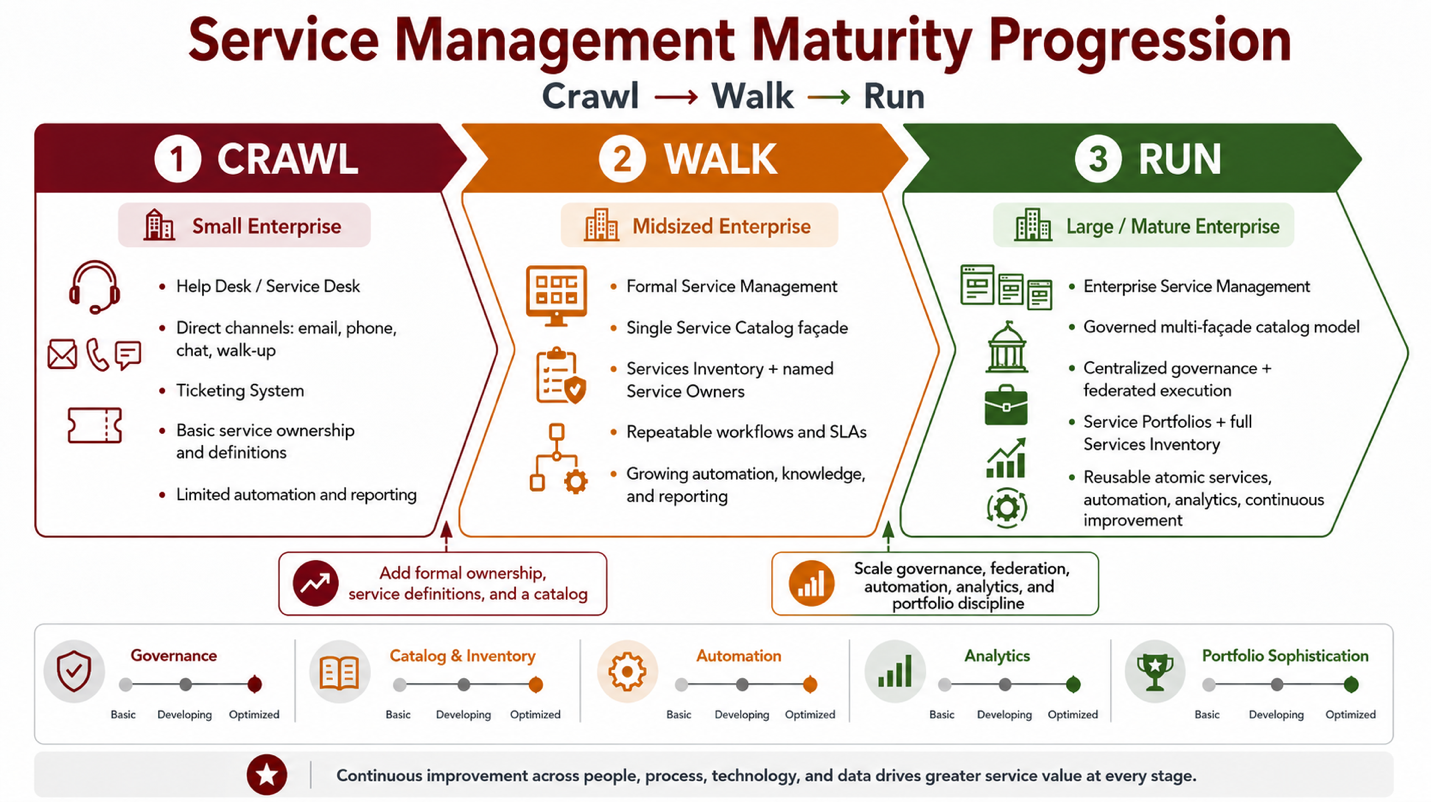
Figure: Service Management Maturity Progression — Crawl → Walk → Run. This figure shows how Service Management typically matures from a Small Enterprise operating model to a Midsized Enterprise model and then to a Large / Mature Enterprise model. Governance, catalog, inventory discipline, automation, analytics, and portfolio sophistication should improve progressively across all three stages.
A good Service Management Architecture connects the major elements of Service Management into a coherent operating model. It shows how Service Requesters discover and engage services; how Service Catalogs, Service Facades, and Service Engagement Channels expose those services; how Service Requests are created; how Service Records or Tickets are captured and managed; how Service Providers and Service Actors perform fulfillment work; how Service Owners define expectations and govern quality; how Service Outcomes and Service Responses are delivered; and how service performance is measured, reviewed, and improved over time.
This architecture is especially important because many organizations begin Service Management by implementing a Help Desk, Service Desk, ticketing system, request form, workflow tool, or Service Catalog. Those tools can be useful, but they do not by themselves create a complete Service Management capability. Without an architecture, the organization may end up with disconnected queues, inconsistent intake, unclear service ownership, incomplete tickets, duplicate request paths, weak reporting, and tool decisions that are difficult to scale.
The architecture should explicitly distinguish three common components that organizations often collapse into one tool-centric idea: the Service Desk or Help Desk performs, coordinates, and communicates service work; the Service Request Management Application or Ticketing System records, routes, tracks, updates, and reports individual work items; and the Service Catalog or Service Facade publishes approved services and initiates request or consumption paths. These components may be packaged in one vendor platform or distributed across several systems, but their architectural responsibilities remain distinct.
A Service Management Architecture should be practical and scalable. A small organization may begin with a basic service list, a shared intake channel, a simple Ticketing System, named service owners, and a regular review of open and closed tickets. A mid-sized organization may add a more formal Service Desk, Service Catalog, standardized request forms, routing rules, knowledge articles, service metrics, and defined governance routines. A larger enterprise may extend the architecture into integrated Service Portfolios, automation, AI-assisted intake, multiple engagement channels, formal service reviews, risk controls, compliance evidence, and portfolio-level reporting.
This progression can be understood as an architectural maturity path: a small organization may operate well with direct Help Desk or Service Desk intake and a Ticketing System but no formal Service Catalog; a growing organization may add a single governed Service Catalog facade; and a larger enterprise may use multiple governed facades for different requester communities. In all cases, governance should remain anchored in the enterprise Services Inventory, Service Portfolio hierarchy, clear ownership, and consistent recordkeeping.
The goal is not to overengineer the architecture before the organization needs it. The goal is to define enough structure to make service work visible, repeatable, accountable, measurable, governable, and improvable. A well-designed architecture allows an organization to start simply, mature deliberately, and scale responsibly.
The figure below represents a more mature architecture in which service discovery is supported by a Service Catalog or Service Facade. Earlier-stage Service Management implementations may operate without that layer, relying instead on Help Desk or Service Desk intake and a Ticketing System as the initial architectural foundation.
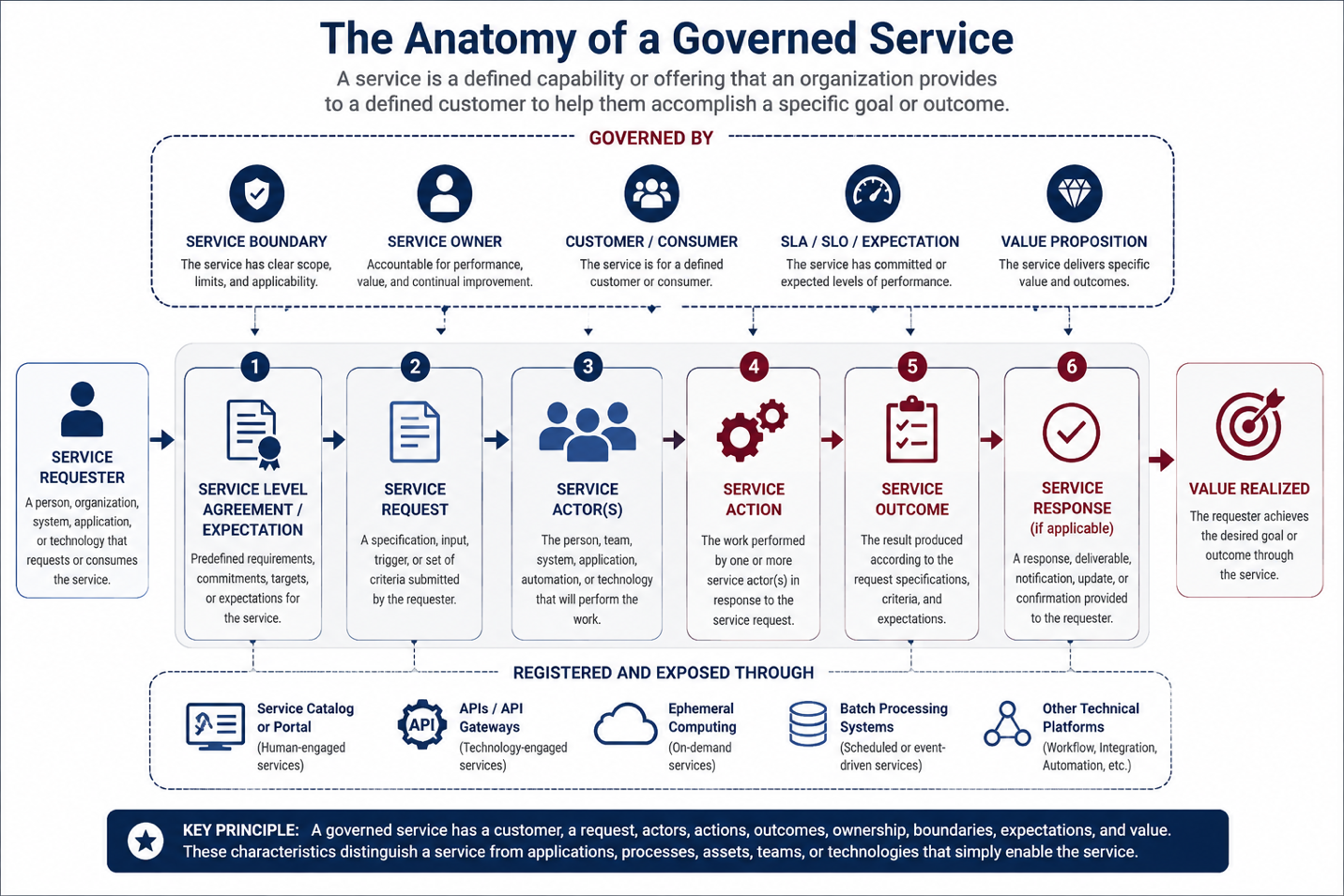
Figure: Example of a scalable Service Management Conceptual Architecture that includes a single Service and that is the foundation for scaling into multi-service portfolios (i.e., Service Portfolios).
Best Practice
Design the Service Management Architecture before implementing or expanding Service Management tools.
Before selecting, configuring, or expanding a Help Desk tool, Service Desk platform, Ticketing System, Service Catalog, workflow tool, automation platform, or reporting solution, define the operating architecture those tools are expected to support. The architecture should explain what the organization means by a service, how services will be discovered, how requests will be submitted, how Service Records or Tickets will be created, how fulfillment work will be assigned and performed, how status will be communicated, how outcomes will be confirmed, and how performance will be measured.
This does not require a large or complex architecture document. For a small organization, the architecture may be a simple diagram, a service list, a few ownership rules, standard intake paths, and basic ticket status definitions. For a larger organization, it may include more formal architectural views, system integrations, service taxonomies, portfolio structures, governance roles, data standards, automation patterns, and reporting models.
The important point is that tool decisions should support the Service Management operating model. The organization should not allow the tool to become the operating model by default.
Benefit(s)
Designing the architecture before implementing tools helps prevent tool-first Service Management. It reduces the risk of buying or configuring platforms that create disconnected queues, confusing request paths, inconsistent tickets, weak ownership, poor reporting, or expensive rework.
This approach also helps IT Management make better investment decisions. It clarifies which capabilities are needed now, which can be deferred, and which should be designed for future scale. It allows the organization to start with practical Help Desk, Service Desk, and Ticketing System capabilities while preserving a path toward more mature Service Catalog, Service Portfolio, automation, reporting, governance, and continuous improvement capabilities.
Best Practice
Define the core Service Management architectural components and how they relate to each other.
A Service Management Architecture should identify the major components needed to operate services consistently. These components may vary by organization, but the core architecture should usually include:
Service Requesters, customers, consumers, or stakeholders who need to discover, request, invoke, consume, or receive support for services.
Service Definitions that describe what each service is, what it is not, who it serves, what value it provides, who owns it, and what outcomes are expected.
Service Catalogs, Service Facades, and Service Engagement Channels that allow requesters or consumers to find, understand, request, invoke, or consume services.
Service Requests that initiate service work through a request, trigger, form, instruction, event, input, or other defined starting point.
Service Records or Tickets that capture, route, assign, track, update, evidence, report, and close the work associated with requests, incidents, tasks, approvals, fulfillment activities, or other service interactions.
Service Providers and Service Actors that perform, route, approve, coordinate, automate, escalate, communicate, validate, or complete service work.
Service Owners and Service Managers that define, govern, operate, measure, review, and improve services.
Service Expectations that describe the indicators, objectives, agreements, response expectations, fulfillment expectations, quality expectations, and communication expectations that apply to the service.
Service Outcomes and Service Responses that define what is delivered, completed, restored, changed, communicated, or confirmed when service work reaches a defined state.
Service Reports, dashboards, reviews, and governance routines that allow the organization to understand demand, performance, quality, risk, cost, value, backlog, improvement opportunities, and service health.
These components do not all need to be implemented in separate tools. A small organization may manage several of them in one Ticketing System, spreadsheet, intranet page, or shared operating routine. A larger organization may implement them across multiple integrated platforms. What matters is that the organization understands which component performs which responsibility and where the authoritative record or decision resides.
Benefit(s)
Defining the core architectural components gives IT Management a clear operating map for Service Management. It helps leaders and practitioners understand how service work flows from discovery and intake through fulfillment, recordkeeping, reporting, governance, and improvement.
This clarity improves service ownership, requester experience, routing, ticket quality, fulfillment consistency, auditability, reporting accuracy, and operational control. It also reduces confusion between related but different concepts, such as the Service Catalog, Ticketing System, Service Record, Service Request, Service Desk, Service Owner, and Service Provider.
Best Practice
Use the architecture to separate requester experience, service recordkeeping, fulfillment, and governance responsibilities.
A strong Service Management Architecture distinguishes between the front-end experience used by requesters, the system of record used to manage work, the fulfillment mechanisms used to perform work, and the governance routines used to manage quality and improvement.
For example, a requester may find a service through an intranet page, Service Catalog, chatbot, email address, phone number, or departmental portal. The resulting work may be captured as a Ticket or Service Record in a Ticketing System or Service Request Management Application. Fulfillment may be performed by a Service Desk analyst, application team, infrastructure team, business operations team, vendor, automation workflow, or API. Governance may be performed through service reviews, performance reports, backlog reviews, risk reviews, or portfolio decisions.
These responsibilities may be connected through one tool or distributed across many tools. The requester does not need to understand the internal architecture, but the organization does. Service Owners, Service Managers, Catalog Managers, platform owners, Service Providers, and Service Actors should understand where services are exposed, where records are captured, where work is performed, where evidence is stored, and where performance is reported.
Benefit(s)
Separating requester experience, recordkeeping, fulfillment, and governance responsibilities makes Service Management easier to design, operate, scale, and improve. It helps prevent common problems such as treating the Service Catalog as the Ticketing System, treating the ticket as the service, treating the Help Desk as the owner of every service, or assuming that a tool implementation automatically creates Service Management maturity.
This separation also improves architecture decisions. It allows the organization to improve the requester experience without weakening operational records, automate fulfillment without losing auditability, distribute service discovery without creating conflicting request paths, and govern services without forcing every service into the same interaction model.
Best Practice
Right-size the Service Management Architecture using a Crawl -> Walk -> Run maturity path.
A Service Management Architecture should be scalable, but it should not force every organization to start with large-enterprise complexity. The architecture should support a practical Crawl -> Walk -> Run path that allows the organization to implement the minimum useful structure first and then mature as service demand, complexity, risk, and governance needs increase.
At the Crawl stage, an organization may define a small set of high-value services, assign clear owners, publish basic Service Details, establish one or more approved intake channels, capture work in a simple Ticketing System or tracking mechanism, use consistent status values, and review service work periodically.
At the Walk stage, the organization may expand into a more formal Service Desk or Help Desk operating model, standard request forms, improved routing, knowledge articles, Service Groups, response and fulfillment expectations, queue management, service metrics, and regular service reviews.
At the Run stage, the organization may implement integrated Service Catalogs, multiple governed Service Engagement Channels, automated routing and fulfillment, AI-assisted intake and knowledge support, formal Service Portfolios, portfolio-level reporting, advanced governance, compliance evidence, cost and value management, and continuous improvement routines across the enterprise.
The same architectural concepts apply at each stage. What changes is the level of formality, automation, integration, governance, and scale.
Benefit(s)
A Crawl -> Walk -> Run architecture helps organizations improve Service Management without creating unnecessary bureaucracy. It makes the guidance practical for small organizations, useful for mid-sized organizations, and scalable for large enterprises.
This approach helps IT Management prioritize the next most valuable improvement instead of attempting a disruptive big-bang implementation. It supports steady maturity by allowing the organization to add structure, tooling, automation, reporting, and governance only when they create real operational or business value.
Best Practice
Use the Service Management Architecture as a living reference for future service, tool, and governance decisions.
The Service Management Architecture should not be created once and then ignored. It should be used as a reference when introducing new services, changing intake channels, configuring the Ticketing System, improving the Service Catalog, adding automation, adopting AI, changing fulfillment responsibilities, integrating tools, designing reports, or governing Service Portfolios.
As services evolve, the architecture should be reviewed and adjusted. New service types may require new engagement channels. Higher request volume may require better routing, automation, or queue management. Regulatory obligations may require stronger evidence capture. Poor ticket quality may require better Service Details, request forms, or status rules. Repeated escalations may reveal unclear ownership or weak fulfillment design.
The architecture should help the organization ask practical questions: Where should this service be exposed? Who owns it? How will it be requested or invoked? What record will capture the work? Who performs fulfillment? What outcome is expected? What evidence is required? How will performance be measured? How will the service be reviewed and improved?
Organizations that want to connect services to applications, capabilities, data, vendors, locations, risks, and other enterprise entities can also use The IF4IT Enterprise Model and Modeling Best Practices as a broader modeling reference.
Benefit(s)
Using the architecture as a living reference helps Service Management remain coherent as the organization changes. It prevents service growth, tool expansion, automation, and governance requirements from becoming fragmented or inconsistent.
This improves long-term scalability, operational control, requester experience, reporting quality, and service governance. It also gives IT Management a practical decision framework for balancing simplicity, maturity, cost, risk, value, and continuous improvement.
How to cite this page
When referencing this page in academic work, internal standards, or external publications, include the page title, IF4IT as author and publisher (The International Foundation for Information Technology (IF4IT), LLC), the URL, and your access date.
Example (informal web citation):
The International Foundation for Information Technology (IF4IT), LLC. Design a Service Management Architecture | Service Management Best Practices. https://if4it.org/best-practices/service-management/design-a-service-management-architecture/ (accessed 2026-07-28).
See About Us for content governance and site-wide citation guidance.
Copyright for The International Foundation for Information Technology (IF4IT), LLC: 2008 - Present
Legal Disclaimers