Overview - Service Management Best Practices
Overview
(Chapter 1 of Service Management Best Practices)
Executive Summary: Chapter Overview
IF4ITThe Bottom Line
Core Concepts
| Concept | Definition & Strategic Role |
|---|---|
| Service Management | Treats services as managed assets with defined customers, owners, expectations, records, outcomes, and improvement routines. |
| Repeatability | Makes service delivery consistent enough to be governed, measured, improved, and scaled. |
| Practical Scalability | Allows organizations to start simply and add formality, tooling, automation, and reporting as maturity increases. |
Quick Q&A
Question: What should readers understand before using these Service Management best practices?
Question: What adoption path should organizations use for the overall Service Management guidance?
Read More Below
What Is Service Management?
Service Management, often first experienced through a Help Desk or Service Desk, is the professional discipline of designing, delivering, governing, and continuously improving services in a way that consistently delivers value to customers. It is not a tool, a platform, or a software product — it is a way of thinking about and operating the service capabilities of an enterprise. At its core, Service Management treats every service as a managed asset: something with a defined purpose, a defined customer, a defined owner, and a defined lifecycle.
In many small and midsized organizations, Service Management is first experienced through what people already call the Help Desk, Service Desk, Support Desk, or Ticketing System. In this document, Help Desk and Service Desk are treated as closely related practical terms, and in many organizations they are used interchangeably. The Help Desk or Service Desk is often the visible operating function through which requests are received, Tickets are created, work is routed, status is communicated, incidents are resolved, and services are fulfilled. Service Management is the broader discipline that helps that practical operating function become more consistent, measurable, governable, and improvable over time.
This progression is intentional. Early-stage Service Management may operate without a separate, formal Service Catalog; requesters may engage the Help Desk or Service Desk directly through phone, email, chat, forms, or a basic support portal, while the Ticketing System becomes the first system of record. As the organization matures, a Service Catalog or Service Facade can be added to improve discovery, Service Details, intake consistency, reporting, and governance.
The discipline of Service Management answers a fundamental organizational question: how does an enterprise ensure that its services are designed well, delivered consistently, governed accountably, and improved continuously? Without Service Management, services emerge ad hoc, ownership is unclear, performance is unmeasured, and the organization has no coherent view of what it offers, to whom, or at what cost.
Scope of Services Covered by This Document
This document focuses on managed services that can be requested, engaged, fulfilled, tracked, measured, governed, and improved through a Service Management operating model. In this context, a service is a defined offering or capability that has a Service Requester, Service Owner, Service Provider or Service Actor, Service Request or trigger, Service Action, Service Record, Service Outcome, Service Response, and Service Expectations.
The primary scope is not every technical use of the word service. This document does not primarily address software services coded inside applications, microservices, internal application components, cloud-provider technical services, infrastructure primitives, platform services, or APIs merely because they are technically called services. Those constructs may be important enabling assets, dependencies, or technology capabilities, but they are not the main subject of this document unless they are exposed and governed as requestable, invokable, consumable, measurable services under a Service Management model.
For example, a cloud storage capability by itself may be a technical platform service. However, Request Cloud Storage, Request API Access, Request a New Development Environment, or Request Production Support may be Service Management services if they have defined Service Details, an accountable Service Owner, approved engagement channels, governed intake, fulfillment responsibilities, Service Records or equivalent records, measurable outcomes, and Service Expectations.
This distinction is important because Service Management is concerned with how services are defined, owned, requested, fulfilled, communicated, measured, governed, and improved. Technical services, application components, APIs, infrastructure resources, and automation platforms may participate in fulfillment, but they should not be confused with the managed service offering unless they are intentionally exposed and governed as such.
The Core Service Management Domains and Supporting Operating Disciplines
Service Management as described in this document is grounded in three interconnected domains:
• Service Governance and Ownership — the organizational structures, policies, roles, accountabilities, and decision rights that ensure services are properly defined, owned, governed, measured, and improved.
• Service as a Product — the discipline of treating each service as a managed offering with a defined customer, value proposition, lifecycle, expectations, performance measures, roadmap, and accountable owner.
• Service Portfolio Management — the strategic practice of organizing services into a recursive hierarchy of Service Portfolios, where a portfolio may contain individual services, child Service Portfolios, or both, so the organization can manage service value, demand, cost, risk, lifecycle state, investment, ownership, and alignment from domain-specific portfolios up to the enterprise root Service Portfolio.
These three domains provide the conceptual foundation for Service Management, but they do not represent the full operating scope of the discipline. To make these domains practical, organizations must also define how services are designed, exposed, requested, fulfilled, tracked, measured, reviewed, governed, and improved.
For that reason, this document also addresses supporting operating disciplines such as Service Management Architecture, Service Definition, Service Discovery, Service Details, Service Records and Tickets, Service Engagement Channels, Help Desk and Service Desk operations, standard intake, fulfillment, queue management, approvals, knowledge management, automation, service lifecycle management, service performance measurement, customer and demand management, organizational alignment, continuous improvement, and implementation guidance.
Together, these domains and operating disciplines help organizations move from informal support activity to a practical Service Management operating model. A small organization may begin with a limited set of defined services, a Help Desk or Service Desk function, basic ticket tracking, and simple service reviews. A midsized organization may add a more formal Service Catalog, standard request forms, Service Groups, reporting, and governance routines. A larger enterprise may extend the model into integrated Service Portfolios, automation, AI-assisted service delivery, formal performance management, risk controls, and enterprise-wide continuous improvement.
The Relationship Between Service Management and the Service Catalog
The Service Catalog is one of the primary tools through which Service Management practices are delivered to customers. It is the customer-facing, requestable view of the active services the organization offers and, implemented correctly, has a direct tie to the Service Request Management Application (a.k.a. the Service Ticket Management application or Support Ticket Management Application; and what help desk staff often refer to as the Ticketing System).
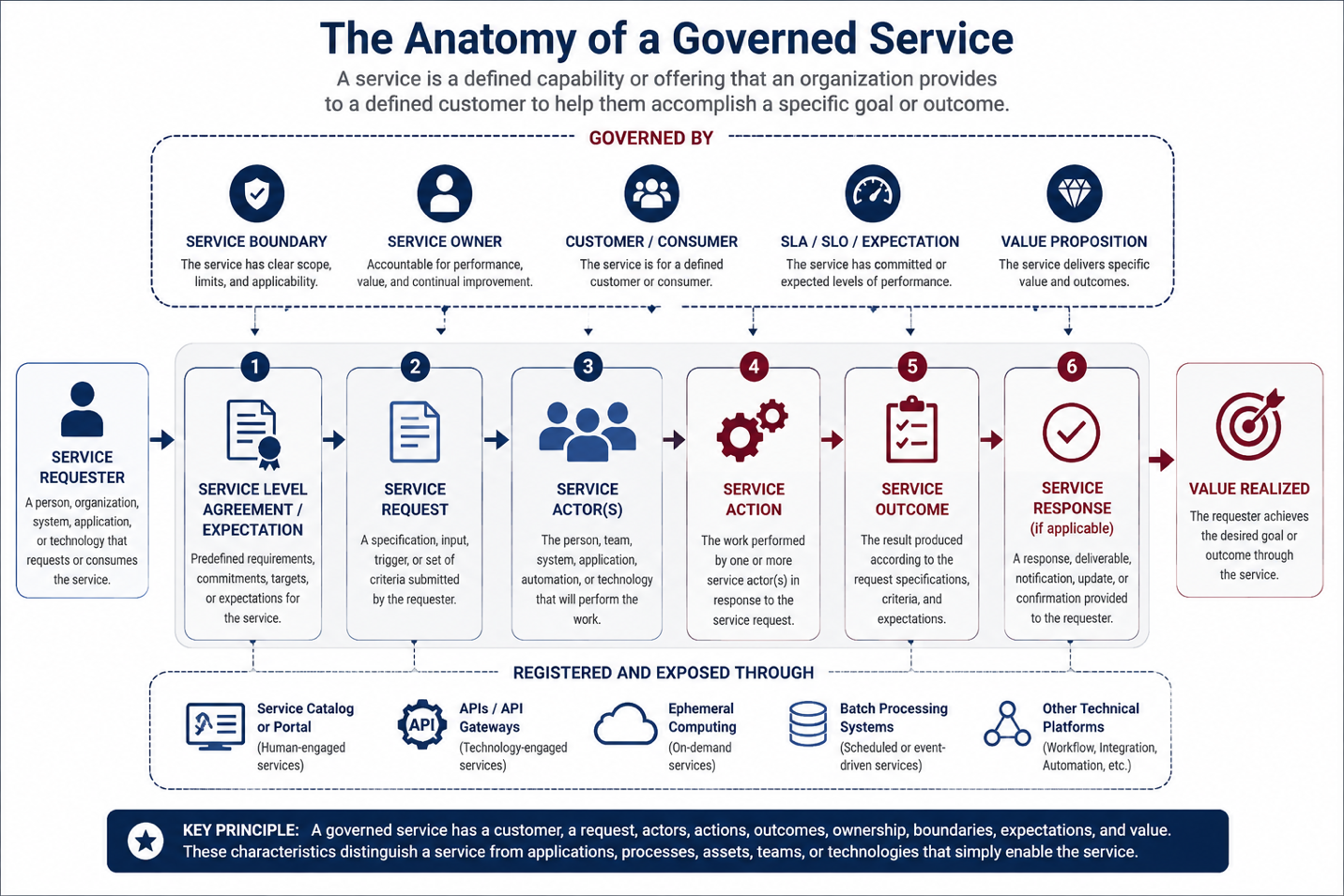
Service Management provides the definition and governance framework, the ownership model, the lifecycle discipline, and the portfolio structure within which the Service Catalog operates. The catalog surfaces what Service Management has defined, governed, and approved.
The enterprise Services Inventory should be treated as the authoritative enterprise record for the full set of governed services across the enterprise root Service Portfolio and all child Service Portfolios. The Service Catalog should be derived from, or reconciled against, that inventory so catalog entries do not become a disconnected list of request forms, local tool entries, or departmental service fragments. In theory, the complete set of active, approved, requestable, invokable, or consumable services in the Services Inventory represents the full enterprise Service Catalog, although catalog views may be filtered by requester community, entitlement, lifecycle state, channel, geography, risk, or operating model.
Understanding this relationship is important. Improving the Service Catalog without improving Service Management produces a better-organized tool built on a poorly governed foundation. Sustainable improvement requires addressing both.
For deeper catalog-specific guidance, see Service Catalog Best Practices and the related IF4IT article Building Service Catalogs That Actually Work.
How to Use This Document
This document contains best practices for the core Service Management domains and the supporting operating disciplines that make those domains practical. Each best practice follows a consistent structure: an Overview setting context, one or more Best Practice recommendations, and the Benefits of implementing each recommendation. These are recommendations, not mandates. Some will be immediately applicable. Others represent aspirational targets that an organization works toward over time.
Use these practices through a practical Crawl, Walk, Run (CWR) adoption path. At the Crawl stage, a small organization may begin with a Help Desk or Service Desk queue, basic Ticketing System discipline, a small number of defined services, clear owners, simple Service Details, and regular review of open and closed Tickets. At the Walk stage, a midsized organization may formalize a Service Catalog, standard request forms, routing rules, Service Groups, knowledge articles, Service Metrics, and a lightweight governance cadence. At the Run stage, a larger enterprise may extend the model into integrated Service Portfolios, automation, AI-assisted service delivery, compliance evidence, cost and value management, and enterprise-wide continuous improvement. The goal is to improve deliberately without forcing every service, team, or organization into the same level of maturity at the same time.
We recommend reading the Glossary of Terms and Phrases that follows this Overview before proceeding to the best practices.
How to cite this page
When referencing this page in academic work, internal standards, or external publications, include the page title, IF4IT as author and publisher (The International Foundation for Information Technology (IF4IT), LLC), the URL, and your access date.
Example (informal web citation):
The International Foundation for Information Technology (IF4IT), LLC. Service Management Best Practices. https://if4it.org/best-practices/service-management/overview/ (accessed 2026-09-11).
See About Us for content governance and site-wide citation guidance.
Copyright for The International Foundation for Information Technology (IF4IT), LLC: 2008 - Present
Legal Disclaimers