Position the Service Desk or Help Desk as a Service Management operating function - Service Management Best Practices
Position the Service Desk or Help Desk as a Service Management operating function
(Chapter 6 of Service Management Best Practices)
Executive Summary: Chapter Overview
IF4ITThe Bottom Line
Core Concepts
| Concept | Definition & Strategic Role |
|---|---|
| Service Management | Treats services as managed assets with defined customers, owners, expectations, records, outcomes, and improvement routines. |
| Repeatability | Makes service delivery consistent enough to be governed, measured, improved, and scaled. |
| Practical Scalability | Allows organizations to start simply and add formality, tooling, automation, and reporting as maturity increases. |
Quick Q&A
Question: What Service Management problem does positioning the Service Desk or Help Desk as a Service Management operating function solve?
Question: How should teams make positioning the Service Desk or Help Desk as a Service Management operating function operational?
Read More Below
Overview
A Service Desk or Help Desk is an operating function within Service Management. It provides a practical way for requesters, customers, consumers, and stakeholders to ask for help, submit requests, report incidents, receive status, obtain guidance, and engage Service Providers or Service Actors. In many small and mid-sized organizations, Service Management begins with a Help Desk or Service Desk because that is where visible service work first becomes organized, tracked, and improved.
The terms Help Desk and Service Desk are often used interchangeably in practice. Some organizations use Help Desk to describe a narrower support function and Service Desk to describe a broader Service Management function. Other organizations use the terms to mean the same thing. The important governance point is not the label. The important point is that the function should be intentionally positioned as part of the broader Service Management discipline, not mistaken for the whole discipline.
Help Desk and Service Desk workers often act as Service Providers or Service Actors. They may receive requests, classify work, answer questions, perform fulfillment steps, resolve incidents, route work, communicate with requesters, update Service Records, and support Service Outcomes. However, the Help Desk or Service Desk should not be treated as the owner of every service it supports. Service ownership, fulfillment responsibility, catalog governance, and portfolio accountability must remain clear.
In early-stage Service Management environments, the Help Desk or Service Desk is often the primary visible operating function through which requesters engage services. Requests may be submitted directly through channels such as email, phone, chat, forms, or a basic support portal, with a Ticketing System used to capture, route, and track the resulting work. A formal Service Catalog may be introduced later as the organization matures and needs more structured service discovery, standardized Service Details, and more governed intake paths.
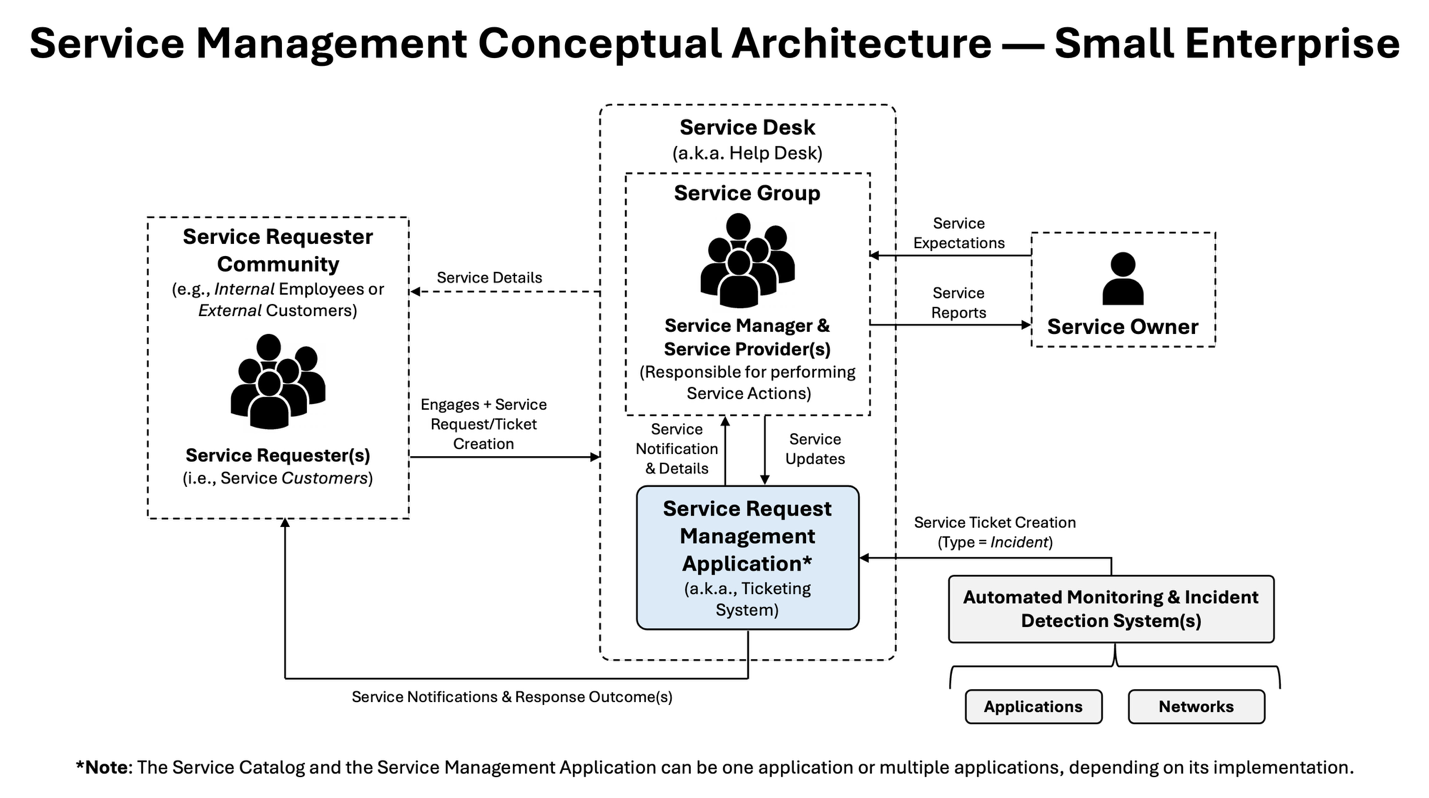
Best Practice
Treat the Help Desk or Service Desk as an operating function within broader Service Management.
A Help Desk or Service Desk should be designed as one important part of the Service Management operating model. It may serve as the front door for many services, but it should work within a broader model that includes defined services, Service Owners, Service Details, Service Expectations, Service Records, fulfillment responsibilities, Service Reports, Service Groups, and Service Portfolios.
For example, a small organization may start with a shared support inbox and a basic ticketing queue. As the organization grows, the same function may mature into a more formal Service Desk that supports a Service Catalog, standard request forms, routing rules, fulfillment procedures, escalation paths, knowledge articles, and service reporting.
Benefit(s)
Positioning the Help Desk or Service Desk within Service Management improves clarity, scalability, and governance. It helps organizations start practically without confusing ticket handling with the full discipline of Service Management.
Best Practice
Define Help Desk and Service Desk workers as Service Providers or Service Actors for the services they fulfill, route, coordinate, or resolve.
Workers who operate in a Help Desk or Service Desk function should have clear responsibilities for the services and service activities they support. They may act as Service Providers when they perform work directly. They may act as Service Actors when they route, coordinate, communicate, validate, or automate parts of the service process. Their responsibilities should be defined by service, not only by queue or job title.
For example, a Service Desk analyst may be a Service Provider for a password reset service, a routing actor for an application access service, and a communication actor for a major incident. These responsibilities should be understood, documented, trained, and governed.
Benefit(s)
Defining Help Desk and Service Desk workers as Service Providers or Service Actors improves routing, training, escalation, accountability, and reporting. It helps the organization understand who performs which service actions and where fulfillment responsibility actually sits.
Best Practice
Right-size Help Desk and Service Desk practices to the organization’s scale, complexity, and maturity.
Organizations should not overengineer Help Desk or Service Desk practices before the operating need exists. A small organization may begin with simple services, basic ownership, request tracking, and clear response expectations. A mid-sized organization may add a Service Catalog, standard forms, Service Groups, reporting, and more formal escalation. A larger organization may add integrated platforms, automation, portfolio reporting, formal service reviews, and advanced governance.
The goal is not to copy a large-enterprise model too early. The goal is to build enough structure to make service work visible, repeatable, accountable, measurable, and improvable.
Benefit(s)
Right-sizing Help Desk and Service Desk practices makes Service Management approachable for small and mid-sized organizations while still supporting enterprise-level maturity over time. It reduces unnecessary bureaucracy and helps the organization mature responsibly.
How to cite this page
When referencing this page in academic work, internal standards, or external publications, include the page title, IF4IT as author and publisher (The International Foundation for Information Technology (IF4IT), LLC), the URL, and your access date.
Example (informal web citation):
The International Foundation for Information Technology (IF4IT), LLC. Position the Service Desk or Help Desk as a Service Management operating function | Service Management Best Practices. https://if4it.org/best-practices/service-management/position-the-service-desk-or-help-desk-as-a-service-management-operating-function/ (accessed 2026-09-11).
See About Us for content governance and site-wide citation guidance.
Copyright for The International Foundation for Information Technology (IF4IT), LLC: 2008 - Present
Legal Disclaimers