Understand the relationship between a Service Catalog, Service Portfolios, Service Requests, and the Service Pipeline - Service Management Best Practices
Understand the relationship between a Service Catalog, Service Portfolios, Service Requests, and the Service Pipeline
(Chapter 16 of Service Management Best Practices)
Executive Summary: Chapter Overview
IF4ITThe Bottom Line
Core Concepts
| Concept | Definition & Strategic Role |
|---|---|
| Service Catalog (Facade) | Provides the requester-facing or consumer-facing publication layer through which approved services are discovered, understood, requested, invoked, or consumed. |
| Service Portfolio (Hierarchical Grouping) | Groups services and/or child Service Portfolios. A portfolio may contain individual services, other portfolios, or both, allowing service governance to scale from domain portfolios to the enterprise root. |
| The Service Portfolio (Enterprise Root) | Refers to the enterprise-wide root of the portfolio hierarchy, encompassing all Service Portfolios and, transitively, all governed services the organization manages. |
| Service Request (Transaction) | Represents an individual requester, customer, consumer, system, or automation submission against a specific service. A request is a transaction, not a grouping or a catalog facade. |
| Service Pipeline | Represents the proposed, planned, designed, or in-development portion of the Service Portfolio, before services are approved for normal operational request, invocation, or consumption. |
| Federated Presentation / Centralized Governance | Allows multiple requester-facing portals or façades to expose services for different communities while preserving centralized governance through the enterprise Services Inventory, Service Portfolio hierarchy, common ownership rules, and lifecycle controls. |
Quick Q&A
Question: Are a Service Portfolio and the Service Portfolio different constructs?
Question: Where do lifecycle states fit in this model?
Question: Do multiple Service Catalog façades mean multiple Service Portfolios?
Read More Below
Overview
Four closely related Service Management constructs are frequently confused in Service Catalog and Service Portfolio discussions: the Service Catalog, Service Portfolios, Service Requests, and the Service Pipeline. Each represents a distinct kind of thing with a distinct purpose — a facade, a hierarchical grouping, a transaction, and a lifecycle-management subset, respectively. Confusing them leads to poor design decisions, misaligned expectations, weak governance, and reporting gaps that undermine the effectiveness of the Service Management operating model.
A Service Catalog is the requester-facing or consumer-facing facade that publishes approved services for discovery, request, invocation, or consumption. It helps requesters, customers, consumers, systems, applications, or other stakeholders understand Service Details and engage the appropriate request, invocation, or consumption path. It is a presentation and engagement construct, not the authoritative governance registry and not the record of individual work items.
Service Portfolios are recursive hierarchical groupings of services. A Service Portfolio may contain individual services, child Service Portfolios, or both. Common domain examples include the HR Service Portfolio, Finance Service Portfolio, IT Service Portfolio, and Project Management Service Portfolio; each may contain sub-portfolios, such as an IT Infrastructure Service Portfolio or IT Application Services Portfolio. The phrase “the Service Portfolio,” used with the definite article, refers to the enterprise-wide root of the hierarchy — the grouping of all Service Portfolios and, transitively, all services the organization manages.
A Service Request is a transaction against a specific service, while the Service Pipeline is the portion of the Service Portfolio used to manage proposed, planned, designed, or in-development services that are not yet approved for normal operational request, invocation, or consumption. The enterprise Services Inventory should sit behind all of these views as the authoritative record of services, portfolio placement, ownership, lifecycle state, catalog exposure, and governance metadata. In a multi-façade environment, separate requester-facing portals, such as HR, IT, Finance, Legal, Facilities, or Project Management portals, may expose different service views for different communities, but those façades should not become independent governance structures. Every service exposed through every façade should still be registered in the enterprise Services Inventory, placed within the Service Portfolio hierarchy, assigned to an accountable owner and Service Group, and reconciled to its lifecycle state and approved engagement channels.
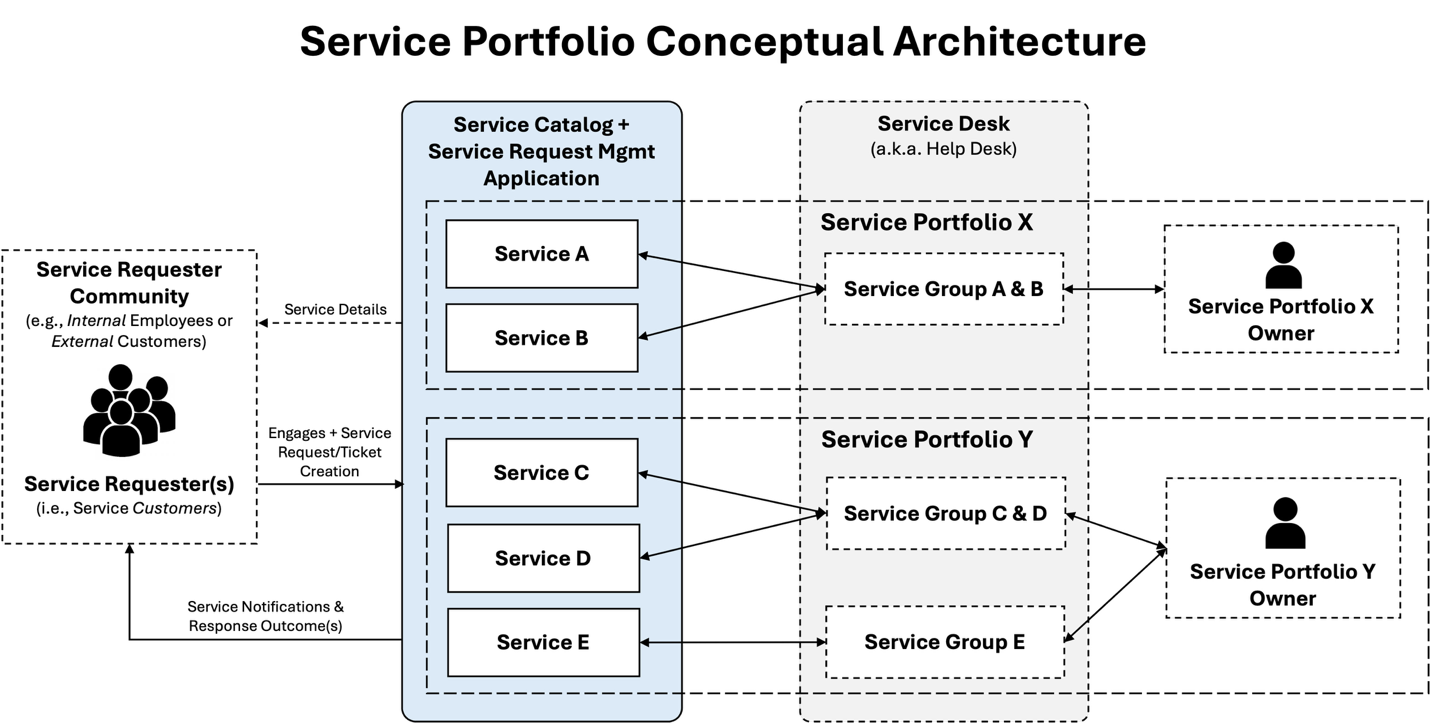
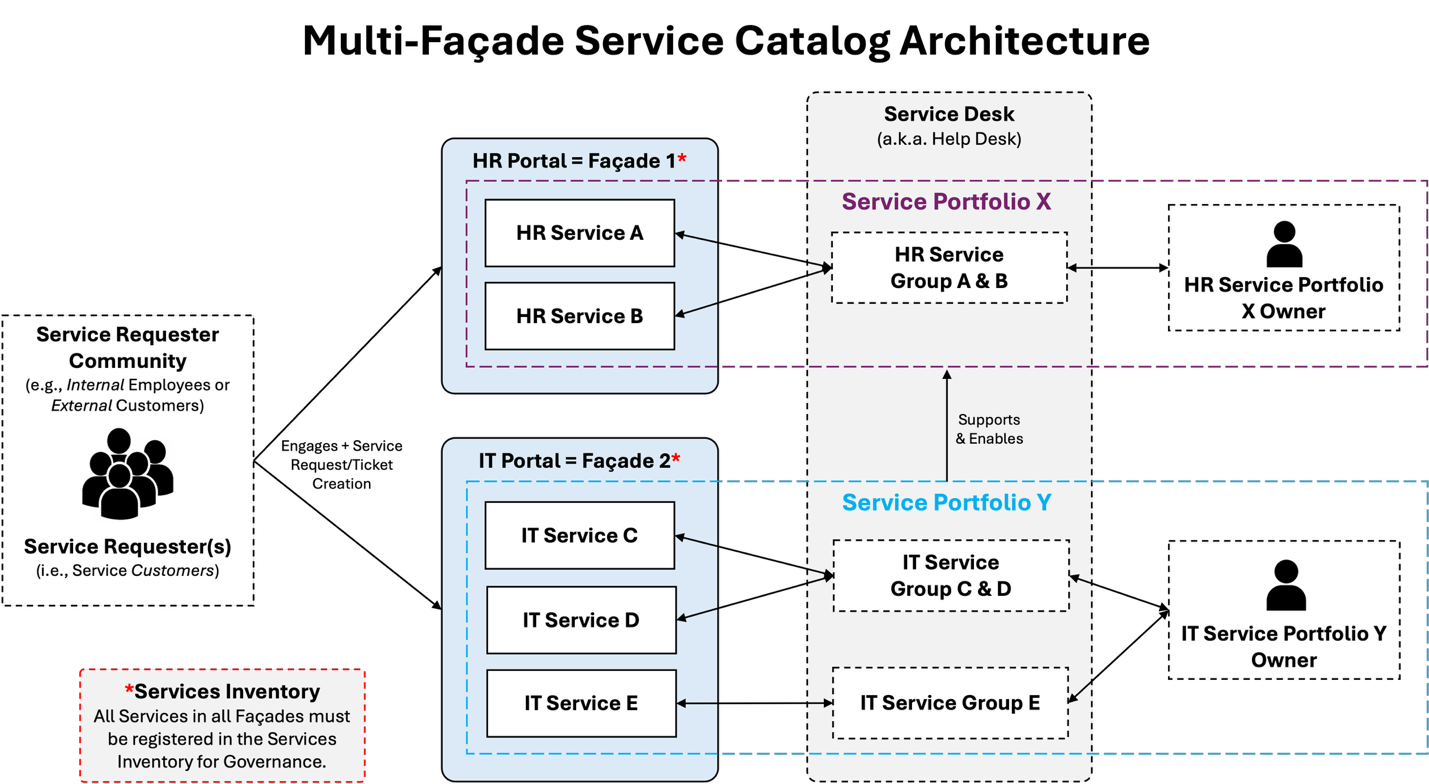
This distinction prevents organizations from confusing catalog presentation with service governance. A single façade may expose services from many portfolios, and multiple façades may expose services that are governed through the same enterprise portfolio hierarchy. The governance obligation is the same in both cases: façades, portfolios, Service Groups, owners, and service lifecycle states should be traceable through the enterprise Services Inventory rather than maintained as disconnected lists.
The operating principle is simple: presentation may federate, but governance must remain centralized. Domain portals, departmental pages, technical portals, API catalogs, and other façades may be optimized for their audiences, but they should not define independent service identities, duplicate ownership models, disconnected lifecycle states, or competing versions of the service truth.
Best Practice
Treat the Service Catalog as the approved requester-facing view of active services.
The Service Catalog should represent the services that requesters, customers, consumers, systems, applications, or other stakeholders are allowed to discover, request, invoke, or consume. It should not include every idea, draft service, retired service, unmanaged task, internal activity, enabling asset, application, or informal support activity unless those items have been intentionally defined and approved as services.
For example, “Request Application Access,” “Request New Laptop,” “Employee Onboarding,” “Vendor Setup,” “Project Intake,” and “API Access Request” may be catalog services if they are defined, owned, requestable, governed, and supported by Service Details. A backlog idea for a future vendor-risk service may belong in the Service Pipeline, not the active Service Catalog.
Benefit(s)
Treating the Service Catalog as the approved requester-facing view improves trust, usability, and governance. It helps requesters know what is available now and prevents the catalog from becoming cluttered with ideas, assets, internal tasks, or unmanaged work.
Best Practice
Use the Service Portfolio hierarchy to govern the complete service landscape.
The Service Portfolio hierarchy should provide the broader management view of services across lifecycle states, ownership boundaries, domain portfolios, service groups, customers, costs, risks, value, performance, dependencies, and improvement priorities. It should include more than the active Service Catalog because leaders and Service Owners need to understand what exists, what is changing, what is being retired, what is being proposed, and where gaps or overlaps exist.
For example, an enterprise root Service Portfolio may contain an IT Service Portfolio, HR Service Portfolio, Finance Service Portfolio, and Project Management Service Portfolio. The IT Service Portfolio may then contain child portfolios such as IT Infrastructure Services, IT Application Services, End User Services, Access Management Services, and Collaboration Services. Each portfolio may contain active services, proposed services, deprecated services, retired services, internal services, customer-facing services, human-delivered services, and technology-delivered services.
Portfolio views should therefore be reconciled to the enterprise Services Inventory. The inventory provides the enterprise-wide control point for answering which services exist, which portfolio or child portfolio they belong to, which lifecycle state they are in, which services should be visible in the Service Catalog, and which services should remain internal, restricted, planned, deprecated, or retired.
Benefit(s)
Using the Service Portfolio to govern the full service landscape improves strategic planning, ownership, investment decisions, lifecycle management, risk visibility, and service rationalization. It allows the organization to manage services as a portfolio of value-delivering assets rather than only as a list of request forms.
Best Practice
Use the Service Pipeline to manage proposed and in-development services before they become operational.
The Service Pipeline should contain candidate, proposed, planned, designed, or in-development services that are not yet ready for normal requester consumption. Pipeline services should have enough governance to determine whether they should be approved, funded, designed, built, piloted, rejected, deferred, or merged with existing services.
For example, a proposed “Automated Contractor Onboarding” service may begin in the Service Pipeline while its owner, scope, funding, Service Details, request path, fulfillment model, Service Expectations, controls, and reporting are being designed. Once it is approved and operational, it may move into the active Service Catalog and the active portion of the Service Portfolio.
Benefit(s)
Managing a Service Pipeline prevents premature publication of immature services and creates a controlled path from idea to operational service. It improves planning, reduces duplicate service creation, and helps ensure that new services are properly defined, owned, governed, and ready before requesters depend on them.
Best Practice
Keep catalog, portfolio, pipeline, and request records aligned but distinct.
The Service Catalog, Service Portfolio hierarchy, Service Pipeline, and Service Request records should be connected, but they should not be collapsed into one undifferentiated list. Each service should have a clear lifecycle state and an authoritative source for its catalog-facing, portfolio-facing, pipeline-facing, and request-facing information. When a service changes lifecycle state, related records and engagement channels should be updated accordingly.
Use the enterprise Services Inventory as the reconciliation anchor for these views. Catalog records, portfolio records, pipeline records, lifecycle states, requester-facing Service Details, Service Requests, and governance metadata should remain aligned to the same underlying service identity so the organization can trace each catalog entry back to an approved governed service, trace each governed service to its portfolio, owner, lifecycle state, and exposure decision, and trace each request to the service it was submitted against.
For example, when a service moves from pipeline to active, its Service Details, request path, Service Owner, Service Expectations, fulfillment responsibilities, and reporting model should be ready before publication. When a service is deprecated or retired, catalog entries, intranet links, request forms, workflow routes, and related documentation should be updated so requesters do not continue using obsolete paths.
Benefit(s)
Keeping catalog, portfolio, pipeline, and request records aligned but distinct improves lifecycle governance, requester experience, reporting quality, and service rationalization. It helps prevent stale catalog entries, unmanaged service ideas, orphaned services, duplicate service definitions, and confusion about which services are active, planned, deprecated, retired, or actually requested.
Best Practice
Use Service Groups and the Service Portfolio hierarchy to scale beyond individual services.
As organizations mature, individual services should be organized into logical groups and recursive portfolios. Service Groups may organize related services by fulfillment responsibility, service area, requester community, operational capability, or business context. Service Portfolios provide a higher-level governance hierarchy for strategy, investment, value, lifecycle, performance, and risk, and they may contain individual services, child portfolios, or both.
For example, an IT Service Portfolio may contain child portfolios for End User Services, Access Management Services, Collaboration Services, Infrastructure Services, and Application Support Services. An HR Service Portfolio may contain child portfolios or Service Groups for Onboarding, Benefits, Employee Relations, Learning, and Workforce Administration.
Benefit(s)
Using Service Groups and the Service Portfolio hierarchy helps organizations scale Service Management without losing clarity. It improves ownership, reporting, investment planning, service rationalization, and leadership visibility while still allowing individual services to remain understandable and requestable.
How to cite this page
When referencing this page in academic work, internal standards, or external publications, include the page title, IF4IT as author and publisher (The International Foundation for Information Technology (IF4IT), LLC), the URL, and your access date.
Example (informal web citation):
The International Foundation for Information Technology (IF4IT), LLC. Understand the relationship between a Service Catalog, Service Portfolios, Service Requests, and the Service Pipeline | Service Management Best Practices. https://if4it.org/best-practices/service-management/understand-the-relationship-between-a-service-catalog-service-portfolios-service-requests-and-the-service-pipeline/ (accessed 2026-09-11).
See About Us for content governance and site-wide citation guidance.
Copyright for The International Foundation for Information Technology (IF4IT), LLC: 2008 - Present
Legal Disclaimers