Solutions Architecture Best Practices and Framework
Executive Summary: Document Overview
IF4ITThe Bottom Line
Solutions Architecture is not a new invention or a technology-selection exercise; it is a decades-proven consulting pattern, now standardized into one repeatable, governed discipline that turns an IT or Business problem into a comprehensive, well-documented, and Customer-decided answer. Without it, organizations improvise a different approach for every engagement, deliver solutions that address only the technical slice of a problem, and lose the knowledge each engagement could have fed back into Enterprise Architecture. Practiced through the Solutions Architecture Framework and documented in the Solutions Architecture Reference Book, it scales from a single-engineer problem to an enterprise-wide transformation, compounding the EA Platform’s value with every engagement completed.
Core Pillars & Document Modules
| Document Pillar / Focus Area | Strategic Business Outcome & Intent |
|---|---|
| Practice Foundation & Team Structure | Establishes Solutions Architecture as a repeatable, accountable discipline — distinct from the specialized architecture practices and Enterprise Architecture it integrates with — scales the team from a single architect to coordinated Programs, and coordinates significant decisions with governance bodies such as ARB and TRB before they ever reach the Customer. |
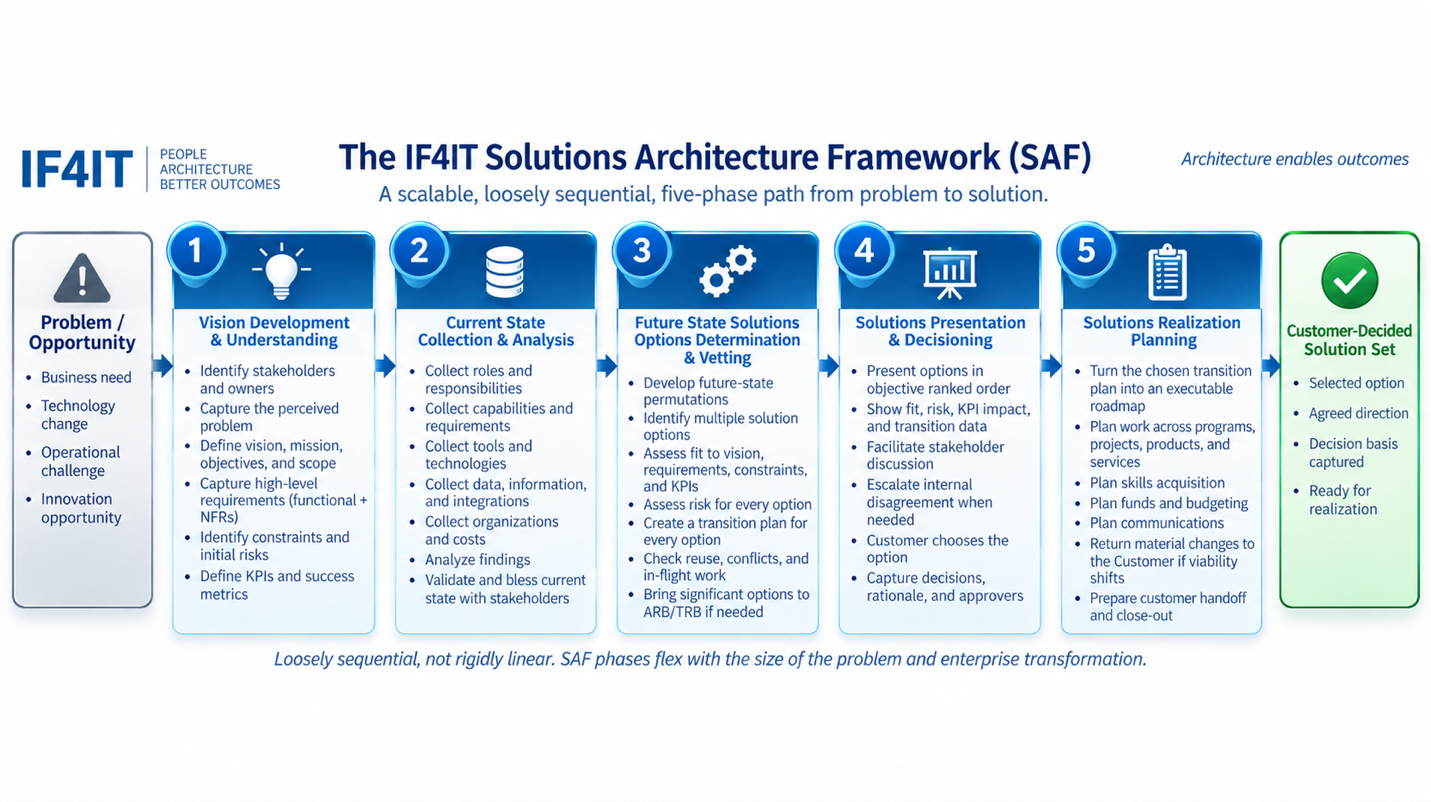
| The Solutions Architecture Framework | Standardizes engagement work into a repeatable five-phase methodology, the SA Dimensions a comprehensive solution must address, and the SARB that documents every decision made along the way. |
| Engagement Execution, Phase by Phase | Guides an engagement from Vision Development through Solutions Realization Planning, keeping the Customer’s own decision authority intact throughout — objectively presenting every option, resolving internal disagreement by escalation, and bringing significant course-corrections back to the Customer rather than absorbing them silently. |
| Close-Out & the Architecture Flywheel Effect | Ensures every engagement closes out properly — SARB delivered to the Customer, stored and categorized in the Architecture Repository, and its vetted data folded back into enterprise inventories — compounding the EA Platform’s value for every engagement still to come. |
| Correlated IT Management Disciplines | Clarifies exactly where Solutions Architecture hands off to the Systems Development Lifecycle, Delivery Methodology selection, Release Management, and Application/Technology Portfolio Management — so no two disciplines duplicate governance or leave a gap between them. |
Quick Q&A (Macro Executive Reference)
Question: Why can't Engineers or Architects just solve each IT problem their own way instead of following a formal Solutions Architecture framework?
Answer: Because an improvised approach produces inconsistent documentation, no repeatable way to compare solution options objectively, and no mechanism for one engagement’s hard-won knowledge to benefit the next. The Solutions Architecture Framework and its governed Reference Book make the practice repeatable and its output reusable across the enterprise.
Question: What is the first thing an organization needs in place before a Solutions Architecture engagement can actually succeed?
Answer: A clearly documented Vision Development phase: the key stakeholders, the perceived problem, and — critically — the KPIs and metrics that define success, all vetted directly with the Customer before any solution option work begins. Skipping this step is the most common source of costly rework later in an engagement.
Read Full Table of Contents Below
Table of Contents
Understanding What Solutions Architecture Is
- Overview
- Glossary of Terms and Phrases
- What Solutions Architecture Means
- Solutions Architecture as a Solution Set
- Solutions Architecture as a Practice
- Solutions Architecture Team Structure
- Solutions Architecture Program Coordination
- How Solutions Architecture Relates to Other Architecture Practices
- The Boundary Between Solutions Architecture and Detailed Engineering/Implementation
- When a Solutions Architecture Engagement Is Needed
- Solutions Architecture’s Relationship to Enterprise Architecture
- Value, Credibility, and the Architecture Value Ladder
- Why Solutions Architecture Produces a More Reliable Current State
- How Solutions Architecture and the EA Platform Reinforce Each Other
- Solutions Architecture and Governance Body (ARB/TRB) Review
The IF4IT Solutions Architecture Framework
- The Solutions Architecture Framework (SAF)
- Solutions Architecture Dimensions
- The Solutions Architecture Reference Book (SARB)
- SAF Phase 1 — Vision Development and Understanding
- SAF Phase 2 — Current State Collection and Analysis
- SAF Phase 3 — Future State Solutions Options Determination and Vetting
- SAF Phase 4 — Solutions Presentation and Decisioning
- SAF Phase 5 — Solutions Realization Planning
- Post Solutions Architecture Engagement Best Practices
Correlating Solutions Architecture With Other Disciplines
- Solutions Architecture and the Systems Development Lifecycle (SDLC)
- Solutions Architecture and Delivery Methodology (Agile, Waterfall, or Hybrid)
- Solutions Architecture and Release Management
- Solutions Architecture and Portfolio Management (APM/TPM)
Closing and Additional Resources
Copyright for The International Foundation for Information Technology (IF4IT), LLC: 2008 - Present