Closing Summary: Solutions Architecture as a Scalable, Governed Practice - Solutions Architecture Best Practices and Framework
Closing Summary: Solutions Architecture as a Scalable, Governed Practice
(Chapter 29 of Solutions Architecture Best Practices and Framework)
Executive Summary: Chapter Overview
IF4ITThe Bottom Line
Core Concepts
| Concept | Definition & Strategic Role |
|---|---|
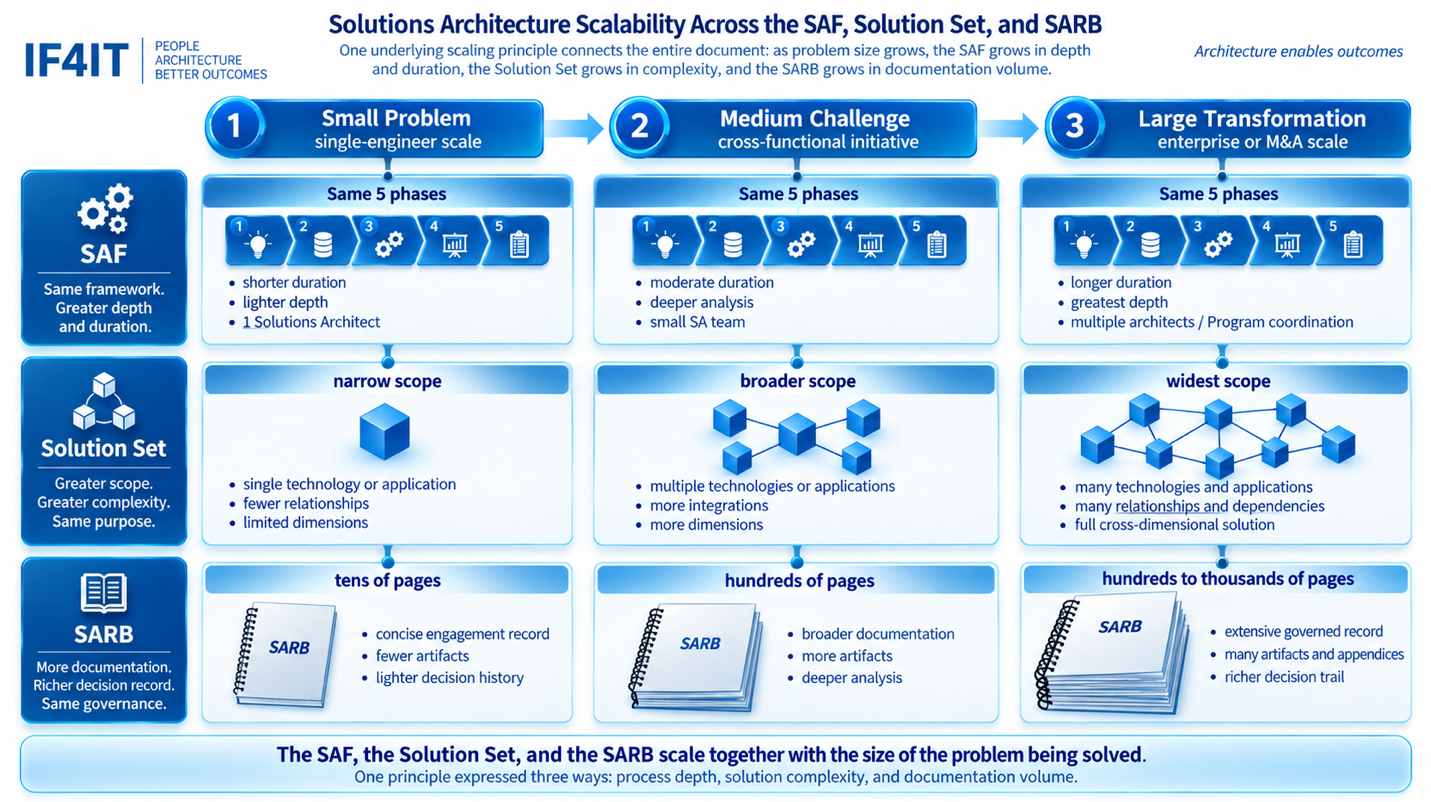
| Scalability as a unifying theme | The Solutions Architecture Framework scales to any sized challenge; the Solution Set it produces scales in complexity with the problem; and the SARB that documents it scales in length accordingly — three expressions of one underlying principle, introduced separately across this document and drawn together here. |
| What this document has established | A locked definition of Solutions Architecture in both its practice and Solution Set senses; its team structure, Program coordination, and relationship to Enterprise Architecture and the governance bodies it coordinates with; the Solutions Architecture Framework, its five phases, and the SA Dimensions; the Solutions Architecture Reference Book; and the close-out practices, anti-patterns, and correlated disciplines that complete this document’s coverage. |
| Where this document goes next | Later subsections correlate Solutions Architecture with other IT Management disciplines — the Systems Development Lifecycle, Delivery Methodology, Release Management, and Portfolio Management — with room to extend further as more disciplines are identified. |
Quick Q&A
Question: What is the one idea that connects the SAF, the Solution Set, and the SARB?
Question: Does the practice of Solutions Architecture end with this document?
Question: Does this document only cover the five SAF phases and the SARB, or does it go further?
Read More Below
Overview
This document opened by distinguishing Solutions Architecture as a practice from the Solution Set it produces, and by establishing that the practice is what leads to the Solution Set for any given problem. It then situated Solutions Architecture among the other specialized architecture practices it draws on, established its own team structure and how multiple related engagements coordinate under a Program, and established its bidirectional relationship with Enterprise Architecture — the value and credibility that relationship confers, the current-state fidelity it depends on, and the Architecture Flywheel Effect that compounds its value over time, including through coordination with governance bodies such as ARB and TRB. It then presented the Solutions Architecture Framework itself: its five phases, the Dimensions a comprehensive solution must account for — including Risk and Non-Functional Requirements — the Solutions Architecture Reference Book that documents the work, and the close-out practices that complete every engagement properly.
Beyond the framework itself, this document correlates Solutions Architecture with four adjacent IT Management disciplines — the Systems Development Lifecycle, Delivery Methodology, Release Management, and Portfolio Management — and names the anti-patterns paired with many of its Best Practices throughout, making clear not only what to do at each step but what commonly goes wrong when that guidance is skipped.
One idea has run beneath nearly all of this, introduced in three separate places rather than all at once: the Solutions Architecture Framework scales to any sized challenge, from a single-engineer problem to an engagement the size of a merger or acquisition; the Solution Set it produces scales in complexity with the problem, from a single technology to many; and the Solutions Architecture Reference Book that documents it all scales in length accordingly, from tens of pages to thousands. These are not three separate facts — they are the same underlying principle, expressed once in the process, once in its output, and once in its documentation. A practice built to handle any size of problem necessarily produces outputs and documentation that flex the same way.
Best Practice: Treat This Document as a Living Reference, Not a One-Time Read
Return to specific chapters of this document during actual engagements — the relevant SAF phase chapter while that phase is underway, the SARB chapter while assembling engagement documentation, the Dimensions chapter while scoping a problem’s full breadth, the Governance Body Review chapter when a significant option needs ARB or TRB review — rather than treating it as something read once and set aside.
Benefit(s)
Using this document as an ongoing reference, rather than a one-time read, is what actually produces the consistency across engagements that this document has argued for throughout — and consistency across engagements is the precondition for the Architecture Flywheel Effect to materialize in practice, not just on paper.
How to cite this page
When referencing this page in academic work, internal standards, or external publications, include the page title, IF4IT as author and publisher (The International Foundation for Information Technology (IF4IT), LLC), the URL, and your access date.
Example (informal web citation):
The International Foundation for Information Technology (IF4IT), LLC. Closing Summary: Solutions Architecture as a Scalable, Governed Practice | Solutions Architecture Best Practices and Framework. https://if4it.org/best-practices/solutions-architecture/closing-summary-solutions-architecture-as-a-scalable-governed-practice/ (accessed 2026-09-11).
See About Us for content governance and site-wide citation guidance.
Copyright for The International Foundation for Information Technology (IF4IT), LLC: 2008 - Present
Legal Disclaimers