How Solutions Architecture Relates to Other Architecture Practices - Solutions Architecture Best Practices and Framework
How Solutions Architecture Relates to Other Architecture Practices
(Chapter 8 of Solutions Architecture Best Practices and Framework)
Executive Summary: Chapter Overview
IF4ITThe Bottom Line
Core Concepts
| Concept | Definition & Strategic Role |
|---|---|
| Peer-practice integration model | Solutions Architecture draws on and integrates specialized practices such as Business Architecture, Data & Information Architecture, Technical/Technology Architecture, and Security Architecture — a representative, not exhaustive, list — to assemble a single comprehensive Solution Set. |
| Recursive specialization | Within any specialized practice Solutions Architecture draws on, an architect can specialize further in a narrow focus area — for example, a Technical/Technology Architect specializing in storage solutions, or an Application Architect, a type of Technical/Technology Architect, specializing in a specific application. |
| Classification by function, not label | The same surface category can belong to different specialized practices depending on its underlying purpose — a Data Center is “Real Estate” that belongs to Technical/Technology Architecture, not Business Architecture, because it houses technology infrastructure rather than supporting business operations. |
Quick Q&A
Question: Is Solutions Architecture a peer to Business Architecture, Data & Information Architecture, and the other specialized practices?
Question: What is an Application Architect's relationship to Solutions Architecture?
Read More Below
Overview
Solutions Architecture draws on and integrates a set of specialized architecture practices — Business Architecture, Data & Information Architecture, Technical/Technology Architecture, and Security Architecture, among others — rather than operating as one more peer specialization alongside them.
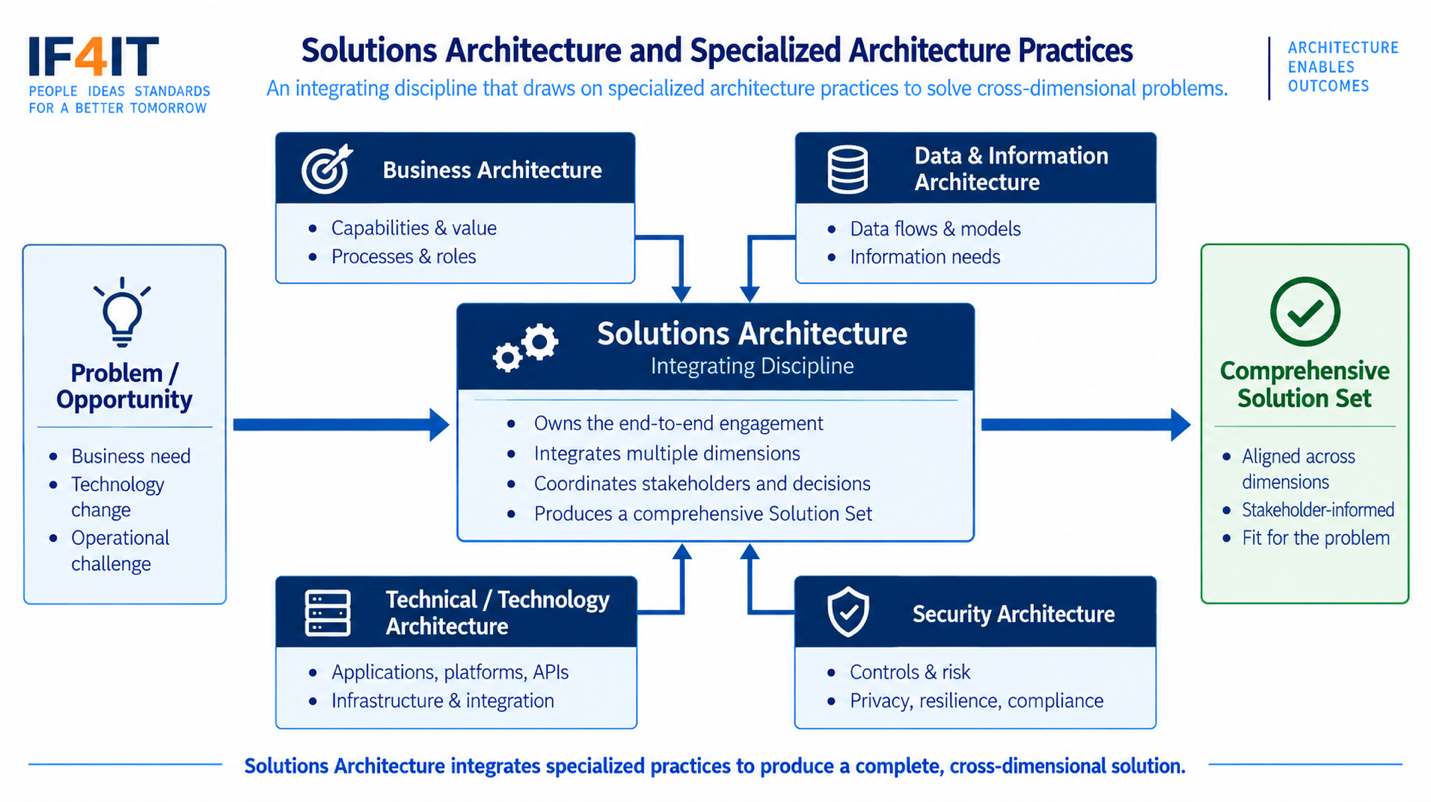
This list is representative, not exhaustive: new specialized practices can be added as they are identified.
Each of these specialized practices can itself contain narrower focus-area specializations. A Technical/Technology Architect may specialize in a specific technology, such as storage solutions. An Application Architect follows the same pattern: it is a type of Technical/Technology Architect who specializes in a specific application or set of applications, each of which provides specific capabilities or services that solve IT and/or Business problems — not a subtype of Solutions Architecture itself, despite the similarity in name.
Classifying which specialized practice a given “thing” belongs to depends on its function, not its surface label. Real Estate, for example, typically falls under Business Architecture — but a Data Center or Co-Location Center, despite also being “Real Estate,” belongs to Technical/Technology Architecture instead, because it exists to house technology infrastructure rather than to support business operations directly.
Best Practice: Draw on Specialized Practices Deliberately, Rather Than Duplicating Them
Early in an engagement, identify which specialized architecture practices the problem actually touches, and draw on the relevant specialists rather than attempting to perform that specialized work from within Solutions Architecture itself. A Solutions Architect’s role is to integrate and orchestrate this expertise toward a comprehensive answer, not to replace it.
Benefit(s)
Deliberately drawing on specialized practices avoids reinventing expertise that already exists elsewhere in the organization, ensures the right depth of knowledge is applied to each dimension of a problem, and scales naturally with the size of the engagement: a simple problem may need input from only one specialist, while a complex one draws on several working together, as established in the discussion of Solution Set scale variability earlier in this document.
How to cite this page
When referencing this page in academic work, internal standards, or external publications, include the page title, IF4IT as author and publisher (The International Foundation for Information Technology (IF4IT), LLC), the URL, and your access date.
Example (informal web citation):
The International Foundation for Information Technology (IF4IT), LLC. How Solutions Architecture Relates to Other Architecture Practices | Solutions Architecture Best Practices and Framework. https://if4it.org/best-practices/solutions-architecture/how-solutions-architecture-relates-to-other-architecture-practices/ (accessed 2026-09-11).
See About Us for content governance and site-wide citation guidance.
Copyright for The International Foundation for Information Technology (IF4IT), LLC: 2008 - Present
Legal Disclaimers