SAF Phase 2 — Current State Collection and Analysis - Solutions Architecture Best Practices and Framework
SAF Phase 2 — Current State Collection and Analysis
(Chapter 20 of Solutions Architecture Best Practices and Framework)
Executive Summary: Chapter Overview
IF4ITThe Bottom Line
Core Concepts
| Concept | Definition & Strategic Role |
|---|---|
| Current State categories | Roles & Responsibilities; Capabilities & Requirements; Tools and Technologies (including Applications, Services, Software, Hardware, Cloud); Data & Information (including Integrations); Organizations, internal and external; and Costs. |
| Collection versus analysis | This phase both collects the current-state data across these categories and analyzes it — collection alone, without analysis, does not fulfill the phase, since raw data on its own does not yet tell the engagement anything actionable about the problem. |
| Stakeholder-blessed validation | As established in “Why Solutions Architecture Produces a More Reliable Current State” earlier in this document, this phase’s output is validated directly with the stakeholders who own the problem, not assumed or rolled up from aggregate sources. |
Quick Q&A
Question: What categories of current state does this phase cover?
Question: Why does this phase matter beyond the immediate engagement?
Read More Below
Overview
Current State Collection and Analysis covers the current-state Roles & Responsibilities, Capabilities & Requirements, Tools and Technologies (including Applications, Services, Software, Hardware, and Cloud), Data & Information (including Integrations), Organizations both internal and external, and Costs — and the analysis of all of it. This becomes the current-state representation portion of the SARB.
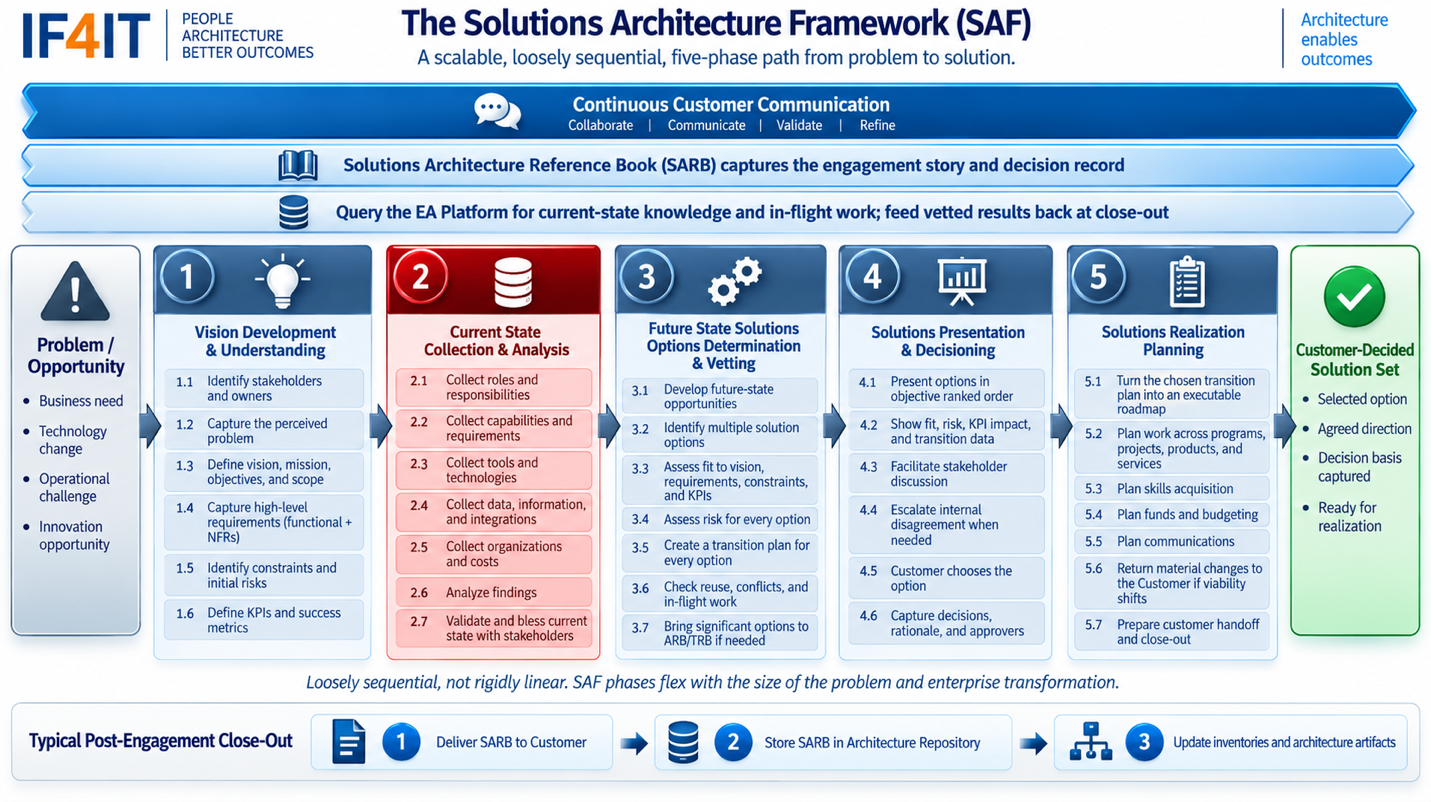
As established in “Why Solutions Architecture Produces a More Reliable Current State” earlier in this document, the defining characteristic of this phase is not merely that data is collected, but that it is vetted directly with the stakeholders who own the problem — with their blessing — rather than assumed or rolled up from aggregate sources. This is also the phase in which the SARB, drawing on the EA Platform as described in “How Solutions Architecture and the EA Platform Reinforce Each Other,” can accelerate collection by leveraging what is already known centrally, concentrating fresh effort on what is actually unknown or changed.
Best Practice: Do Not Proceed to Future State Until Current State Is Vetted and Blessed
Treat explicit stakeholder sign-off on the current-state findings as a gate before formally finalizing Future State Solutions Options in Phase 3 — informal ideas and possibilities for those options may naturally surface earlier and should be captured as they arise, consistent with the loosely sequential nature of the SAF established in “The Solutions Architecture Framework (SAF)” earlier in this document. This is the same discipline established in “Why Solutions Architecture Produces a More Reliable Current State” earlier in this document, applied concretely at this point in the engagement.
Benefit(s)
A vetted, blessed current state ensures the engagement’s own subsequent phases — future state options and decisions — are built on solid ground, not just on an assumption that later proves wrong. This is distinct from, though related to, the broader Enterprise-Architecture-level benefit described in “Why Solutions Architecture Produces a More Reliable Current State”: this benefit accrues to the engagement itself.
How to cite this page
When referencing this page in academic work, internal standards, or external publications, include the page title, IF4IT as author and publisher (The International Foundation for Information Technology (IF4IT), LLC), the URL, and your access date.
Example (informal web citation):
The International Foundation for Information Technology (IF4IT), LLC. SAF Phase 2 — Current State Collection and Analysis | Solutions Architecture Best Practices and Framework. https://if4it.org/best-practices/solutions-architecture/saf-phase-2-current-state-collection-and-analysis/ (accessed 2026-09-11).
See About Us for content governance and site-wide citation guidance.
Copyright for The International Foundation for Information Technology (IF4IT), LLC: 2008 - Present
Legal Disclaimers