Solutions Architecture and Portfolio Management (APM/TPM) - Solutions Architecture Best Practices and Framework
Solutions Architecture and Portfolio Management (APM/TPM)
(Chapter 28 of Solutions Architecture Best Practices and Framework)
Executive Summary: Chapter Overview
IF4ITThe Bottom Line
Core Concepts
| Concept | Definition & Strategic Role |
|---|---|
| APM as a TPM sub-branch | Application Portfolio Management (APM) governs the Applications technology type specifically; Technology Portfolio Management (TPM) is the overarching discipline governing every technology type an organization depends on, including Applications, Software, Hardware, and Cloud. Both correlate with Solutions Architecture the same way. |
| Application/Technology Owner | The named owner APM and TPM require for every governed application and technology — the same stakeholder the SARB chapter already requires approval from when a decision affects a pre-existing construct not owned by the Solutions Architect. |
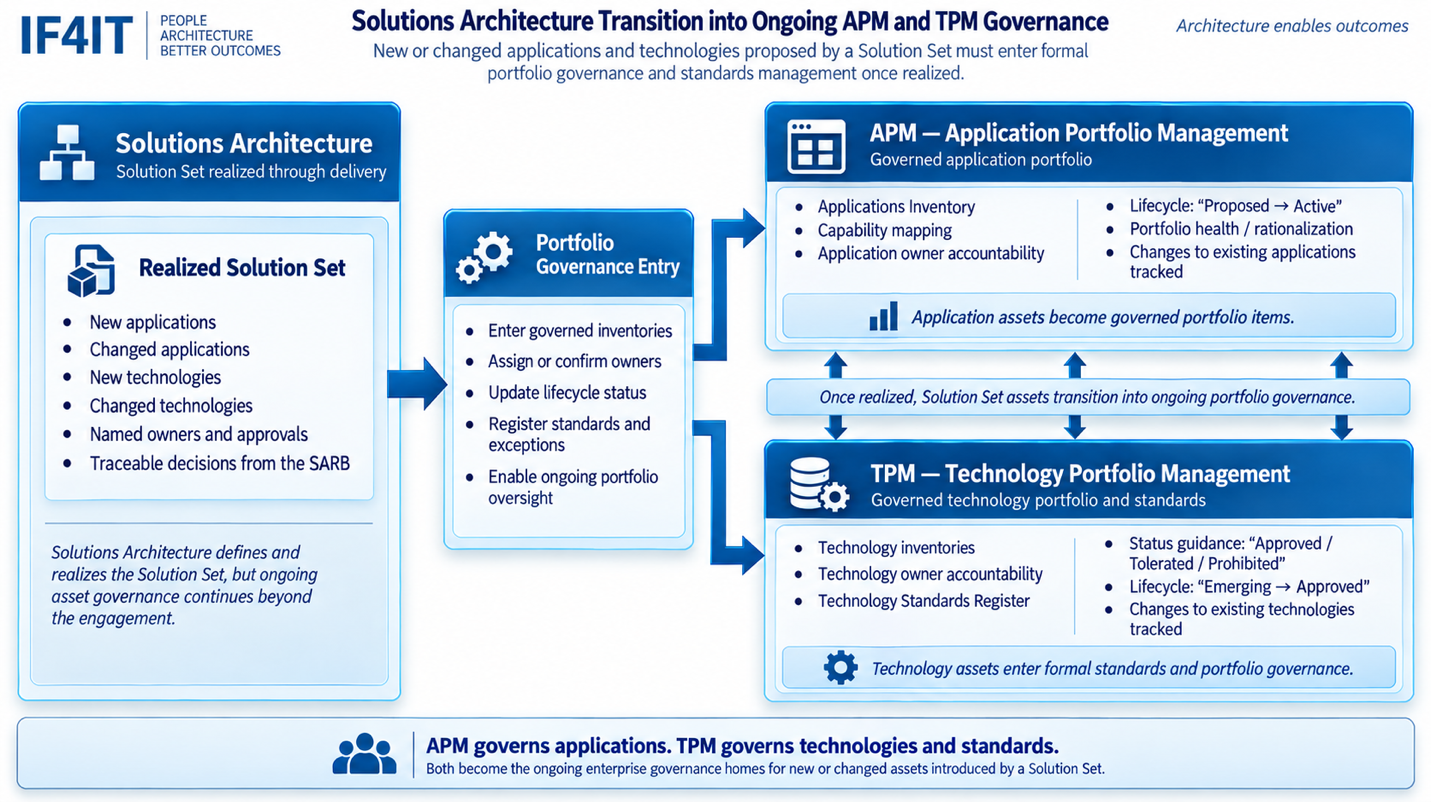
| Portfolio lifecycle entry | New applications and technologies proposed by a Future State Solutions Option enter APM’s Proposed-to-Active lifecycle or TPM’s Emerging-to-Approved lifecycle once realized — a formal transition that should happen at Post Solutions Architecture Engagement close-out, not be left informal. |
| Technology Standards Register | TPM’s authoritative record of every approved, tolerated, and prohibited technology in the enterprise — checked alongside the fit and risk assessment already required in Phase 3 whenever a Future State Solutions Option introduces a technology not already established. |
Quick Q&A
Question: Is Application Portfolio Management the same discipline as Technology Portfolio Management?
Question: Does Solutions Architecture already touch disciplines that connect to APM and TPM?
Read More Below
Overview
Application Portfolio Management (APM) and Technology Portfolio Management (TPM) govern, as ongoing enterprise disciplines, the applications and technologies an organization depends on — APM specifically scoped to the Applications technology type, as a sub-branch of the broader TPM, which governs every technology type an organization owns or depends on, including Applications, Software, Hardware, Cloud, and more. A Solutions Architecture engagement correlates with both the same way: through whichever one governs the specific application or technology a Solution Set introduces or changes.
When a Future State Solutions Option in Phase 3 proposes a new application or technology, or changes an existing one, that item is a candidate for APM’s or TPM’s governed inventories — the Applications Inventory, or the relevant Technologies Inventory — once the engagement realizes it. Both disciplines already maintain their own established connections to the Systems Development Lifecycle and to Release Management, the same two disciplines correlated with Solutions Architecture earlier in this subsection, so this is not a new relationship being introduced but an existing web of governance Solutions Architecture is stepping into.
Where a Future State Solutions Option is an Acquired solution built on a vendor product, its evaluation in Phase 3 should draw on APM’s and TPM’s own vendor management practices — vendor health and viability, license compliance, and vendor concentration risk — rather than assessing these things independently. The specialized practices already established for this exist precisely so Solutions Architecture does not need to reinvent them.
APM’s Capabilities Inventory mapping — connecting every application to the business capabilities it supports — lines up directly with the Value Streams and Capabilities Dimension established earlier in this document. Where a Solution Set touches an existing application or technology, coordination is owed to its named Application Owner or Technology Owner: the same stakeholder the SARB chapter already requires approval from when a decision affects a pre-existing construct not owned by the Solutions Architect.
TPM also maintains a Technology Standards Register: the authoritative record of every approved, tolerated, and prohibited technology in the enterprise. Where a Future State Solutions Option involves a specific technology, checking that register belongs alongside the fit and risk assessment already required in Phase 3.
Best Practice: Check the Technology Standards Register Before Finalizing Options That Introduce New Technology
Where a Future State Solutions Option under consideration in Phase 3 introduces a technology not already established in the enterprise, check TPM’s Technology Standards Register before carrying that option forward — confirming it is approved or tolerated, not prohibited, and coordinating with the technology’s named Owner where one already exists.
Benefit(s)
Checking the Technology Standards Register before finalizing options avoids presenting the Customer with a Solutions Option built on a technology the enterprise has already prohibited or is actively phasing out — a conflict better caught in Phase 3 than discovered during Phase 5 realization.
How to cite this page
When referencing this page in academic work, internal standards, or external publications, include the page title, IF4IT as author and publisher (The International Foundation for Information Technology (IF4IT), LLC), the URL, and your access date.
Example (informal web citation):
The International Foundation for Information Technology (IF4IT), LLC. Solutions Architecture and Portfolio Management (APM/TPM) | Solutions Architecture Best Practices and Framework. https://if4it.org/best-practices/solutions-architecture/solutions-architecture-and-portfolio-management-apm-tpm/ (accessed 2026-09-11).
See About Us for content governance and site-wide citation guidance.
Copyright for The International Foundation for Information Technology (IF4IT), LLC: 2008 - Present
Legal Disclaimers