Solutions Architecture Program Coordination - Solutions Architecture Best Practices and Framework
Solutions Architecture Program Coordination
(Chapter 7 of Solutions Architecture Best Practices and Framework)
Executive Summary: Chapter Overview
IF4ITThe Bottom Line
Core Concepts
| Concept | Definition & Strategic Role |
|---|---|
| Program vs. single engagement | A Program exists when a transformation goal decomposes into multiple genuinely distinct engagements — each with its own Phase 1 vision, scope, and SARB — rather than one large engagement capable of encompassing the whole problem in a single SAF cycle, however long or heavily staffed. |
| Program vs. parallel independent engagements | Distinct from the parallel engagement scaling described in “How Solutions Architecture and the EA Platform Reinforce Each Other”: those are independent engagements solving unrelated problems that happen to run concurrently; a Program’s constituent engagements are deliberately related, coordinated toward one shared transformation goal. |
| Shared Program Vision | Each constituent engagement’s own Phase 1 Vision should trace back to one shared Program-level Vision, keeping the individual engagements aligned to the same larger goal even as their own Scope, Requirements, and timelines differ. |
| Program Lead | The role that coordinates alignment and sequencing across a Program’s constituent engagements, mirroring the Lead Solutions Architect role established in “Solutions Architecture Team Structure” — but operating across engagements rather than within one, and never substituting for any single engagement’s own decision authority. |
Quick Q&A
Question: How is a Program different from one very large Solutions Architecture engagement?
Question: Does a Program have its own SARB separate from its constituent engagements?
Read More Below
Overview
A Program is a deliberate umbrella joining multiple related Solutions Architecture engagements toward one larger transformation goal. This is distinct from the SAF’s own scalability, covered in full later in this document in “The Solutions Architecture Framework (SAF),” which already accommodates a very large problem within a single engagement — an M&A-scale problem, for example, is still typically one engagement, just a large one. A Program exists specifically when the transformation decomposes into multiple genuinely distinct engagements, each with its own Phase 1 vision, scope, and SARB, rather than a single engagement however large.
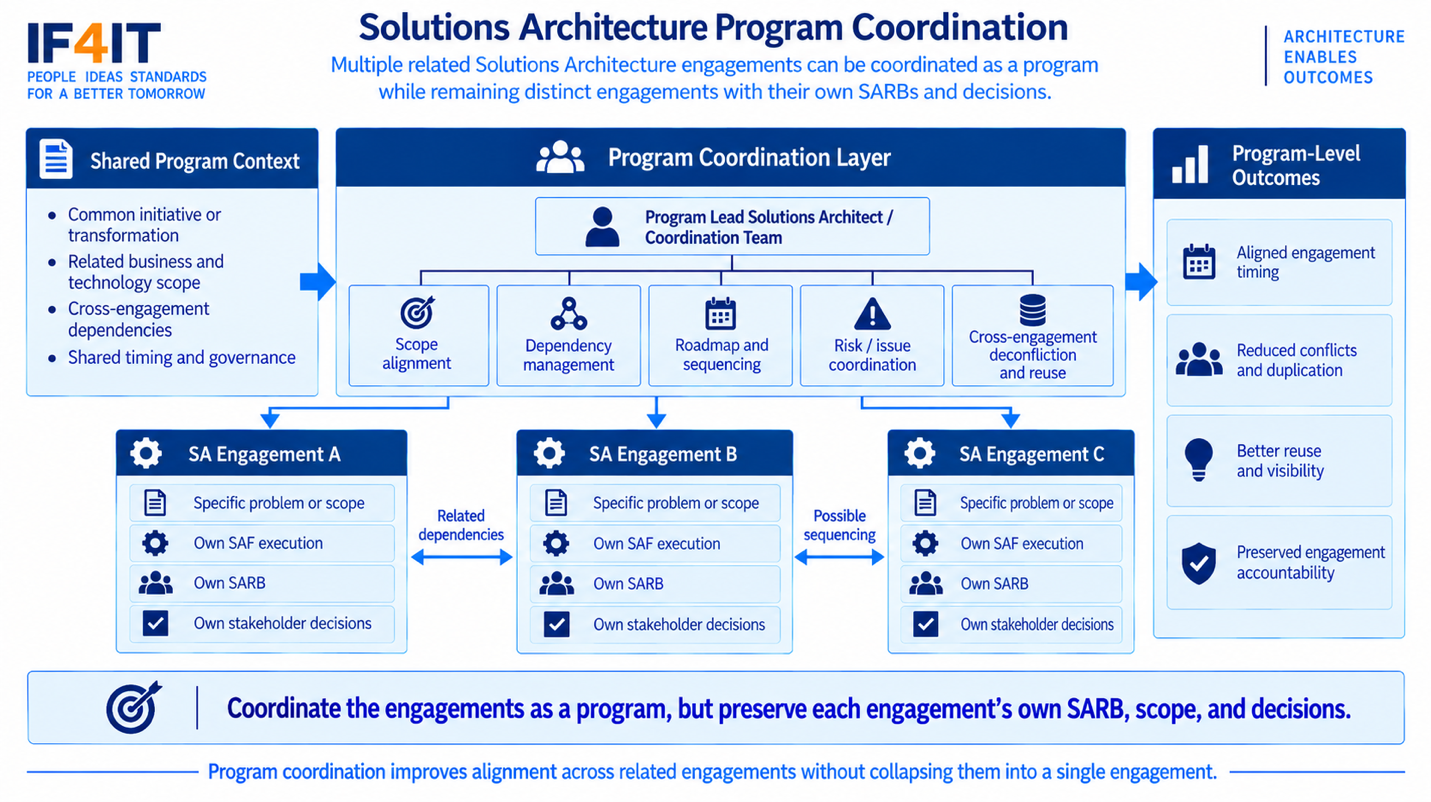
A Program is also distinct from the parallel engagement scaling described in “How Solutions Architecture and the EA Platform Reinforce Each Other,” covered later in this document: that chapter describes independent engagements solving unrelated problems that happen to run concurrently, each contributing to the EA Platform’s growth without being deliberately connected to one another. A Program’s constituent engagements, by contrast, are deliberately related — coordinated toward one shared transformation goal, not simply running at the same time.
Each constituent engagement’s own Phase 1 Vision should trace back to one shared Program-level Vision, keeping the individual engagements aligned to the same larger goal even as their own Scope, Requirements, and timelines differ. Deconfliction and sequencing between constituent engagements draw on the same Architecture Repository mechanism already established for independent engagements in “How Solutions Architecture and the EA Platform Reinforce Each Other” — checking for other in-progress SARBs before finalizing options — but the stakes are higher here, since a Program’s engagements are expected to build on one another, not merely avoid conflicting.
A Program benefits from a Program Lead: a role coordinating alignment and sequencing across the constituent engagements, mirroring the Lead Solutions Architect role established in “Solutions Architecture Team Structure” earlier in this document. The Program Lead coordinates between engagements, not within any one of them, and never substitutes for a constituent engagement’s own Lead Solutions Architect or its own Customer’s decision authority.
Best Practice: Trace Every Constituent Engagement’s Vision Back to the Program’s Shared Goal
Where multiple engagements are coordinated under a Program, confirm at the outset of each constituent engagement’s own Phase 1 that its Vision, Mission, and Objectives genuinely trace back to the Program’s shared transformation goal — not just to that engagement’s own local problem in isolation. Revisit this alignment as constituent engagements complete and understanding of the larger goal deepens.
Benefit(s)
Confirming alignment to the shared goal at each constituent engagement’s own Phase 1 prevents a Program’s engagements from drifting into locally optimal but collectively incoherent solutions — each individually well-architected, but not actually adding up to the transformation the Program exists to deliver.
How to cite this page
When referencing this page in academic work, internal standards, or external publications, include the page title, IF4IT as author and publisher (The International Foundation for Information Technology (IF4IT), LLC), the URL, and your access date.
Example (informal web citation):
The International Foundation for Information Technology (IF4IT), LLC. Solutions Architecture Program Coordination | Solutions Architecture Best Practices and Framework. https://if4it.org/best-practices/solutions-architecture/solutions-architecture-program-coordination/ (accessed 2026-09-11).
See About Us for content governance and site-wide citation guidance.
Copyright for The International Foundation for Information Technology (IF4IT), LLC: 2008 - Present
Legal Disclaimers