Solutions Architecture Team Structure - Solutions Architecture Best Practices and Framework
Solutions Architecture Team Structure
(Chapter 6 of Solutions Architecture Best Practices and Framework)
Executive Summary: Chapter Overview
IF4ITThe Bottom Line
Core Concepts
| Concept | Definition & Strategic Role |
|---|---|
| The Solutions Architecture team | The Solutions Architect or Solutions Architects accountable for a given engagement, distinct from the specialized architects — Business, Data & Information, Technical/Technology, Security — the team draws on but does not include, who remain external contributors coordinated rather than staffed as team members. |
| Team size scales with the engagement | A single-engineer-scale problem may need only one Solutions Architect; an M&A-scale engagement may need several — the same scalability already established for the Solutions Architecture Framework itself, applied here to who performs the work rather than how much work there is to do. |
| Lead Solutions Architect | The role required whenever an engagement is staffed with more than one Solutions Architect — accountable for the SARB’s overall coherence and the Customer’s single point of accountability on the team, though the final decision in Phase 4 still belongs to the Customer, not the Lead. |
Quick Q&A
Question: Does the Solutions Architecture team include the specialized architects it draws on, such as a Business Architect or Security Architect?
Question: Is a Lead Solutions Architect required for every engagement?
Read More Below
Overview
Throughout this document, “the Solutions Architect” and “the Solutions Architecture team” both refer to the same thing: the Solutions Architect or Solutions Architects accountable for a given engagement. This is distinct from the specialized architecture practices established in “How Solutions Architecture Relates to Other Architecture Practices” — Business, Data & Information, Technical/Technology, and Security Architecture. Those specialists remain external contributors the team draws on, coordinates, and orchestrates; they are not members of the Solutions Architecture team itself, however central their input is to a given engagement.
Team size scales with the engagement the same way the Solutions Architecture Framework itself already scales, covered in full later in this document in “The Solutions Architecture Framework (SAF)”: a problem one engineer could resolve may need only one Solutions Architect, while an engagement the size of a merger or acquisition may need several working in parallel across different parts of the problem. This is a direct corollary, not a separate scaling rule — the same forces that make the framework flex in duration and staffing make the team flex in size.
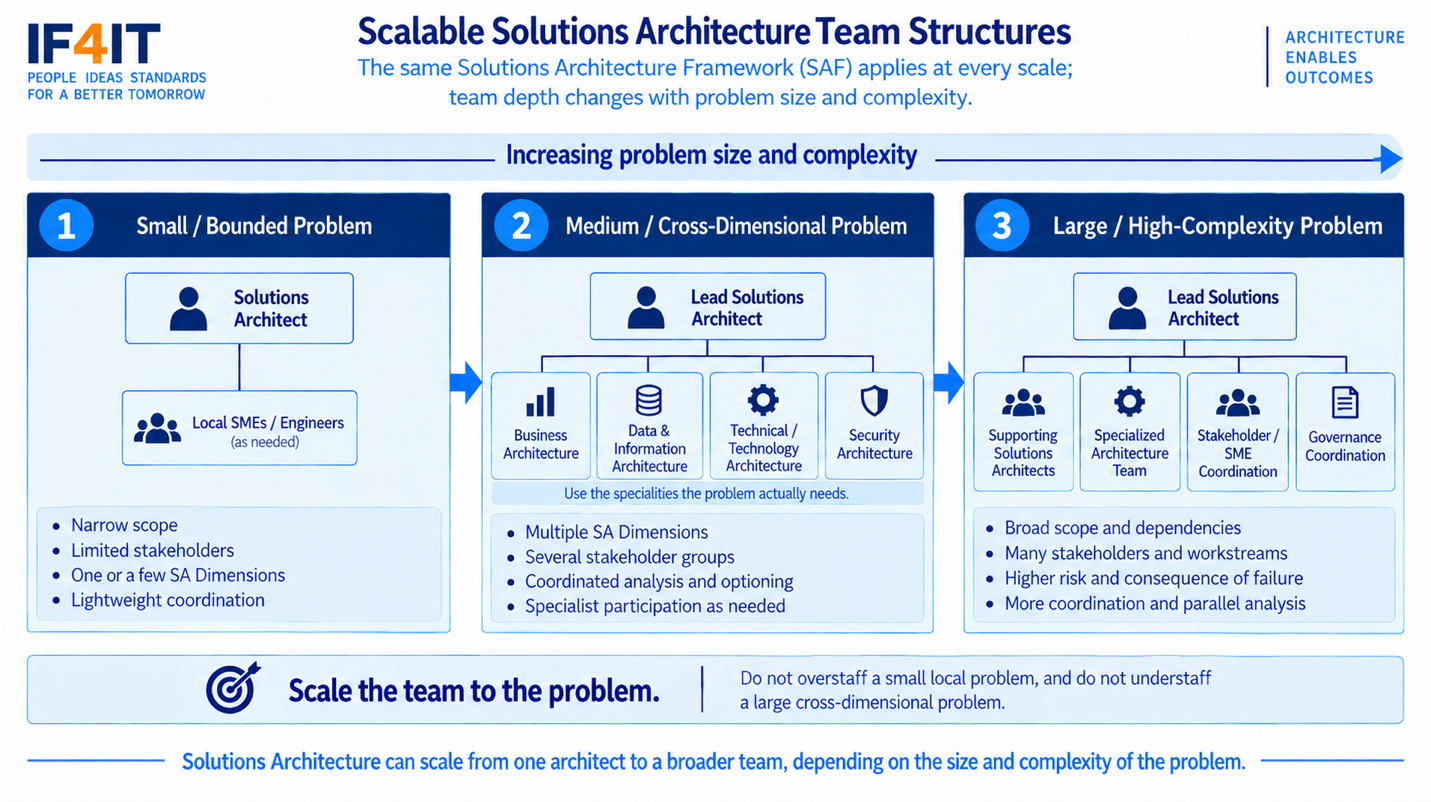
Any engagement staffed with more than one Solutions Architect requires a designated Lead Solutions Architect. The Lead is accountable for the SARB’s overall coherence — ensuring the problem statement, current state, options, and decisions read as one consistent account of the engagement rather than several disconnected contributions — and serves as the Customer’s single point of accountability on the team. This does not change who owns the final decision: as established in “Solutions Presentation and Decisioning,” that decision belongs to the Customer, not the Solutions Architect, Lead or otherwise.
Where a team includes more than one Solutions Architect, work commonly divides along the SA Dimensions covered in full later in this document — one architect concentrating on Data & Information and Security concerns, another on Business and Technology concerns, for example — with the SARB serving as the single point of consolidation regardless of how many contributed to it. The SARB’s own definition already anticipates this: it is the governed container that holds all other related governed artifacts produced across an engagement, not a document written by one person.
Best Practice: Designate a Lead Solutions Architect Whenever More Than One Solutions Architect Is Staffed
As soon as an engagement is staffed with more than one Solutions Architect, formally designate one as Lead — do not leave accountability implicit or assume it will resolve itself as the engagement proceeds. Communicate this designation to the Customer at the outset, alongside the other key stakeholders identified in Vision Development.
Benefit(s)
A formally designated Lead prevents the specific failure of a multi-architect engagement producing a fragmented SARB and an unclear point of contact for the Customer — the same coherence problem a single Solutions Architect never has to solve, made explicit and assigned before it can occur.
How to cite this page
When referencing this page in academic work, internal standards, or external publications, include the page title, IF4IT as author and publisher (The International Foundation for Information Technology (IF4IT), LLC), the URL, and your access date.
Example (informal web citation):
The International Foundation for Information Technology (IF4IT), LLC. Solutions Architecture Team Structure | Solutions Architecture Best Practices and Framework. https://if4it.org/best-practices/solutions-architecture/solutions-architecture-team-structure/ (accessed 2026-09-11).
See About Us for content governance and site-wide citation guidance.
Copyright for The International Foundation for Information Technology (IF4IT), LLC: 2008 - Present
Legal Disclaimers