Why Solutions Architecture Produces a More Reliable Current State - Solutions Architecture Best Practices and Framework
Why Solutions Architecture Produces a More Reliable Current State
(Chapter 13 of Solutions Architecture Best Practices and Framework)
Executive Summary: Chapter Overview
IF4ITThe Bottom Line
Core Concepts
| Concept | Definition & Strategic Role |
|---|---|
| Current-state vetting with blessing | Solutions Architecture engagements validate current-state understanding directly with the people who own the problem, rather than relying on rolled-up or assumed baselines that may no longer reflect what is actually true across the organization. |
| Baseline dependency | Target-state models and transformation roadmaps are only as reliable as the current-state baseline they are built from — a shaky starting point quietly undermines every downstream artifact built on top of it, no matter how carefully those artifacts are produced. |
| SAF Phase 2 | Current State Collection and Analysis, covered in depth later in this document, is the phase in which this vetting takes place — the point in the Solutions Architecture Framework where perceived understanding is checked against what stakeholders actually confirm to be true. |
Quick Q&A
Question: Why is Solutions Architecture's current-state picture more reliable than a typical Enterprise Architecture baseline?
Question: Why does this matter for Enterprise Architecture specifically?
Read More Below
Overview
A Solutions Architecture engagement vets what currently exists — with the actual blessing of the problem owners — before it designs what should exist. Enterprise Architecture, working at a more aggregate, cross-enterprise level, rarely gets this kind of granular, stakeholder-blessed current-state confirmation; it more commonly works from rolled-up or assumed baselines.
This matters beyond the immediate engagement. A target-state model or a transformation roadmap is only as reliable as the current-state baseline it is built from. If that baseline is shaky, every downstream artifact — gap analyses, capability roadmaps, investment sequencing — inherits the error. Solutions Architecture’s discipline of vetting current state before touching future state is what makes the baseline solid, which in turn strengthens Enterprise Architecture’s own forward-looking artifacts, not just its static inventories and models.
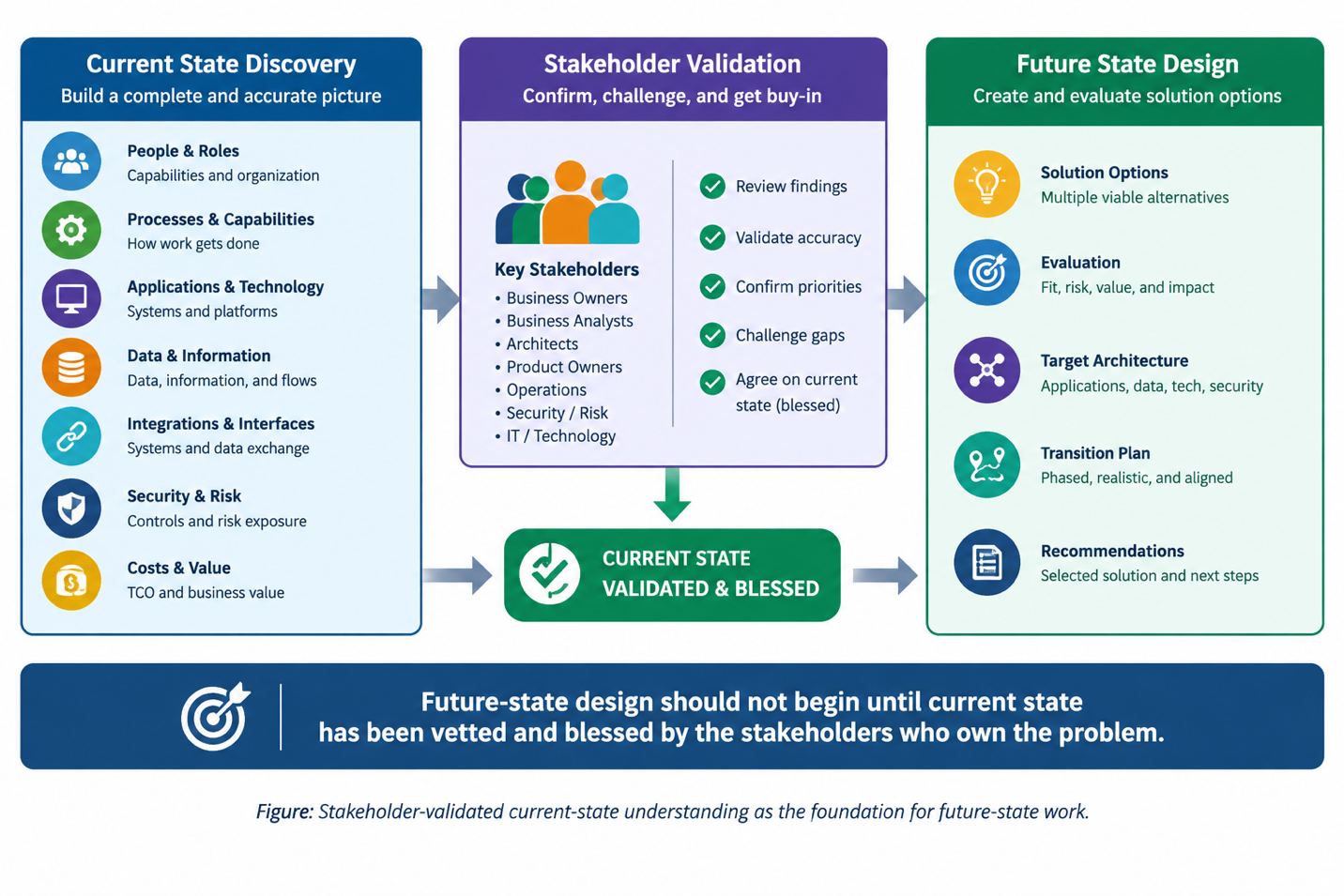
Best Practice: Never Design Future State Before Current State Is Vetted and Blessed
Treat explicit sign-off from the problem owners on the current-state understanding as a gate, not a formality, before any future-state options work begins. This is the responsibility of SAF Phase 2, Current State Collection and Analysis, covered later in this document.
Benefit(s)
A vetted, blessed current-state baseline produces stronger Enterprise Architecture artifacts and avoids costly rework that results from building future-state plans on an inaccurate foundation — a distinct benefit from the organizational-trust case made in the previous chapter.
Anti-Pattern: Designing Future State Before Current State Is Validated
It is tempting to jump straight to solutioning, especially when the Customer is eager for answers and the current state seems obvious enough not to need formal validation. But an unvalidated assumption about what currently exists can silently invalidate every Future State option built on top of it — the fastest way to produce a well-designed solution to the wrong problem.
How to cite this page
When referencing this page in academic work, internal standards, or external publications, include the page title, IF4IT as author and publisher (The International Foundation for Information Technology (IF4IT), LLC), the URL, and your access date.
Example (informal web citation):
The International Foundation for Information Technology (IF4IT), LLC. Why Solutions Architecture Produces a More Reliable Current State | Solutions Architecture Best Practices and Framework. https://if4it.org/best-practices/solutions-architecture/why-solutions-architecture-produces-a-more-reliable-current-state/ (accessed 2026-09-11).
See About Us for content governance and site-wide citation guidance.
Copyright for The International Foundation for Information Technology (IF4IT), LLC: 2008 - Present
Legal Disclaimers