Systems Development Lifecycle (SDLC) Best Practices
Executive Summary: Document Overview
IF4ITThe Bottom Line
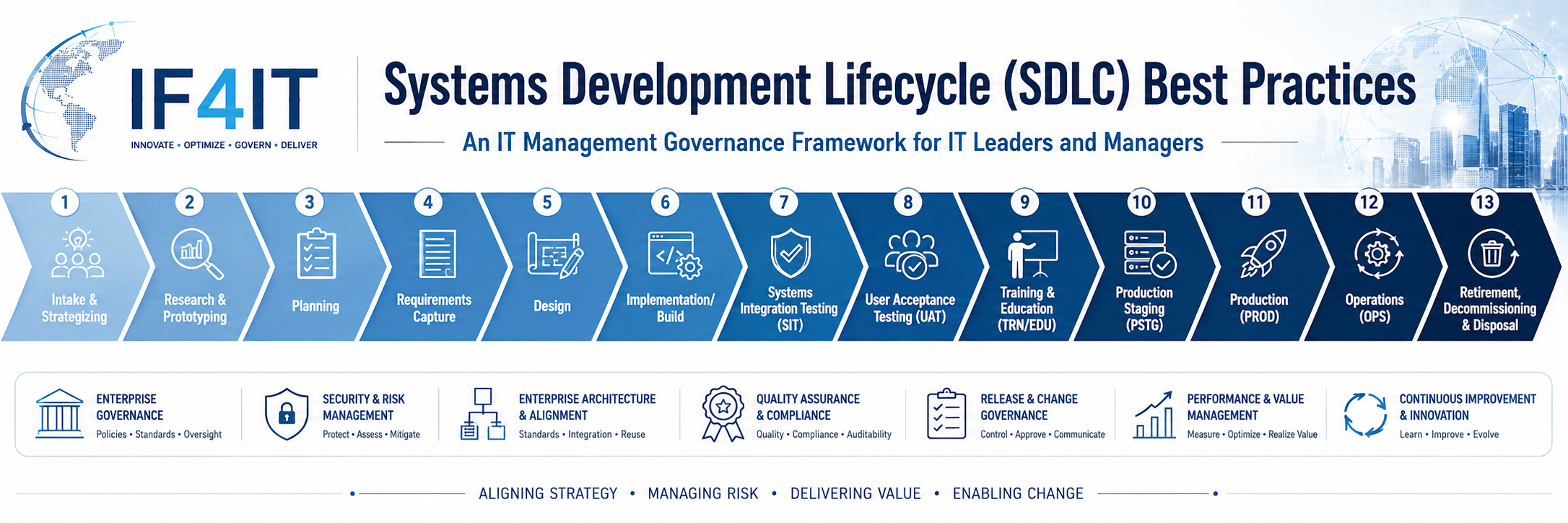
The IF4IT Systems Development Lifecycle (SDLC) is an IT management governance framework for leaders and managers—not merely a software-development process. It provides a comprehensive, tailorable 13-phase lifecycle for Custom-Built, Acquired, and Composite Solutions across Agile, Waterfall, and Hybrid delivery; defines accountable ownership, decision rights, paths, utilization profiles, readiness gates, evidence, enterprise-inventory integration, Operations, and retirement; and embeds security, privacy, verification, validation, accessibility, supply-chain, artificial-intelligence, and other cross-cutting disciplines. The document now pairs prescriptive practices with their benefits, identifies and corrects recurring SDLC antipatterns, uses concise enterprise examples to make difficult decisions concrete, and establishes evidence-based governance and continuous improvement that can make execution more consistent, faster, less costly, more knowledgeable, traceable, and auditable.
Core Pillars & Document Modules
| Document Pillar / Focus Area | Strategic Business Outcome & Intent |
|---|---|
| IT Management Governance Foundation | Positions the SDLC as an enterprise IT management governance framework with authoritative ownership, decision rights, a common vocabulary, a 13-phase lifecycle, and published knowledge so obligations remain visible, accountable, discoverable, and consistently governed. |
| Tailoring, Sourcing, and Delivery Paths | Enables proportionate execution through governed SDLC Paths and Utilization Profiles for Custom-Built, Acquired, and Composite Solutions using Agile, Waterfall, Hybrid, and supplier delivery without silently removing required outcomes or accountability. |
| Phase Execution and Cross-Cutting Assurance | Integrates requirements, architecture, security, privacy, verification, validation, configuration, supply-chain integrity, accessibility, artificial intelligence, stakeholder engagement, supportability, and specialized testing across applicable phases and IT Operating Environments. |
| Roles, Evidence, and Enterprise Integration | Clarifies enterprise, phase, solution, Product, Service, Release, risk, supplier, and operational accountabilities; connects artifacts and evidence to decisions, traceability, inventories, systems of record, readiness gates, exceptions, and residual-risk acceptance. |
| Maturity, Measurement, Antipatterns, and Improvement | Provides Crawl-Walk-Run adoption, paired practices and benefits, concise enterprise examples, outcome-oriented metrics, Release post-mortems, explicit antipattern correction, rollout guidance, and evidence-based continuous improvement that strengthens speed, consistency, cost, knowledge, and auditability. |
Quick Q&A (Macro Executive Reference)
Question: What distinguishes the IF4IT Systems Development Lifecycle (SDLC) from software-development-only lifecycle guidance?
Answer: It is an enterprise IT management governance framework that governs technology-enabled capabilities across strategy, research, planning, requirements, design, acquisition or build, assurance, training, staging, Production, Operations, improvement, and retirement. It defines ownership, decision rights, evidence, readiness, tailoring, supplier accountability, enterprise knowledge, and cross-cutting controls in addition to engineering work.
Question: Must every Release execute all 13 phases with the same activities, artifacts, environments, and rigor?
Answer: No. The 13 phases form a comprehensive enterprise superset. Each Release uses an approved SDLC Path and Utilization Profile to select and scale applicable phases, activities, environments, evidence, and approvals according to risk, complexity, sourcing, and delivery method while preserving required outcomes and accountability.
Question: What enterprise capabilities does this document help establish beyond delivery execution?
Answer: It helps establish authoritative SDLC ownership and knowledge, governed paths and tailoring, Release and readiness governance, traceability and evidence, supplier and risk controls, enterprise-inventory integration, operational acceptance, antipattern correction, outcome-oriented measurement, and a continuous-improvement cycle supported by concise practical examples.
Read Full Table of Contents Below
Table of Contents
Overview and Orientation
- Overview of Systems Development Lifecycle (SDLC) Best Practices
- Why Enterprises Need a Clearly Defined Systems Development Lifecycle (SDLC)
- Why the IF4IT Systems Development Lifecycle (SDLC) Uses Detailed Phases
- How the IF4IT Systems Development Lifecycle (SDLC) Maps to the NIST SDLC
- How to Use This Systems Development Lifecycle (SDLC) Best Practices Document
Foundational SDLC Definitions
- What Is a Systems Development Lifecycle (SDLC)?
- What Is Systems Development Lifecycle (SDLC) Management?
- What Is an SDLC Phase?
- What Is an SDLC Path?
- What Is an SDLC Utilization Profile?
- How Assets, Products, Services, Systems, Applications, and Solutions Relate to the SDLC
- How the Systems Development Lifecycle (SDLC) Relates to a Product or Service Lifecycle
- How the Systems Development Lifecycle (SDLC) Relates to Projects, Programs, and Initiatives
- How the Systems Development Lifecycle (SDLC) Relates to Releases, Release Iterations, and Deployments
- The Difference Between an SDLC Phase, an Activity, an IT Operating Environment, and a Readiness Gate
The IF4IT 13-Phase SDLC
- The 13 Phases of the IF4IT Systems Development Lifecycle (SDLC)
- Why the 13 SDLC Phases Are a Customizable Enterprise Superset
- Which SDLC Phases Correspond to IT Operating Environments?
- Which SDLC Phases Do Not Require a Dedicated IT Operating Environment?
- How Releases Move Through Selected SDLC Phases and IT Operating Environments
The SDLC as an Enterprise Knowledge Framework
- The Systems Development Lifecycle (SDLC) Is a Critical IT Knowledge Artifact
- How the SDLC Becomes the Backbone of an Enterprise Architecture Portal
- How SDLC Phases Should Link to Policies, Standards, Procedures, Best Practices, and Guidelines
- How SDLC Artifacts Should Link Back to the Phases That Require Them
- Centralize and Openly Share SDLC Documentation Through an Enterprise Document Repository
- How a Detailed SDLC Improves Knowledge Transfer and Practitioner Onboarding
Enterprise SDLC Definition and Governance
- How a Detailed SDLC Improves Quality, Productivity, Reuse, and Cost Control
- Use a Standard Knowledge Model for Every SDLC Phase
- Define and Publish an Enterprise Systems Development Lifecycle (SDLC)
- Assign Accountability for Systems Development Lifecycle (SDLC) Governance
- Define the Purpose, Inputs, Activities, Roles, Outputs, Evidence, and Gates for Every SDLC Phase
- Publish Enterprise Governance and Knowledge Assets for Every SDLC Phase
- Align Release Management With Every Applicable SDLC Phase
- Define Standard IT Operating Environment Mappings for Each Asset, Product, Service, System, Application, and Solution Across the SDLC
- Apply Environment Management Across the Systems Development Lifecycle (SDLC)
Roles and Accountability
- Roles and Responsibilities Across the Systems Development Lifecycle (SDLC)
- Asset Owner Responsibilities Across the SDLC
- Product Owner Responsibilities Across the SDLC
- Service Owner Responsibilities Across the SDLC
- Release Owner and Release Manager Responsibilities Across the SDLC
- Architecture Responsibilities Across the SDLC
- Engineering, Testing, Operations, Security, Privacy, Data, and Support Responsibilities Across the SDLC
- Supplier, Procurement, Legal, and Vendor-Management Responsibilities Across the SDLC
- Decision Authorities, Risk Owners, and Acceptance Authorities Across the SDLC
Crawl, Walk, and Run SDLC Maturity
- Crawl, Walk, and Run Maturity Across the Systems Development Lifecycle (SDLC)
- Distinguish SDLC Maturity From Solution Risk
- Tailor and Mature the SDLC Without Compromising Required Outcomes
- How Small and Resource-Constrained Enterprises Can Implement an Effective SDLC
- Document What Is Deferred When Applying a Crawl-Level SDLC
- Define Minimum Non-Negotiable SDLC Outcomes
- Develop an SDLC Maturity Improvement Roadmap
Establishing, Maturing, and Governing the Enterprise SDLC
- How to Establish an Enterprise Systems Development Lifecycle (SDLC)
- How to Assess the Current State of an Enterprise SDLC
- How to Establish a Crawl-Level SDLC
- How to Pilot and Roll Out a New Enterprise SDLC
- How to Train Employees, Consultants, Suppliers, and Stakeholders to Use the SDLC
- How to Advance From Crawl to Walk SDLC Maturity
- How to Advance From Walk to Run SDLC Maturity
- How to Sustain Adoption and Prevent SDLC Process Decay
- Govern and Continuously Improve the Enterprise Systems Development Lifecycle (SDLC)
SDLC Tailoring and Utilization Profiles
- Tailor the SDLC for Each Asset, Product, Service, and Release
- How Asset Owners, Product Owners, and Service Owners Customize the SDLC
- Create and Maintain an SDLC Utilization Profile for Each Release
- Select SDLC Phases and IT Operating Environments Based on Risk and Complexity
- The Difference Between SDLC Tailoring and an SDLC Exception
SDLC Conformance and Exception Governance
- SDLC Conformance, Deviations, Exceptions, and Risk Acceptance
- Govern SDLC Conformance, Exceptions, Compensating Controls, and Residual Risk
- How SDLC Readiness Gates Should Make Progression Decisions
- How SDLC Exceptions Should Be Tracked Through Operations and Maintenance
Custom-Built and Acquired Solution Paths
- What Is a Custom-Built Solution?
- What Is an Acquired Solution?
- What Is a Composite or Mixed-Sourcing Solution?
- Custom-Built vs. Acquired Solutions — Comparing Lifecycle Mechanics Across the SDLC
- Custom-Built vs. Acquired Solutions — Governance, Decision Rights, and Authority Within and Across the SDLC
- Apply the SDLC to Acquired, Outsourced, SaaS, and Externally Developed Solutions
- Define and Publish Custom-Built and Acquired Solution Paths Through the SDLC
- How Contractual Requirements Support the SDLC for Acquired Solutions
Agile, Waterfall, and Hybrid Delivery
- The Systems Development Lifecycle (SDLC) Is Methodology-Neutral
- How Waterfall Delivery Moves Through the SDLC
- How Agile Delivery Moves Through the SDLC
- How Hybrid Delivery Moves Through the SDLC
- The Difference Between a Sprint, a Release Iteration, a Release, and an SDLC Phase
- Select Delivery Methodology for the SDLC Based on the Characteristics and Risks of the Work
Cross-Cutting SDLC Disciplines
- Cross-Cutting Disciplines That Apply Throughout the SDLC
- Security and Privacy Across the Systems Development Lifecycle (SDLC)
- Integrate Security and Privacy Into Every Applicable SDLC Phase
- Verification, Validation, and Assurance Across the Systems Development Lifecycle (SDLC)
- Define Verification, Validation, Evidence, and Assurance Requirements for Every SDLC Phase
- Configuration, Baseline, and Technical-Data Management Across the SDLC
- Govern Solution, Infrastructure, and IT Operating Environment Configurations Across the SDLC
- Technology Supply-Chain Integrity Across the Systems Development Lifecycle (SDLC)
- Govern Technology Supply-Chain Integrity Across the SDLC
- Accessibility and Inclusive Design Across the Systems Development Lifecycle (SDLC)
- Integrate Accessibility and Inclusive Design Into Every Applicable SDLC Phase
- Artificial Intelligence (AI) and Generative AI Across the Systems Development Lifecycle (SDLC)
- Tailor the SDLC for Artificial Intelligence (AI)-Enabled Solutions
- Govern the Use of Generative AI Across the Systems Development Lifecycle (SDLC)
- Stakeholder Engagement and Human-Centered Outcomes Across the SDLC
- Identify, Engage, and Govern Stakeholders Throughout the SDLC
- End-of-Life, Supportability, and Technology Obsolescence Across the SDLC
- Plan for Supportability, Obsolescence, Replacement, and Retirement Throughout the SDLC
Lifecycle Information, Inventories, and Enterprise Systems
- Lifecycle Information Architecture and Artifact Metadata Across the SDLC
- Define and Govern an Enterprise SDLC Information Architecture
- Required Metadata for SDLC Artifacts and Evidence
- Integrate the SDLC With Enterprise Inventories and Operational Systems
- Enterprise Inventories That Should Be Updated Through the SDLC
- Enterprise Systems That Should Integrate With the SDLC
- Release-Triggered Updates to Enterprise Inventories and Systems of Record Across the SDLC
- Automate SDLC Inventory and Operational-System Updates Where Practical
Artifacts, Evidence, and Traceability
- Common Inputs, Outputs, Artifacts, and Evidence Across the SDLC
- Maintain Traceability From Stakeholder Needs Through Production Outcomes Across the SDLC
- Prove Across the SDLC That the Tested and Approved Configuration Is the Configuration Deployed
- Keep Technical Documentation Synchronized With the Operated Solution Across the SDLC
- Preserve Required SDLC Evidence Through Operations and Retirement
The 13 SDLC Phase Best Practices
- Intake and Strategizing Phase of the Systems Development Lifecycle (SDLC)
- Research and Prototyping Phase of the Systems Development Lifecycle (SDLC)
- Planning Phase of the Systems Development Lifecycle (SDLC)
- Requirements Capture Phase of the Systems Development Lifecycle (SDLC)
- Design Phase of the Systems Development Lifecycle (SDLC)
- Implementation and Build Phase of the Systems Development Lifecycle (SDLC)
- Systems Integration Testing (SIT) Phase of the Systems Development Lifecycle (SDLC)
- User Acceptance Testing (UAT) Phase of the Systems Development Lifecycle (SDLC)
- Training and Education (TRN/EDU) Phase of the Systems Development Lifecycle (SDLC)
- Pre-Production Staging (PSTG) Phase of the Systems Development Lifecycle (SDLC)
- Production (PROD) Phase of the Systems Development Lifecycle (SDLC)
- Operations and Maintenance (OPS) Phase of the Systems Development Lifecycle (SDLC)
- Retirement, Decommissioning, and Disposal Phase of the Systems Development Lifecycle (SDLC)
Optional and Specialized SDLC Phases and Activities
- When to Add Optional or Specialized Phases to the SDLC
- The Difference Between an Optional SDLC Phase, Specialized Activity, and Dedicated Environment
- Penetration Testing Within the Systems Development Lifecycle (SDLC)
- Disaster-Recovery and Business-Continuity Testing Within the SDLC
- Performance, Load, Stress, and Capacity Testing Within the SDLC
- Data Migration and Conversion Rehearsal Within the SDLC
- Regulatory Validation and Certification Within the SDLC
- Security Certification and Authorization Within the SDLC
- Operational-Readiness Assessment Within the SDLC
- Cutover and Rollback Rehearsal Within the SDLC
- Safety Validation Within the SDLC
SDLC Metrics and Continuous Improvement
- Metrics and Measures for Systems Development Lifecycle (SDLC) Effectiveness
- How to Measure SDLC Quality, Efficiency, Cost, Risk, and Outcomes
- How Release Post-Mortems Improve the SDLC
- Use SDLC Evidence and Outcomes to Drive Continuous Improvement
- Periodically Reassess SDLC Maturity, Tailoring Rules, and Conformance
Closing Guidance
Glossary of Terms and Phrases
Copyright for The International Foundation for Information Technology (IF4IT), LLC: 2008 - Present