Apply the SDLC to Acquired, Outsourced, SaaS, and Externally Developed Solutions - Systems Development Lifecycle (SDLC) Best Practices
Apply the SDLC to Acquired, Outsourced, SaaS, and Externally Developed Solutions
(Chapter 75 of Systems Development Lifecycle (SDLC) Best Practices)
Executive Summary: Chapter Overview
IF4ITThe Bottom Line
Core Concepts
| Concept | Definition & Strategic Role |
|---|---|
| Governing Principle | The enterprise may outsource lifecycle activities, but it cannot outsource accountability for the suitability and lifecycle consequences of the resulting Solution. |
| Lifecycle Accountability | Enduring ownership and Release-specific coordination remain explicit. |
| Evidence | Claims and decisions are supported by attributable, current, relevant, and sufficient evidence. |
| Risk-Based Tailoring | Depth changes with context; minimum outcomes and accountability remain. |
Quick Q&A
Question: Why must SaaS and outsourced Solutions follow the SDLC?
Question: Which phases are commonly underestimated for externally provided Solutions?
Question: What should the enterprise require from external providers?
Read More Below
Explains how to apply the full Enterprise SDLC when work or technology is acquired, outsourced, delivered as SaaS, or developed externally.
Best Practice: Establish the Governing Principle for Apply the SDLC to Acquired, Outsourced, SaaS, and Externally Developed Solutions
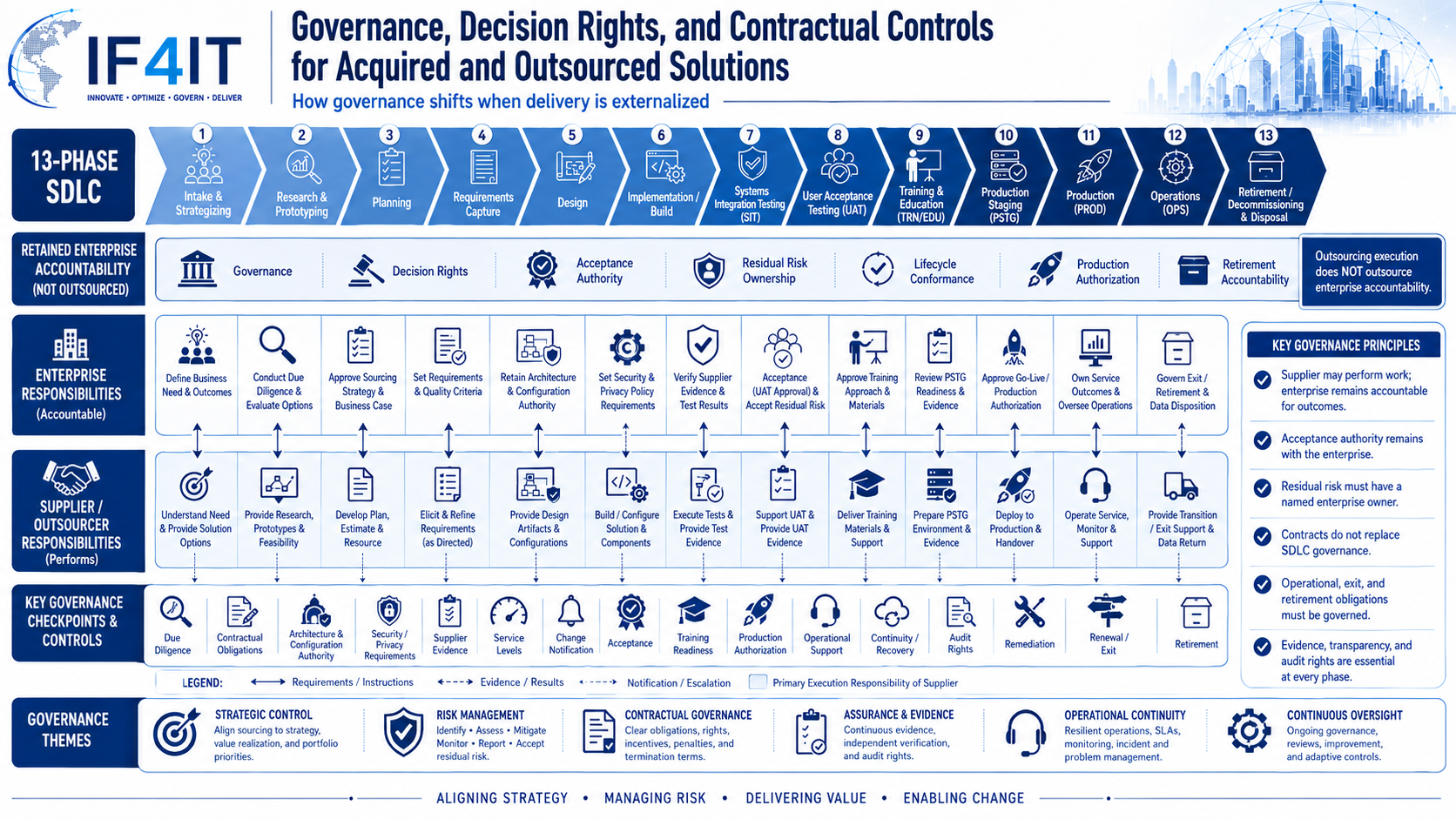
The enterprise may outsource lifecycle activities, but it cannot outsource accountability for the suitability and lifecycle consequences of the resulting Solution.
Benefits: Making clear that outsourcing activities doesn’t outsource accountability keeps the enterprise from assuming a vendor’s contractual performance automatically satisfies the enterprise’s own obligation to confirm the Solution actually works and is safe to operate.
Best Practice: Define Required Lifecycle Treatment for Apply the SDLC to Acquired, Outsourced, SaaS, and Externally Developed Solutions
| Area | Required treatment |
|---|---|
| Classification | Classify the Solution by actual lifecycle responsibility, not merely by who performs the coding or hosting. |
| Mapping | Map supplier methods and deliverables to all applicable 13 phases, outcomes, Environments, Gates, evidence, and authorities. |
| Contracts | Require deliverables, participation, evidence, notifications, support, continuity, and exit obligations. |
| Enterprise V&V | Validate the configured, integrated, data-enabled, and operational Solution in the enterprise context. |
| Ongoing governance | Apply the SDLC to supplier upgrades, renewals, material changes, support changes, and retirement. |
Benefits: Classifying a Solution by actual lifecycle responsibility, not by who wrote the code, means an outsourced build the enterprise fully governs gets treated more like Custom-Built, while a lightly configured SaaS Product gets Acquired treatment — matching governance to genuine responsibility rather than a superficial label.
Best Practice: Apply the SDLC to Acquired, Outsourced, SaaS, and Externally Developed Solutions Throughout the SDLC
This discipline spans the complete lifecycle. Planning establishes ownership and evidence needs; Design and Build turn it into testable requirements; SIT, UAT, and Staging generate representative evidence; Production and Operations verify and monitor compliance; Retirement closes it out with evidence of completion.
Benefits: Carrying supplier participation requirements from Intake through Retirement means externally developed work stays under enterprise oversight for its entire operational life, not just during the initial delivery engagement when the supplier relationship is most visible.
Best Practice: Govern Decisions and Preserve Evidence for Apply the SDLC to Acquired, Outsourced, SaaS, and Externally Developed Solutions
Assign enduring ownership across the Solution, Release, and applicable discipline, plus evidence producers, reviewers, and a Risk Owner, scaling rigor to criticality and reversibility. Track Risks, exceptions, and Technical Debt authoritatively rather than informally. Automation and generative AI can support the work but should not make accountable decisions on their own.
Benefits: Naming an enduring Solution owner regardless of who actually built the Solution ensures externally developed and outsourced work has the same durable accountability as anything built entirely in-house, closing a gap where ‘someone else built it’ quietly becomes ’no one owns it.’
Example
An enterprise acquiring a SaaS customer-service platform begins with supplier due diligence, data and privacy assessment, architectural fit, and contractual requirements for security, availability, support, audit rights, and data return. The implementation then governs tenant configuration, integrations, identity, migration, and enterprise acceptance testing. Production readiness confirms monitoring, support, incident escalation, continuity, and vendor contacts. Operations tracks service performance and supplier obligations, while retirement planning addresses data extraction, replacement, contract termination, and secure disposal. Acquisition changes the control model; it does not eliminate the lifecycle.
Best Practice: Advance Maturity Deliberately for Apply the SDLC to Acquired, Outsourced, SaaS, and Externally Developed Solutions
At Crawl maturity, apply a short supplier-oversight checklist covering due diligence, acceptance criteria, and a named enterprise owner. At Walk maturity, apply a standard supplier onboarding and evidence process consistently across acquired and outsourced work, with defined enterprise acceptance criteria independent of supplier certification. At Run maturity, integrate supplier compliance, contract obligations, and evidence into enterprise systems so gaps between contracted and actual supplier performance are flagged automatically.
Benefits: A short checklist at Crawl maturity is enough to keep enterprise accountability visible without requiring a formal supplier-management program the enterprise doesn’t yet have. Applying consistent onboarding and acceptance criteria at Walk maturity means every acquired or outsourced Solution gets genuinely comparable enterprise scrutiny, not whatever the individual Release Owner happens to think of. Integrating compliance tracking at Run maturity catches the gap between what a supplier promised and what they’re actually delivering before it becomes an enterprise incident.
Best Practice: Avoid Common Antipatterns in Apply the SDLC to Acquired, Outsourced, SaaS, and Externally Developed Solutions
Enterprises should avoid classifying a Solution by who performs the work rather than who holds lifecycle responsibility. A Solution built by an outsourced team but governed and accepted entirely by the enterprise is functionally closer to Custom-Built than a lightly configured SaaS Product; classifying purely by who wrote the code, rather than by actual lifecycle responsibility, can misapply the wrong governance model.
| Antipattern | Why it fails |
|---|---|
| Classifying a Solution by who performs the work rather than who holds lifecycle responsibility | A Solution built by an outsourced team but governed entirely by the enterprise is functionally closer to Custom-Built; classifying purely by who wrote the code can misapply the wrong governance model. |
Benefits: Avoiding this antipattern keeps governance treatment matched to actual accountability, not to a surface-level label. It prevents an enterprise-governed outsourced build from receiving lighter treatment than the genuine lifecycle responsibility actually warrants.
Connections to Related IF4IT Practices and Inventories
Use Application Portfolio Management (APM) Best Practices and the Applications Inventory and Attributes to govern ownership, sourcing posture, lifecycle status, dependencies, and enterprise acceptance for custom-built and acquired solutions. Use Technology Portfolio Management (TPM) Best Practices, the Software Technologies Inventory and Attributes, and IT Operating Environments Best Practices to connect the decisions and responsibilities addressed in this chapter to governed technology choices, platform lifecycle, and environment controls.
Ground quality expectations in the Non-Functional Requirements (NFRs) Framework for Software Systems, connecting them to validation methods, test evidence, acceptance criteria, readiness gates, and Production assurance.
Release scope, environment progression, deployment evidence, cutover, rollback, and closure are governed through Release Management guidance, IT Operating Environments Best Practices, and Agile, Waterfall, or Hybrid: An IF4IT Framework for Choosing Delivery Methodology.
How to cite this page
When referencing this page in academic work, internal standards, or external publications, include the page title, IF4IT as author and publisher (The International Foundation for Information Technology (IF4IT), LLC), the URL, and your access date.
Example (informal web citation):
The International Foundation for Information Technology (IF4IT), LLC. Apply the SDLC to Acquired, Outsourced, SaaS, and Externally Developed Solutions | Systems Development Lifecycle (SDLC) Best Practices. https://if4it.org/best-practices/systems-development-lifecycle-sdlc/apply-the-sdlc-to-acquired-outsourced-saas-and-externally-developed-solutions/ (accessed 2026-10-16).
See About Us for content governance and site-wide citation guidance.
Copyright for The International Foundation for Information Technology (IF4IT), LLC: 2008 - Present
Legal Disclaimers