Create and Maintain an SDLC Utilization Profile for Each Release - Systems Development Lifecycle (SDLC) Best Practices
Create and Maintain an SDLC Utilization Profile for Each Release
(Chapter 63 of Systems Development Lifecycle (SDLC) Best Practices)
Executive Summary: Chapter Overview
IF4ITThe Bottom Line
Core Concepts
| Concept | Definition & Strategic Role |
|---|---|
| SDLC Utilization Profile | See the chapter discussion and enterprise glossary for the governed meaning and application of this concept. |
| Release-Specific Lifecycle Configuration | See the chapter discussion and enterprise glossary for the governed meaning and application of this concept. |
| Profile Approval | See the chapter discussion and enterprise glossary for the governed meaning and application of this concept. |
| Profile Reassessment | See the chapter discussion and enterprise glossary for the governed meaning and application of this concept. |
| Phase Applicability | See the chapter discussion and enterprise glossary for the governed meaning and application of this concept. |
Quick Q&A
Question: Is the Utilization Profile a separate SDLC?
Question: Must every Release have a long profile?
Question: Does profile approval prove lifecycle outcomes were achieved?
Read More Below
This chapter defines the governed Release-specific record that translates the Enterprise SDLC, selected standard Path, and enduring governed-object context into an explicit lifecycle implementation for one Release or approved scope.
Best Practice: Apply Purpose and Definition
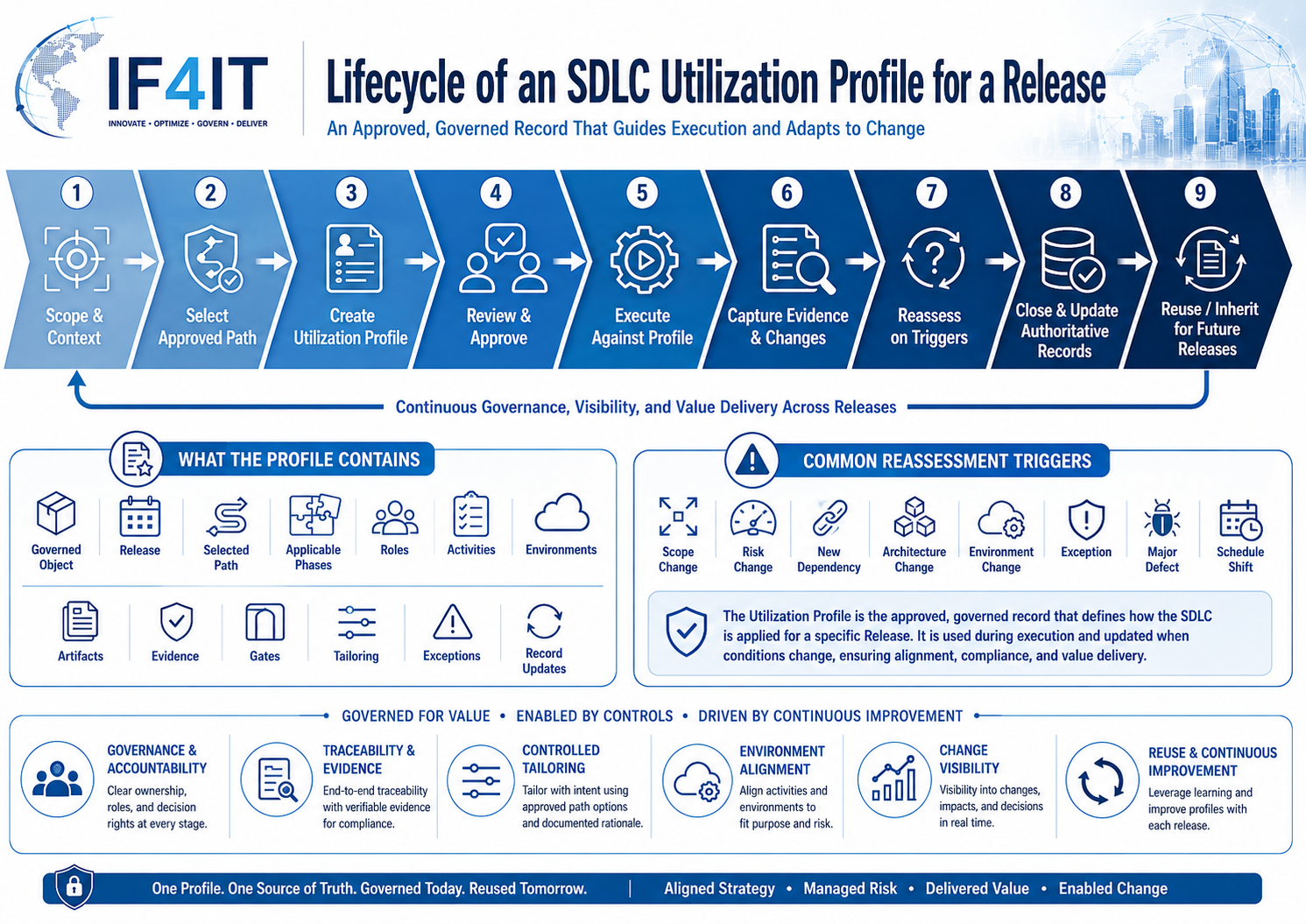
An SDLC Utilization Profile identifies the selected Path, applicable phases, phase depth, sequencing, Activities, roles, stakeholders, sourcing responsibilities, specialist participation, Artifacts, documentation, evidence, Environments, baselines, Readiness Gates, enterprise-record updates, Technical Debt obligations, tailoring, alternative methods, exceptions, and reassessment triggers.
The profile defines the lifecycle configuration; it is not a Project plan, Release record, Risk record, Exception record, Technical Debt Item, or proof that outcomes were achieved.
Benefits: Capturing the selected Path, sourcing responsibilities, and reassessment triggers together in one profile gives every stakeholder a single, complete reference for how the Release is actually being governed, rather than piecing that picture together from scattered emails and separate documents.
Best Practice: Apply When and How Much Detail
Material new capabilities, Releases, supplier implementations and upgrades, significant infrastructure changes, migrations, high-risk remediation, modernization, Technical Debt remediation, and retirement should normally have explicit profiles. Routine low-risk work may use an automatically generated, standing, or concise profile.
The profile should be detailed enough to remove material ambiguity and concise enough to remain current.
Benefits: Reserving explicit profiles for material changes while letting routine low-risk work use a concise or standing profile means documentation effort scales with actual Risk, instead of imposing the same heavyweight profile requirement on a minor Defect fix as on a major migration.
Best Practice: Establish the Profile Early
Create an initial profile during Intake, Planning, or another approved early point before detailed schedules, supplier commitments, Environment dates, assurance scope, or Production targets are fixed. The profile may begin provisionally and mature as scope, requirements, Architecture, sourcing, and Risk become clearer.
Benefits: Creating the profile during Intake or Planning, before schedules and supplier commitments are fixed, means tailoring decisions can still shape the Release’s actual scope and approach, rather than being reduced to documenting choices that have already been locked in elsewhere.
Best Practice: Apply Required Profile Content
Unique Release or governed-scope identifier, owner, purpose, intended outcomes, type, and sourcing model
Affected Assets, Products, Services, Systems, Applications, Solutions, APIs, integrations, data, suppliers, Environments, and business processes
Enduring governed-object context retrieved from authoritative systems
Release-specific risk, criticality, complexity, novelty, change impact, and reversibility
Selected standard SDLC Path and version
Minimum non-negotiable outcome mapping
Phase applicability, depth, sequencing, overlap, iteration, and completion basis
Material Activities, accountable and responsible roles, stakeholders, decision rights, and required independence
Custom-Built, Acquired, Composite, supplier, and component responsibility boundaries
Cross-cutting discipline triggers, contributions, timing, evidence, and authority
Required, conditional, inherited, combined, supplier-provided, and continuously maintained Artifacts and documentation
Evidence source, owner, Environment, baseline, reviewer, retention, and decision use
Readiness Gates, exit criteria, authorities, possible outcomes, conditional approvals, and decision-record locations
IT Operating Environment route, Instances, data, access, baselines, representativeness, and limitations
Release Iterations, Deployments, promotion rules, rollback, Production verification, stabilization, and closure
Configuration and baseline requirements
Enterprise Document Repository publication obligations
Enterprise inventory and system-of-record updates
Technical Debt inheritance, discovery, creation, remediation, validation, transfer, and closure obligations
Tailoring decisions, alternative methods, linked exceptions, and reassessment triggers
Benefits: Requiring the profile to capture affected Assets, sourcing model, and enduring governed-object context together means a Gate reviewer sees the complete picture in one place, rather than needing to separately track down each piece of context from a different authoritative system.
Best Practice: Distinguish Tailoring, Alternatives, Exceptions, and Nonconformance
| Category | Meaning |
|---|---|
| Tailoring | Selects or adjusts an approved implementation within enterprise rules |
| Alternative method | Satisfies the same requirement through an approved equivalent mechanism |
| Exception | Authorizes a departure from an applicable requirement and records residual Risk |
| Nonconformance | Fails to satisfy an applicable obligation without valid authorization |
Benefits: Keeping tailoring, alternative methods, and exceptions as genuinely distinct categories in the profile prevents any one of them from becoming a catch-all label that quietly disguises what’s actually a nonconformance the enterprise never formally authorized.
Best Practice: Apply Approve, Maintain, Use, and Close the Profile
Approval authority should reflect risk, criticality, scope, sourcing, and degree of tailoring and may involve the Release Owner, enduring owners, SDLC governance, technical and operational owners, Risk Owners, and specialists.
Maintain the profile through material changes and preserve version, rationale, approver, and effective date. Gate authorities should use the current profile to determine applicable outcomes, evidence, participants, tailoring, exceptions, and unresolved obligations.
At closure, record the final Path, actual phase and Environment treatment, tailoring, exceptions, evidence completion, documentation publication, inventory updates, Technical Debt disposition, continuing obligations, and closure decision. Preserve the final profile with the Release record.
Benefits: Scaling approval authority to actual risk and degree of tailoring means a routine profile doesn’t need to escalate to senior governance, while a highly tailored, high-risk Release genuinely does get the oversight its departure from standard practice warrants.
Best Practice: Apply Reassessment Triggers
Material scope or criticality change
New sensitive data, supplier, AI functionality, or regulatory obligation
Major Architecture or Production-exposure change
Changed Environment route or unsuitable Environment
Failed Verification or Validation
Significant Technical Debt discovery
Changed operational ownership or support model
Benefits: Defining concrete reassessment triggers like a changed Environment route or failed Validation means the profile gets revisited exactly when circumstances actually warrant it, rather than staying frozen at its original assumptions while the Release’s real risk profile has since shifted.
Best Practice: Advance Maturity Deliberately for Create and Maintain an SDLC Utilization Profile for Each Release
| Capability | Crawl | Walk | Run |
|---|---|---|---|
| Creation | Manual concise form | Standard workflow using reusable Paths | Context-aware generated profile |
| Context | Manually referenced | Integrated authoritative relationships | Automatically retrieved and validated |
| Path selection | Practitioner judgment | Governed decision matrix | Policy-assisted recommendation |
| Evidence | Manually listed | Integrated requirements | Continuous attributable mapping |
| Updates | Periodic manual review | Workflow-triggered reassessment | Event-driven reassessment |
| Analytics | Basic completion reporting | Path, outcome, and tailoring dashboards | Predictive lifecycle-treatment analysis |
Benefits: Starting with a manual concise form at Crawl maturity establishes the discipline that a standard workflow using reusable Paths at Walk maturity depends on. Pursuing context-aware, automatically generated profiles at Run maturity before the basics are solid tends to automate a process built on incomplete practitioner judgment.
Best Practice: Avoid Common Antipatterns in Create and Maintain an SDLC Utilization Profile for Each Release
Enterprises should avoid treating the SDLC Utilization Profile as a late administrative form, a copied checklist, or static documentation. The profile should be established early enough to shape planning and execution, tailored to the actual governed scope, and reassessed whenever material conditions change. Tailoring, alternative methods, exceptions, and nonconformance must remain distinct, and profile approval must not be mistaken for evidence that required lifecycle outcomes have been achieved.
| Antipattern | Why it fails |
|---|---|
| Creating the profile after most work is complete | Prevents it from shaping planning and execution. |
| Copying a prior profile blindly | Carries forward obsolete assumptions. |
| Treating the profile as a document checklist | Omits outcomes, authority, evidence, Environments, and records. |
| Recording exceptions as tailoring | Bypasses Risk and approval governance. |
| Failing to update after scope change | Makes lifecycle governance inaccurate. |
| Treating approval as evidence of achieved outcomes | Confuses planned treatment with completed work. |
Benefits: Avoiding these antipatterns keeps the Utilization Profile accurate, actionable, and useful throughout the Release. It improves planning, stakeholder alignment, evidence expectations, readiness decisions, exception governance, and closure. It also prevents obsolete assumptions from being copied forward, ensures material changes trigger reassessment, and preserves a reliable historical record of how the Release actually used the SDLC.
Example
A supplier-delivered payment integration uses an SDLC Utilization Profile that records selected phases, required test environments, enterprise and supplier responsibilities, required evidence, readiness gates, and named decision authorities. The profile notes that the supplier performs component testing, but the enterprise retains responsibility for integration testing, business acceptance, security validation, and operational readiness. A temporary performance-test exception is linked to its risk owner, compensating controls, expiration date, and remediation Release. The profile becomes the governed map of how this specific Release will use the SDLC.
Connections to Related IF4IT Practices and Inventories
Use Application Portfolio Management (APM) Best Practices and the Applications Inventory and Attributes to place this SDLC decision in the context of application ownership, portfolio value, lifecycle state, and dependencies. Use Technology Portfolio Management (TPM) Best Practices, the Software Technologies Inventory and Attributes, and IT Operating Environments Best Practices to connect the decisions and responsibilities addressed in this chapter to governed technology choices, platform lifecycle, and environment controls.
Connect this practice to Release Management guidance, IT Operating Environments Best Practices, and Agile, Waterfall, or Hybrid: An IF4IT Framework for Choosing Delivery Methodology, which together govern Release scope, environment progression, deployment evidence, cutover, rollback, and closure.
Use the Non-Functional Requirements (NFRs) Framework for Software Systems to tie quality expectations to validation methods, test evidence, acceptance criteria, readiness gates, and Production assurance.
How to cite this page
When referencing this page in academic work, internal standards, or external publications, include the page title, IF4IT as author and publisher (The International Foundation for Information Technology (IF4IT), LLC), the URL, and your access date.
Example (informal web citation):
The International Foundation for Information Technology (IF4IT), LLC. Create and Maintain an SDLC Utilization Profile for Each Release | Systems Development Lifecycle (SDLC) Best Practices. https://if4it.org/best-practices/systems-development-lifecycle-sdlc/create-and-maintain-an-sdlc-utilization-profile-for-each-release/ (accessed 2026-10-16).
See About Us for content governance and site-wide citation guidance.
Copyright for The International Foundation for Information Technology (IF4IT), LLC: 2008 - Present
Legal Disclaimers