Cross-Cutting Disciplines That Apply Throughout the SDLC - Systems Development Lifecycle (SDLC) Best Practices
Cross-Cutting Disciplines That Apply Throughout the SDLC
(Chapter 84 of Systems Development Lifecycle (SDLC) Best Practices)
Executive Summary: Chapter Overview
IF4ITThe Bottom Line
Core Concepts
| Concept | Definition & Strategic Role |
|---|---|
| Governing Principle | A cross-cutting discipline is not a separate phase or late review; it is a governed body of requirements, expertise, controls, evidence, and continuing responsibilities applied across applicable lifecycle decisions. |
| Lifecycle Accountability | Enduring ownership and Release-specific coordination remain explicit. |
| Evidence | Claims and decisions are supported by attributable, current, relevant, and sufficient evidence. |
| Risk-Based Tailoring | Depth changes with context; minimum outcomes and accountability remain. |
Quick Q&A
Question: What makes a discipline cross-cutting?
Question: Which disciplines commonly cut across the SDLC?
Question: How should cross-cutting obligations be planned?
Read More Below
Defines cross-cutting disciplines that influence multiple SDLC phases and must shape lifecycle work from the earliest applicable point through Operations and Retirement.
Governing Principle
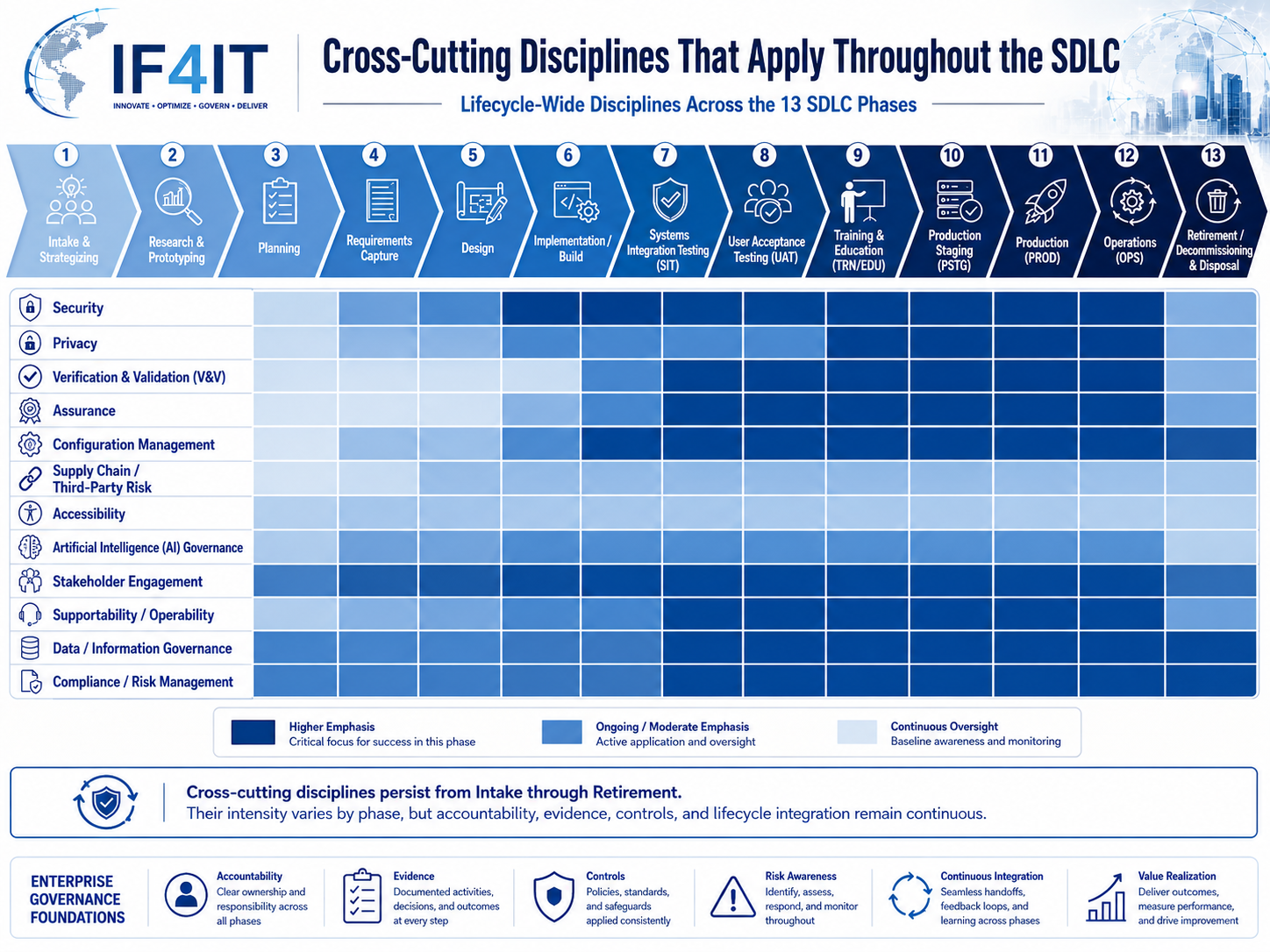
A cross-cutting discipline is not a separate phase or late review; it is a governed body of requirements, expertise, controls, evidence, and continuing responsibilities applied across applicable lifecycle decisions.
Required Lifecycle Treatment
| Area | Required treatment |
|---|---|
| Core disciplines | Include Security, Privacy, V&V, Assurance, configuration and baselines, technical data, supply-chain integrity, accessibility, AI, information management, resilience, Architecture, Risk, supplier governance, and operational readiness. |
| Applicability | Apply every relevant discipline, but scale depth and specialist participation according to risk and context. |
| Integration | Embed discipline requirements in Paths, Utilization Profiles, requirements, Design, Build, Environments, Gates, Release, Operations, and Retirement. |
| Ownership | Combine enterprise discipline ownership with enduring Solution ownership, Release coordination, specialist participation, and accountable decision authority. |
| Shared controls | Reuse shared Services and evidence only when scope, version, currentness, configuration, and applicability are demonstrated. |
Application Through the SDLC
Apply this discipline from Intake through Retirement. Early phases establish ownership, risk, and evidence needs in the Utilization Profile; Requirements through Build translate the principle into testable conditions; SIT through Staging generate decision-ready evidence in representative Environments; Production and Operations verify and monitor the authorized state; Retirement closes remaining obligations with evidence.
Governance and Evidence
Name accountable owners for the Solution, Release, and applicable discipline, along with evidence producers, reviewers, and a Risk Owner. Scale rigor to actual risk and reversibility, and keep Risks, exceptions, and Technical Debt in authoritative systems rather than narrative status. AI may assist with analysis and drafting but should never independently accept Risk or authorize Production.
Connections to Related IF4IT Practices and Inventories
The IF4IT Enterprise Model, Enterprise Capability Models, and the Capabilities Inventory and Attributes keep this chapter’s decisions and responsibilities connected to enterprise structure, capability ownership, and measurable business outcomes. Use the Data and Information Inventory and Attributes and the Integrations Inventory and Attributes to connect the decisions and responsibilities addressed in this chapter to authoritative information, semantic meaning, interface dependencies, lineage, and lifecycle records.
The Non-Functional Requirements (NFRs) Framework for Software Systems connects quality expectations to validation methods, test evidence, acceptance criteria, readiness gates, and Production assurance.
Security, privacy, Risk, compliance, audit, and authorization controls should be integrated throughout this chapter’s decisions and responsibilities so required evidence, exceptions, residual Risk, and accountable approvals stay visible and governed.
How to cite this page
When referencing this page in academic work, internal standards, or external publications, include the page title, IF4IT as author and publisher (The International Foundation for Information Technology (IF4IT), LLC), the URL, and your access date.
Example (informal web citation):
The International Foundation for Information Technology (IF4IT), LLC. Cross-Cutting Disciplines That Apply Throughout the SDLC | Systems Development Lifecycle (SDLC) Best Practices. https://if4it.org/best-practices/systems-development-lifecycle-sdlc/cross-cutting-disciplines-that-apply-throughout-the-sdlc/ (accessed 2026-10-16).
See About Us for content governance and site-wide citation guidance.
Copyright for The International Foundation for Information Technology (IF4IT), LLC: 2008 - Present
Legal Disclaimers