Define Verification, Validation, Evidence, and Assurance Requirements for Every SDLC Phase - Systems Development Lifecycle (SDLC) Best Practices
Define Verification, Validation, Evidence, and Assurance Requirements for Every SDLC Phase
(Chapter 88 of Systems Development Lifecycle (SDLC) Best Practices)
Executive Summary: Chapter Overview
IF4ITThe Bottom Line
Core Concepts
| Concept | Definition & Strategic Role |
|---|---|
| Governing Principle | Apply independence proportionately to consequence, uncertainty, conflict of interest, and decision significance without transferring accountability away from Solution, Release, Risk, or decision owners. |
| Lifecycle Accountability | Enduring ownership and Release-specific coordination remain explicit. |
| Evidence | Claims and decisions are supported by attributable, current, relevant, and sufficient evidence. |
| Risk-Based Tailoring | Depth changes with context; minimum outcomes and accountability remain. |
Quick Q&A
Question: What should a phase define for V&V and Assurance?
Question: How is assurance intensity selected?
Question: Why is checklist completion insufficient?
Read More Below
Defines Independent Assurance as objective evaluation of whether lifecycle claims and evidence provide justified confidence for an authorized decision.
Best Practice: Establish the Governing Principle for Define Verification, Validation, Evidence, and Assurance Requirements for Every SDLC Phase
Apply independence proportionately to consequence, uncertainty, conflict of interest, and decision significance without transferring accountability away from Solution, Release, Risk, or decision owners.
Benefits: Scaling independence to actual consequence means a routine low-risk change isn’t held up waiting for an external assessor, while a high-consequence Release gets the scrutiny its Risk profile actually warrants. Keeping accountability with the Solution and Risk owners, rather than the assessor, also prevents an independent review from becoming an unintended transfer of responsibility.
Best Practice: Define Required Lifecycle Treatment for Define Verification, Validation, Evidence, and Assurance Requirements for Every SDLC Phase
| Area | Required treatment |
|---|---|
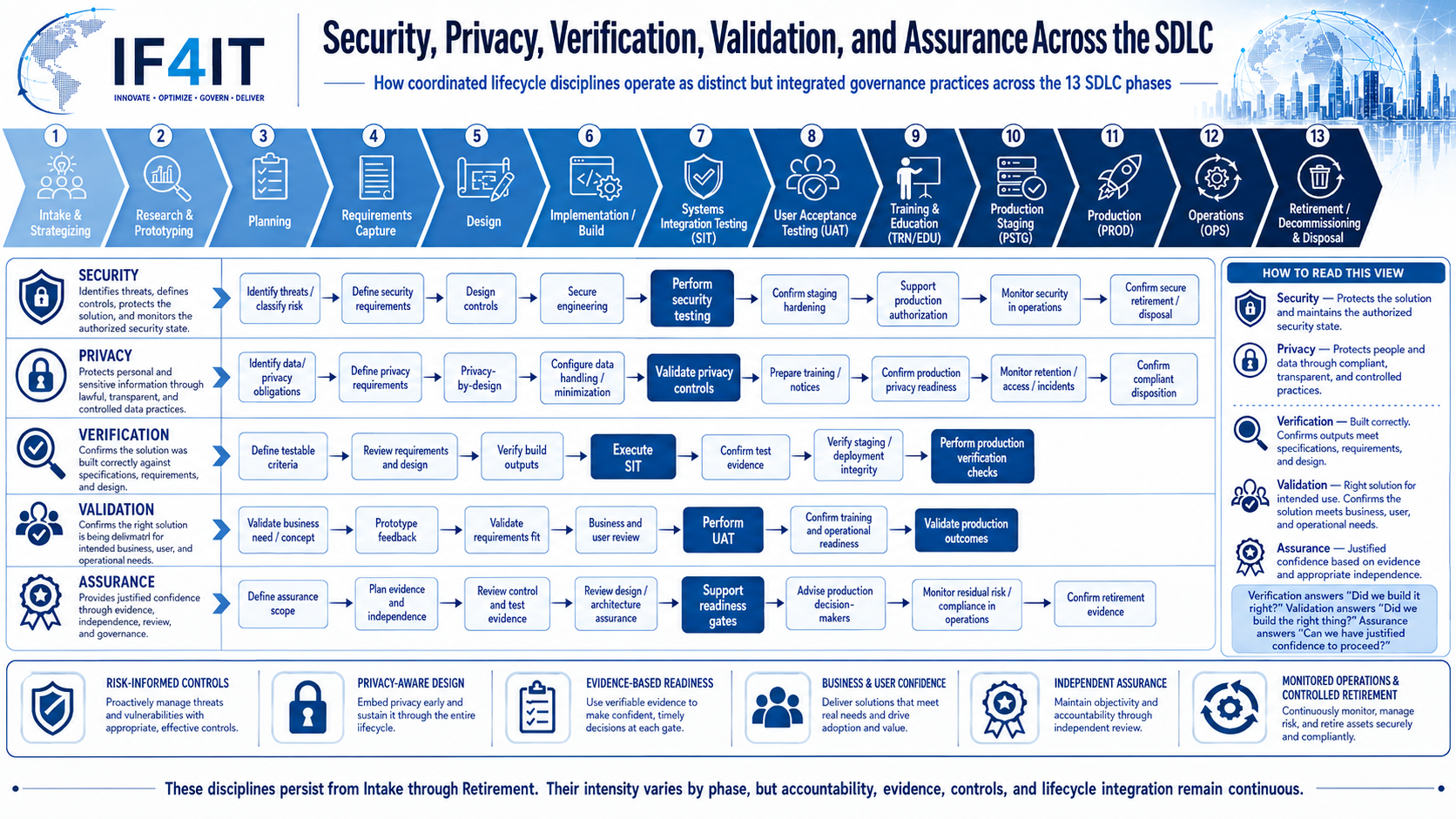
| Assurance versus V&V | V&V generates and evaluates claim evidence; Assurance evaluates whether the complete evidence basis is credible, sufficient, current, and decision-ready. |
| Independence | Use self-assurance, peer review, separate internal roles, independent functions, external assessors, or regulators according to risk and obligation. |
| Evidence quality | Evaluate relevance, sufficiency, validity, currentness, provenance, integrity, representativeness, independence, limitations, and contradictions. |
| Conclusion | Document the claim, scope, criteria, methods, evidence, findings, conditions, limitations, residual uncertainty, conclusion, assessor, and supported decision. |
| Decision ownership | Assurance informs Gates and authorization; designated authorities still own approval, risk acceptance, and Production decisions. |
Benefits: Distinguishing V&V from Assurance keeps teams from mistaking a passed test for a credible, sufficient evidence basis — the two answer different questions. Requiring conclusions to name their limitations and residual uncertainty gives Gate authorities something honest to weigh, instead of a summary that implies more confidence than the evidence supports.
Best Practice: Apply Define Verification, Validation, Evidence, and Assurance Requirements for Every SDLC Phase Throughout the SDLC
Apply this discipline across the full lifecycle, from Intake through Retirement. Establish applicability and ownership during Planning, translate it into testable requirements and decisions during Design and Build, generate decision-ready evidence through SIT, UAT, and Staging, verify and monitor it in Production and Operations, and close out remaining obligations at Retirement.
Benefits: Generating V&V and Assurance evidence as work progresses through each phase, rather than compiling it retroactively before a Gate, means findings surface while there’s still time to correct course cheaply. It also leaves a decision-ready evidence trail that a later independent assessor or auditor can actually follow.
Best Practice: Govern Decisions and Preserve Evidence for Define Verification, Validation, Evidence, and Assurance Requirements for Every SDLC Phase
Assign clear ownership — an enduring Solution owner, Release Owner, discipline owner, evidence producers, and Risk Owner — and scale rigor to the work’s criticality, complexity, and reversibility. Record Risks, exceptions, and Technical Debt in authoritative systems, not narrative status. Generative AI may assist with analysis and evidence organization, but only accountable roles may approve outcomes, accept Risk, or authorize Production.
Benefits: Assigning a named evidence producer and reviewer for V&V work prevents assurance findings from getting lost between teams or quietly dropped when schedule pressure hits. Recording residual uncertainty and limitations in the authoritative Risk record, rather than only in a test report, keeps that information visible to the people who actually decide whether to authorize Production.
Example
A claims-pricing rule is verified by confirming that the configured calculation matches the approved specification and passes technical tests. It is validated by business users who confirm that the result reflects intended policy and real claims scenarios. Evidence includes the requirement, design decision, test results, defect disposition, and approval. Assurance may include independent review by Quality, Compliance, or Internal Audit to determine whether the process and evidence are reliable. These activities answer different questions and should not be treated as interchangeable labels.
Best Practice: Advance Maturity Deliberately for Define Verification, Validation, Evidence, and Assurance Requirements for Every SDLC Phase
At Crawl maturity, define V&V requirements informally per Release, with evidence collected manually and reviewed by whoever is available. At Walk maturity, publish standard V&V and Assurance requirements by phase and risk tier, with evidence collection and independence requirements applied consistently. At Run maturity, generate V&V evidence continuously through integrated testing and monitoring pipelines, with Assurance intensity automatically scaled to Release risk and independent review reserved for genuinely high-consequence claims.
Benefits: Informal, manually reviewed V&V at Crawl maturity is enough to make a defensible claim for a small number of Releases without requiring formal Assurance infrastructure. Publishing standard requirements by phase and risk tier at Walk maturity means similar Releases receive genuinely comparable scrutiny. Continuous, automatically-scaled evidence generation at Run maturity keeps pace with a higher volume of Releases while reserving costly independent review for the claims that actually warrant it.
Best Practice: Avoid Common Antipatterns in Define Verification, Validation, Evidence, and Assurance Requirements for Every SDLC Phase
Enterprises should avoid treating a passed Verification test as proof that a Solution is fit for use. Verification confirms a component matches its specification; it does not confirm the Solution is suitable for its intended business and operational context, which only Validation can demonstrate.
| Antipattern | Why it fails |
|---|---|
| Treating a passed test as proof the Solution is fit for use | Verification and Validation answer different questions, so a component that satisfies its specification can still fail to meet the actual business or operational need it was built for. |
Benefits: Avoiding this antipattern keeps Verification and Validation from being treated as interchangeable labels. It ensures that acceptance decisions rest on evidence that the Solution actually works for its intended use, not only on evidence that it was built as specified.
Connections to Related IF4IT Practices and Inventories
Use the Data and Information Inventory and Attributes and the Integrations Inventory and Attributes to identify authoritative data, semantics, interfaces, lineage, ownership, quality expectations, and integration dependencies before design decisions are finalized.
Use the Non-Functional Requirements (NFRs) Framework for Software Systems to define measurable quality, security, resilience, usability, interoperability, maintainability, and operational requirements, together with explicit validation methods and evidence.
Make sure security, privacy, Risk, compliance, audit, and authorization controls run throughout this chapter’s decisions and responsibilities, keeping required evidence, exceptions, residual Risk, and accountable approvals visible and governed.
How to cite this page
When referencing this page in academic work, internal standards, or external publications, include the page title, IF4IT as author and publisher (The International Foundation for Information Technology (IF4IT), LLC), the URL, and your access date.
Example (informal web citation):
The International Foundation for Information Technology (IF4IT), LLC. Define Verification, Validation, Evidence, and Assurance Requirements for Every SDLC Phase | Systems Development Lifecycle (SDLC) Best Practices. https://if4it.org/best-practices/systems-development-lifecycle-sdlc/define-verification-validation-evidence-and-assurance-requirements-for-every-sdlc-phase/ (accessed 2026-10-16).
See About Us for content governance and site-wide citation guidance.
Copyright for The International Foundation for Information Technology (IF4IT), LLC: 2008 - Present
Legal Disclaimers