Distinguish SDLC Maturity From Solution Risk - Systems Development Lifecycle (SDLC) Best Practices
Distinguish SDLC Maturity From Solution Risk
(Chapter 46 of Systems Development Lifecycle (SDLC) Best Practices)
Executive Summary: Chapter Overview
IF4ITThe Bottom Line
Core Concepts
| Concept | Definition & Strategic Role |
|---|---|
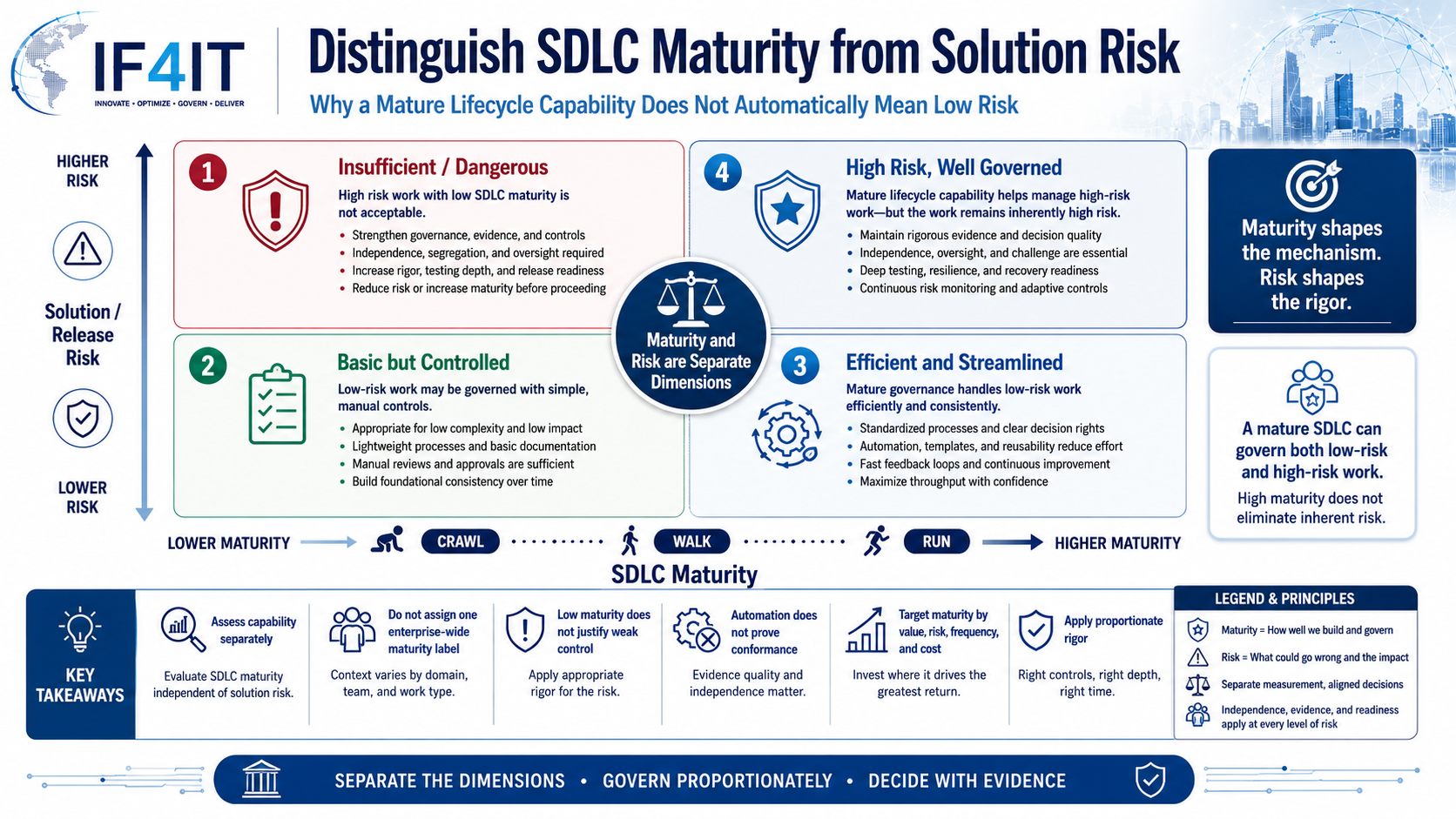
| Two Separate Management Dimensions | SDLC maturity describes how capable, repeatable, integrated, automated, measurable, and continuously improved the lifecycle-management capability is. Solution risk describes uncertainty and potential adverse consequences arising from the design, acquisition, implementation, use, operation, change, failure, misuse, dependency, or retirement of a governed technology capability. |
| Maturity Shapes the Mechanism; Risk Shapes the Rigor | A mature enterprise may govern low-risk work through streamlined, automated, and delegated mechanisms. A lower-maturity enterprise may still need rigorous manual controls, specialist support, independent assurance, and senior authority for high-risk work. High maturity improves risk-management capability but does not make inherent risk disappear. |
| Application of Risk to the SDLC Path and Utilization Profile | Risk should influence phase depth, Artifacts, evidence, Readiness Gates, decision authority, Environment representativeness, verification, validation, supplier assurance, Technical Debt treatment, Production monitoring, and retirement. The SDLC Path and Utilization Profile should be reassessed when scope, data, suppliers, architecture, AI use, criticality, or Production exposure changes. |
| Assess and Measure Separately | Use separate maturity and risk assessments, then combine the results to select oversight, lifecycle rigor, specialist participation, evidence, authority, and capability-improvement priorities. Measure maturity improvement through actual quality, reliability, knowledge, Technical Debt, operational, and risk outcomes rather than tool adoption alone. |
Quick Q&A
Question: Does high SDLC maturity mean a Solution is low risk?
Question: What should happen when Solution risk is high but SDLC maturity is low?
Read More Below
This chapter distinguishes the maturity of an enterprise lifecycle capability from the risk associated with a particular Solution, Release, change, supplier, dependency, or operational condition.
Two Separate Management Dimensions
SDLC maturity describes how capable, repeatable, integrated, automated, measurable, and continuously improved the lifecycle-management capability is. Solution risk describes uncertainty and potential adverse consequences arising from the design, acquisition, implementation, use, operation, change, failure, misuse, dependency, or retirement of a governed technology capability.
Maturity Shapes the Mechanism; Risk Shapes the Rigor
A mature enterprise may govern low-risk work through streamlined, automated, and delegated mechanisms. A lower-maturity enterprise may still need rigorous manual controls, specialist support, independent assurance, and senior authority for high-risk work. High maturity improves risk-management capability but does not make inherent risk disappear.
Apply Risk to the SDLC Path and Utilization Profile
Risk should influence phase depth, Artifacts, evidence, Readiness Gates, decision authority, Environment representativeness, verification, validation, supplier assurance, Technical Debt treatment, Production monitoring, and retirement. The SDLC Path and Utilization Profile should be reassessed when scope, data, suppliers, architecture, AI use, criticality, or Production exposure changes.
Assess and Measure Separately
Use separate maturity and risk assessments, then combine the results to select oversight, lifecycle rigor, specialist participation, evidence, authority, and capability-improvement priorities. Measure maturity improvement through actual quality, reliability, knowledge, Technical Debt, operational, and risk outcomes rather than tool adoption alone.
Common Antipatterns
Enterprises should avoid assuming high SDLC maturity means a Solution is automatically low risk. A mature lifecycle-management capability improves how well an enterprise handles Risk, but it does not make a genuinely high-risk Solution’s inherent Risk disappear; assuming maturity substitutes for actual Risk assessment can lead to under-governing a high-consequence Release simply because the enterprise’s overall SDLC is sophisticated.
| Antipattern | Why it fails |
|---|---|
| Assuming high SDLC maturity means a Solution is automatically low risk | A mature lifecycle-management capability improves how well Risk is handled, but does not make a genuinely high-risk Solution’s inherent Risk disappear. |
Connections to Related IF4IT Practices and Inventories
Use Application Portfolio Management (APM) Best Practices and the Applications Inventory and Attributes to clarify enduring ownership, lifecycle accountability, value, cost, risk, and dependency information. Align SDLC governance with the IF4IT Enterprise Model, Enterprise Capability Models, and the Enterprise Architecture Value Model so lifecycle decisions remain connected to business architecture, enterprise outcomes, and accountable management practices.
Keep security, privacy, Risk, compliance, audit, and authorization controls integrated throughout this chapter’s decisions so required evidence, exceptions, residual Risk, and accountable approvals remain visible and governed.
For Distinguish SDLC Maturity From Solution Risk, IT leaders and managers should establish explicit decision rights, accountable ownership, proportional controls, evidence expectations, performance measures, and continuous-improvement feedback tied to enterprise value.
How to cite this page
When referencing this page in academic work, internal standards, or external publications, include the page title, IF4IT as author and publisher (The International Foundation for Information Technology (IF4IT), LLC), the URL, and your access date.
Example (informal web citation):
The International Foundation for Information Technology (IF4IT), LLC. Distinguish SDLC Maturity From Solution Risk | Systems Development Lifecycle (SDLC) Best Practices. https://if4it.org/best-practices/systems-development-lifecycle-sdlc/distinguish-sdlc-maturity-from-solution-risk/ (accessed 2026-10-16).
See About Us for content governance and site-wide citation guidance.
Copyright for The International Foundation for Information Technology (IF4IT), LLC: 2008 - Present
Legal Disclaimers