Engineering, Testing, Operations, Security, Privacy, Data, and Support Responsibilities Across the SDLC - Systems Development Lifecycle (SDLC) Best Practices
Engineering, Testing, Operations, Security, Privacy, Data, and Support Responsibilities Across the SDLC
(Chapter 42 of Systems Development Lifecycle (SDLC) Best Practices)
Executive Summary: Chapter Overview
IF4ITThe Bottom Line
Core Concepts
| Concept | Definition & Strategic Role |
|---|---|
| Engineering Responsibility | Designing, building, configuring, integrating, correcting, and maintaining the controlled Solution and its technical evidence. |
| Testing Responsibility | Planning and performing Verification and Validation that are independent enough for the claim and consequence. |
| Operational Responsibility | Preparing, accepting, operating, observing, recovering, supporting, and improving the active Solution. |
| Protection and Data Responsibility | Embedding Security, Privacy, data governance, quality, lineage, and lifecycle obligations into decisions and evidence. |
Quick Q&A
Question: Why must Operations and Support participate before Production?
Question: May Engineering approve its own testing and Production readiness?
Question: What is the shared responsibility of Security, Privacy, and Data roles?
Read More Below
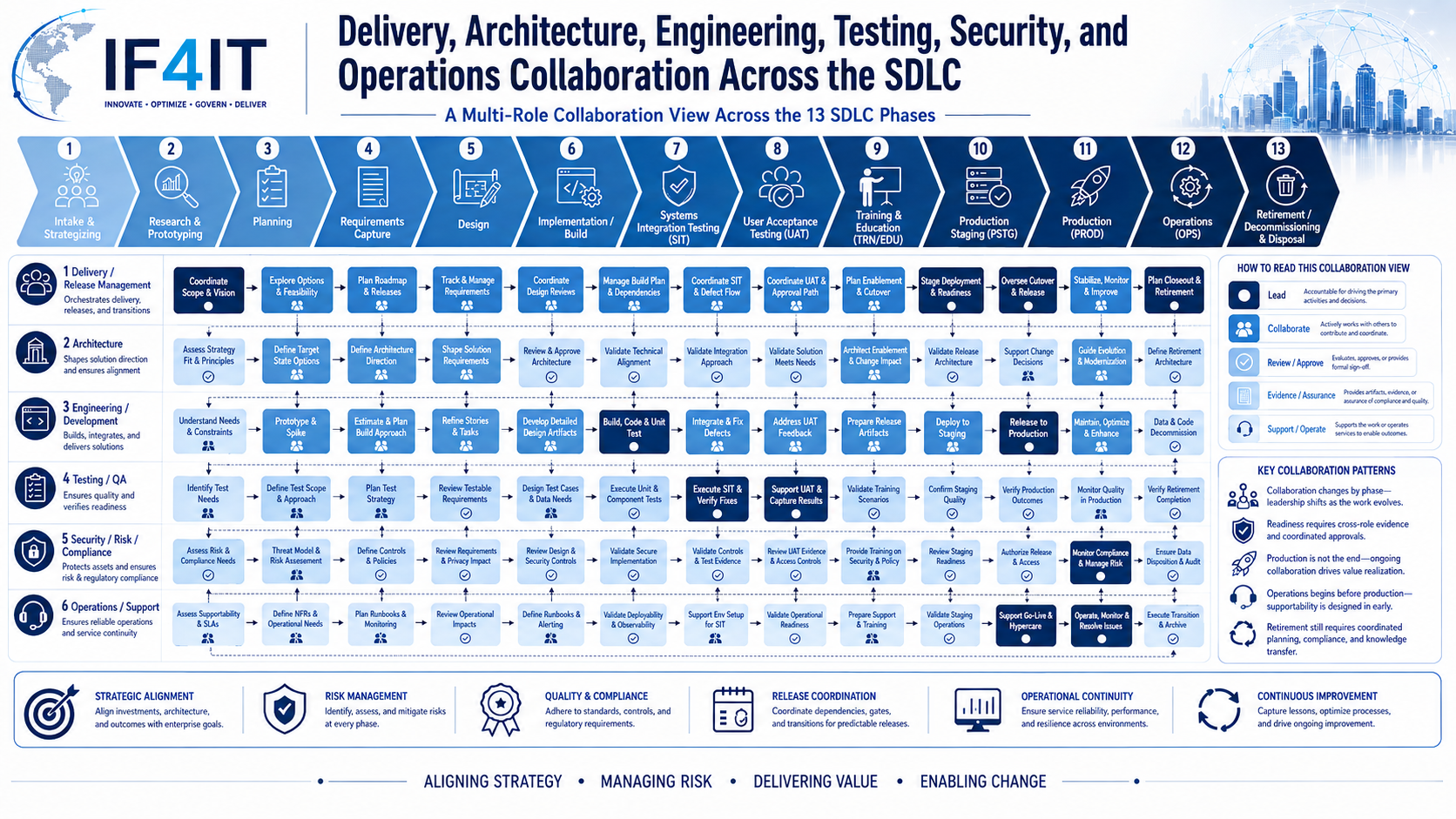
Defines the coordinated responsibilities of the principal technical, assurance, protection, data, operational, and support functions that produce and sustain lifecycle outcomes.
Best Practice: Establish Cross-Functional Participation
The SDLC Path and Utilization Profile should identify when Engineering, Testing, Operations, Support, Security, Privacy, Data, and related specialists participate, what they own, what they review, which evidence they produce, and which decisions they may make or recommend.
Benefits: Defining exactly when each specialist participates and what they own in the Utilization Profile prevents the common failure where everyone assumes someone else is covering a discipline’s concerns, and it turns out no one actually was.
Best Practice: Apply Engineering Responsibilities
Engineering translates approved Requirements and Architecture into controlled code, configuration, integrations, infrastructure, data structures, automation, and technical documentation. It maintains build integrity, resolves defects, manages dependencies and Technical Debt, and supports investigation and remediation throughout Operations.
Benefits: Holding Engineering accountable for build integrity and Technical Debt through Operations, not just through initial delivery, means the team that wrote the code stays connected to how it actually performs, rather than treating a Release as finished the moment it ships.
Best Practice: Apply Testing and Assurance Responsibilities
Testing defines claim-based strategies, test conditions, data, Environments, traceability, results, defects, and limitations across component, integration, system, acceptance, regression, performance, Security, recovery, migration, and other applicable testing. Independence should be proportionate to Risk and should not be confused with mere organizational separation.
Benefits: Scaling testing independence to actual Risk, rather than treating any organizational separation as sufficient, closes the gap where a team technically outside the development group still lacks the genuine independence a high-consequence claim requires.
Best Practice: Apply Operations and Support Responsibilities
Operations and Support define operational Requirements, observability, capacity, availability, continuity, recovery, access, runbooks, support tiers, knowledge, service levels, Incident and Problem handling, supplier escalation, maintenance, and retirement needs. They validate readiness and sustain the operated state after deployment.
Benefits: Having Operations and Support define their own observability and runbook requirements, rather than inheriting whatever Engineering happened to build, means the operational needs that actually matter for supportability get captured instead of assumed.
Best Practice: Integrate Security and Privacy Responsibilities
Security and Privacy roles identify threats, obligations, data uses, trust boundaries, controls, evidence, exceptions, and residual Risks. They participate from Intake through retirement and ensure that changes, suppliers, data, access, monitoring, retention, and disposal remain governed.
Benefits: Keeping Security and Privacy engaged from Intake through Retirement, not just at a pre-Production review, means threats and data obligations are considered while Design decisions can still accommodate them cheaply.
Best Practice: Apply Data Responsibilities
Data Owners, Stewards, Architects, Engineers, and custodians define meaning, quality, lineage, provenance, authoritative sources, access, retention, migration, reconciliation, observability, and disposition. Data responsibilities continue across Releases and supplier boundaries.
Benefits: Assigning Data Owners and Stewards who remain accountable across Releases and supplier boundaries prevents data meaning and lineage from becoming tribal knowledge that disappears when the original team moves on to other work.
Best Practice: Coordinate Handoffs and Shared Evidence
Shared outcomes should use common identifiers, traceability, baselines, defect and Risk records, decision logs, and authoritative systems. Handoffs are complete only when the receiving role accepts the state, open obligations, limitations, knowledge, access, and evidence.
Benefits: Requiring the receiving role to explicitly accept a handoff’s state and open obligations — not just receive a notification — closes the gap where information technically changed hands but no one actually took ownership of what came with it.
Best Practice: Advance Maturity Deliberately for Engineering, Testing, Operations, Security, Privacy, Data, and Support Responsibilities Across the SDLC
At Crawl maturity, name accountable cross-functional participants and minimum evidence. At Walk maturity, publish role matrices, entry and exit expectations, shared workflows, and handoff criteria. At Run maturity, integrate responsibilities, identity, workflow, evidence, telemetry, and continuous feedback across lifecycle systems.
Benefits: Starting with simply naming accountable participants and minimum evidence at Crawl maturity establishes the baseline that published role matrices and shared workflows at Walk maturity depend on. Pursuing full workflow and telemetry integration at Run maturity before roles and handoffs are well understood tends to automate confusion rather than resolve it.
Best Practice: Avoid Common Antipatterns in Engineering, Testing, Operations, Security, Privacy, Data, and Support Responsibilities Across the SDLC
Enterprises should avoid treating a handoff between disciplines as complete once information is sent. A handoff is not complete merely because information was transmitted; if the receiving role never explicitly accepts the state, open obligations, and limitations, gaps in ownership can go unnoticed until an Incident exposes them.
| Antipattern | Why it fails |
|---|---|
| Treating a handoff between disciplines as complete once information is sent | If the receiving role never explicitly accepts the state, open obligations, and limitations that came with a handoff, gaps in ownership can go unnoticed until an Incident exposes them. |
Benefits: Avoiding this antipattern makes handoffs a deliberate transfer of accountability, not just a notification. It closes the gap where each discipline assumes the other has picked up a shared obligation that, in reality, no one accepted.
Connections to Related IF4IT Practices and Inventories
Use Technology Portfolio Management (TPM) Best Practices, the Software Technologies Inventory and Attributes, and IT Operating Environments Best Practices to ensure builds and tests use governed technologies and representative environments. Use the Data and Information Inventory and Attributes, the Integrations Inventory and Attributes, and Best Practices for Making Legacy Data Semantic and AI-Ready to govern source meaning, mappings, lineage, reconciliation, validation, and migration evidence.
Apply Service Management Best Practices and Service Catalog Best Practices to define operational ownership, support models, service levels, monitoring, knowledge transfer, and customer-facing service commitments before and after Production.
Make sure security, privacy, Risk, compliance, audit, and authorization controls run throughout this chapter’s decisions and responsibilities, keeping required evidence, exceptions, residual Risk, and accountable approvals visible and governed.
How to cite this page
When referencing this page in academic work, internal standards, or external publications, include the page title, IF4IT as author and publisher (The International Foundation for Information Technology (IF4IT), LLC), the URL, and your access date.
Example (informal web citation):
The International Foundation for Information Technology (IF4IT), LLC. Engineering, Testing, Operations, Security, Privacy, Data, and Support Responsibilities Across the SDLC | Systems Development Lifecycle (SDLC) Best Practices. https://if4it.org/best-practices/systems-development-lifecycle-sdlc/engineering-testing-operations-security-privacy-data-and-support-responsibilities-across-the-sdlc/ (accessed 2026-10-16).
See About Us for content governance and site-wide citation guidance.
Copyright for The International Foundation for Information Technology (IF4IT), LLC: 2008 - Present
Legal Disclaimers