Govern and Continuously Improve the Enterprise Systems Development Lifecycle (SDLC) - Systems Development Lifecycle (SDLC) Best Practices
Govern and Continuously Improve the Enterprise Systems Development Lifecycle (SDLC)
(Chapter 60 of Systems Development Lifecycle (SDLC) Best Practices)
Executive Summary: Chapter Overview
IF4ITThe Bottom Line
Core Concepts
| Concept | Definition & Strategic Role |
|---|---|
| Establishment of an Accountable Enterprise SDLC Owner | The enterprise should assign an enduring owner for the SDLC operating model. This owner should maintain the lifecycle definition, phase outcomes, Paths, Utilization Profile requirements, governance rules, role model, evidence expectations, metrics, training, and improvement backlog. The owner may coordinate a cross-functional council, but accountability should not be dispersed so broadly that no one can authorize or sustain change. |
| Governance Scope and Decision Rights | Governance should distinguish enterprise policy decisions from Release-specific execution decisions. Enterprise authorities should define mandatory outcomes, approved tailoring boundaries, exception requirements, conformance criteria, and escalation routes. Release, Solution, Risk, Security, Privacy, Architecture, Production, and acceptance authorities should retain their assigned decisions rather than relying on an undefined committee consensus. |
| Maintenance of One Authoritative SDLC Model | The enterprise should publish one authoritative SDLC model and identify the systems and repositories that contain its controlled components. Local methods, team playbooks, templates, and tools may extend the model, but they should map to the authoritative lifecycle and should not redefine mandatory outcomes silently. Superseded guidance should be withdrawn or clearly marked to prevent conflicting instructions. |
| Governance of Paths, Tailoring, Alternatives, and Exceptions | Approved SDLC Paths should provide reusable configurations for recurring classes of work. Tailoring should change how an applicable outcome is satisfied. An approved alternative method may satisfy the same outcome through a different mechanism. An exception should authorize a bounded departure when the obligation cannot be met. These mechanisms should remain distinct, attributable, time-bound where appropriate, and visible in the SDLC Utilization Profile. |
| Iterative IT Management and Governance Outcomes | Continuous improvement should make lifecycle execution more consistent, faster, and less costly while strengthening documentation, enterprise knowledge, traceability, accountability, auditability, evidence retrieval, and the prevention of recurring defects, delays, exceptions, and control failures. |
Quick Q&A
Question: Who should own the Enterprise SDLC?
Question: Does continuous improvement mean adding more controls after every problem?
Question: How should the enterprise know whether an SDLC change worked?
Read More Below
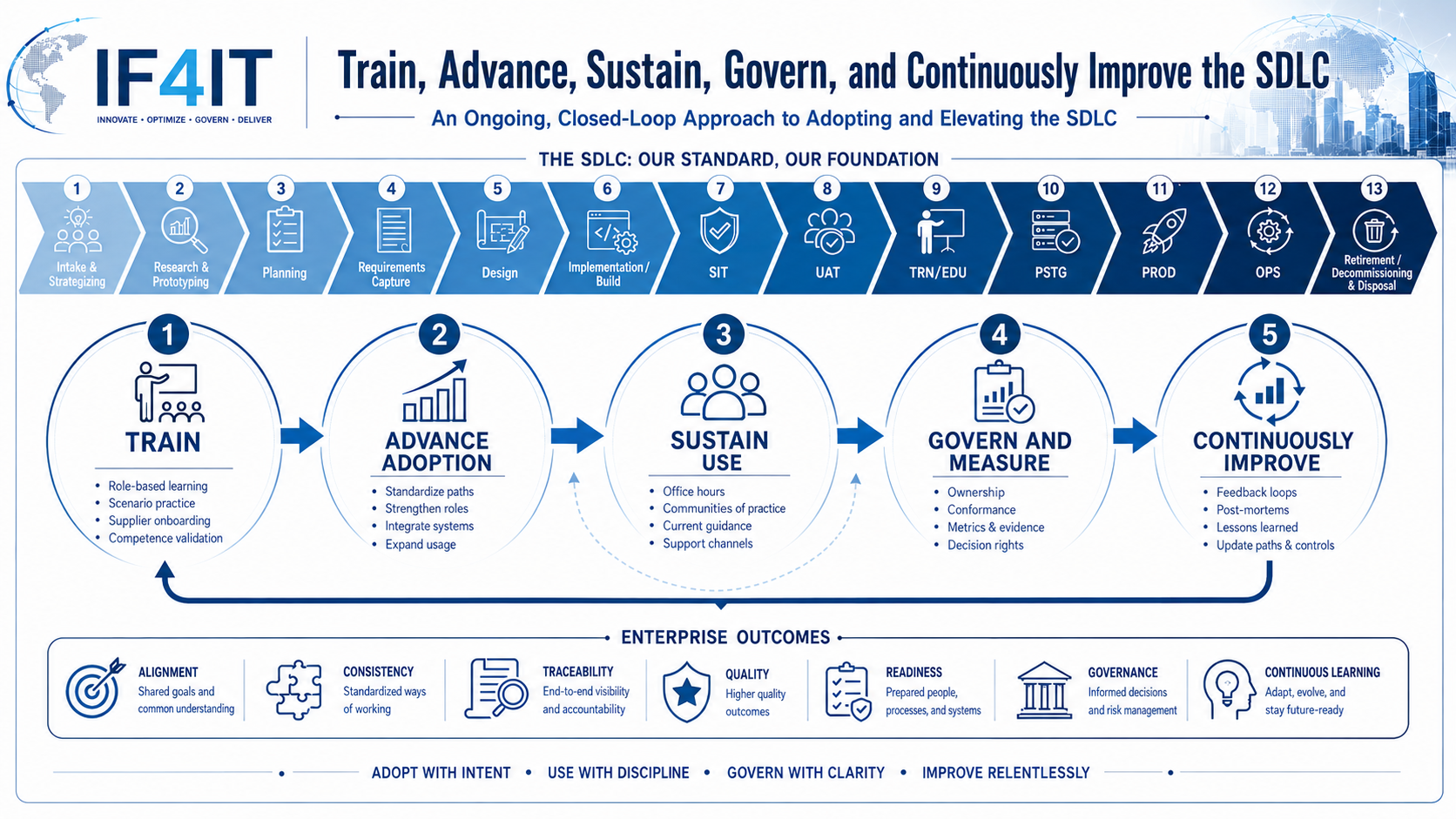
The Enterprise Systems Development Lifecycle (SDLC) should be governed as a living enterprise operating model. Governance should establish ownership, decision rights, minimum required outcomes, approved Paths, tailoring and exception controls, evidence expectations, conformance mechanisms, performance measures, and a disciplined improvement cycle. Continuous improvement should use lifecycle evidence and outcomes to make IT management and governance progressively more consistent, timely, cost-effective, knowledge-rich, traceable, and auditable without creating unnecessary ceremony or allowing local convenience to weaken accountability.
Best Practice: Define the Iterative IT Management and Governance Outcomes
The SDLC owner should define the outcomes that continuous improvement is expected to produce and measure them over time. These outcomes should include more consistent execution across teams and delivery methods; quicker decisions and lifecycle flow; lower delivery, assurance, and governance cost; better documentation and reusable enterprise knowledge; easier auditability and evidence retrieval; stronger traceability and accountability; fewer recurring defects, delays, exceptions, and control failures; and more effective automation and generative AI enablement. Improvements should be retained only when evidence demonstrates that they strengthen applicable outcomes without creating disproportionate administrative burden.
Benefits: Defining and measuring the specific outcomes continuous improvement is supposed to produce — faster decisions, lower governance cost, stronger traceability — gives improvement work something concrete to demonstrate, rather than a vague sense that things are generally getting better.
Best Practice: Establish an Accountable Enterprise SDLC Owner
The enterprise should assign an enduring owner for the SDLC operating model. This owner should maintain the lifecycle definition, phase outcomes, Paths, Utilization Profile requirements, governance rules, role model, evidence expectations, metrics, training, and improvement backlog. The owner may coordinate a cross-functional council, but accountability should not be dispersed so broadly that no one can authorize or sustain change.
Benefits: Keeping accountability for the SDLC operating model concentrated in one owner, even while coordinating through a cross-functional council, prevents the lifecycle from stagnating for lack of anyone actually empowered to authorize and sustain a change.
Best Practice: Define Governance Scope and Decision Rights
Governance should distinguish enterprise policy decisions from Release-specific execution decisions. Enterprise authorities should define mandatory outcomes, approved tailoring boundaries, exception requirements, conformance criteria, and escalation routes. Release, Solution, Risk, Security, Privacy, Architecture, Production, and acceptance authorities should retain their assigned decisions rather than relying on an undefined committee consensus.
Benefits: Distinguishing enterprise policy decisions from Release-specific execution decisions means Security, Architecture, and other specialist authorities retain their assigned decisions instead of deferring to an undifferentiated governance committee that lacks their specific expertise.
Best Practice: Maintain One Authoritative SDLC Model
The enterprise should publish one authoritative SDLC model and identify the systems and repositories that contain its controlled components. Local methods, team playbooks, templates, and tools may extend the model, but they should map to the authoritative lifecycle and should not redefine mandatory outcomes silently. Superseded guidance should be withdrawn or clearly marked to prevent conflicting instructions.
Benefits: Publishing one authoritative SDLC model, with superseded guidance clearly withdrawn, prevents teams from following conflicting instructions when a local playbook and the enterprise model disagree. Ambiguity about which version is current is a common, avoidable source of inconsistent execution.
Best Practice: Govern Paths, Tailoring, Alternatives, and Exceptions
Approved SDLC Paths should provide reusable configurations for recurring classes of work. Tailoring should change how an applicable outcome is satisfied. An approved alternative method may satisfy the same outcome through a different mechanism. An exception should authorize a bounded departure when the obligation cannot be met. These mechanisms should remain distinct, attributable, time-bound where appropriate, and visible in the SDLC Utilization Profile.
Benefits: Publishing Paths, Tailoring, Alternative Methods, and Exceptions as four distinct, attributable mechanisms gives the enterprise SDLC owner a portfolio-wide view of where governed reuse is genuinely happening, rather than discovering only at audit time that “tailoring” has quietly become the label every unauthorized departure hides behind.
Best Practice: Use Evidence-Based Conformance
Conformance should be evaluated against the applicable Enterprise SDLC requirements, selected Path, approved Utilization Profile, authorized tailoring, alternatives, exceptions, and decision records. Assessment should examine whether required outcomes, ownership, evidence, and continuing obligations were satisfied. The mere presence of templates, approvals, or tool records should not be treated as proof of effective conformance.
Benefits: Evaluating conformance against actual satisfied outcomes, not just the presence of templates and approvals, catches the gap where a Release looks compliant on paper but never actually delivered the ownership, evidence, or continuing obligations the SDLC requires.
Best Practice: Operate a Governed Improvement Cycle
Improvement should use Release outcomes, Production Incidents, Problems, audit and assurance findings, user feedback, supplier performance, metrics, exception patterns, deferred obligations, Technical Debt, and practitioner experience. Proposed changes should identify the problem, evidence, affected stakeholders, intended outcome, implementation approach, validation method, owner, and effective date.
Benefits: Requiring every proposed SDLC change to identify its problem, evidence, and validation method — not just a suggestion — means improvement decisions are made with the same rigor the SDLC itself demands of Release decisions.
Best Practice: Control and Validate SDLC Changes
Changes to the SDLC should be reviewed for consistency, usability, implementation cost, tool impact, training needs, and unintended consequences. A change should be piloted when uncertainty or enterprise impact is material. The enterprise should validate whether the change improved the intended outcome and should revise or withdraw it when evidence does not support continued use.
Benefits: Piloting a material SDLC change before enterprise-wide rollout, and validating whether it actually improved the intended outcome, prevents the enterprise from committing to a change that looked good in theory but doesn’t hold up once teams try to use it.
Best Practice: Prevent Governance From Becoming Excessive Ceremony
Governance should simplify mechanisms before removing obligations. Repetitive approvals, duplicate Artifacts, manual transcription, and unclear handoffs should be redesigned or automated where the underlying rule is stable and understood. The enterprise should not automate ambiguity or create controls whose administrative burden exceeds their decision or Risk value.
Benefits: Redesigning or automating a stable, understood rule before removing the obligation behind it — rather than either preserving unnecessary ceremony or cutting a real control — keeps governance proportionate to the actual decision or Risk value it provides.
Best Practice: Sustain Adoption and Accountability
Published changes should be incorporated into Paths, templates, tools, training, onboarding, supplier expectations, metrics, and support channels. Leaders should reinforce the model through actual decisions and should not reward teams for bypassing lifecycle obligations to meet dates. Adoption should be measured through use, outcome quality, and closure of continuing responsibilities rather than policy acknowledgment alone.
Benefits: Refusing to reward teams for bypassing lifecycle obligations to meet a date is what actually reinforces the SDLC through real decisions, not just policy language. Leaders’ actual choices under pressure communicate the enterprise’s real priorities far more effectively than any published guidance.
Best Practice: Avoid Common Antipatterns in Govern and Continuously Improve the Enterprise Systems Development Lifecycle (SDLC)
Enterprises should avoid dispersing SDLC ownership so broadly that no one can authorize change. A cross-functional council can coordinate perspectives, but if accountability for the SDLC operating model is spread across so many stakeholders that no single owner can actually approve or sustain a change, the lifecycle stagnates for lack of anyone empowered to update it.
| Antipattern | Why it fails |
|---|---|
| Dispersing SDLC ownership so broadly that no one can authorize change | If accountability for the SDLC operating model is spread across too many stakeholders, the lifecycle stagnates for lack of anyone actually empowered to approve or sustain a change. |
Benefits: Avoiding this antipattern keeps the SDLC able to actually evolve. It ensures a genuinely needed improvement has a clear path to approval instead of dissolving into a council that can discuss but never decide.
Connections to Related IF4IT Practices and Inventories
Align SDLC governance with the IF4IT Enterprise Model, Enterprise Capability Models, and the Enterprise Architecture Value Model so lifecycle decisions remain connected to business architecture, enterprise outcomes, and accountable management practices.
Apply Enterprise Inventory Management Best Practices so each Release reads authoritative lifecycle records and updates affected inventories, identifiers, relationships, ownership, status, evidence, configuration, and retirement information as governed outputs.
For Govern and Continuously Improve the Enterprise Systems Development Lifecycle (SDLC), IT leaders and managers should establish explicit decision rights, accountable ownership, proportional controls, evidence expectations, performance measures, and continuous-improvement feedback tied to enterprise value.
How to cite this page
When referencing this page in academic work, internal standards, or external publications, include the page title, IF4IT as author and publisher (The International Foundation for Information Technology (IF4IT), LLC), the URL, and your access date.
Example (informal web citation):
The International Foundation for Information Technology (IF4IT), LLC. Govern and Continuously Improve the Enterprise Systems Development Lifecycle (SDLC) | Systems Development Lifecycle (SDLC) Best Practices. https://if4it.org/best-practices/systems-development-lifecycle-sdlc/govern-and-continuously-improve-the-enterprise-systems-development-lifecycle-sdlc/ (accessed 2026-08-24).
See About Us for content governance and site-wide citation guidance.
Copyright for The International Foundation for Information Technology (IF4IT), LLC: 2008 - Present
Legal Disclaimers