How Agile Delivery Moves Through the SDLC - Systems Development Lifecycle (SDLC) Best Practices
How Agile Delivery Moves Through the SDLC
(Chapter 80 of Systems Development Lifecycle (SDLC) Best Practices)
Executive Summary: Chapter Overview
IF4ITThe Bottom Line
Core Concepts
| Concept | Definition & Strategic Role |
|---|---|
| Governing Principle | Agile delivery moves repeatedly through lifecycle work using short feedback cycles, prioritized backlogs, collaboration, and increments without replacing required evidence, authority, or Release accountability. |
| Lifecycle Accountability | Enduring ownership and Release-specific coordination remain explicit. |
| Evidence | Claims and decisions are supported by attributable, current, relevant, and sufficient evidence. |
| Risk-Based Tailoring | Depth changes with context; minimum outcomes and accountability remain. |
Quick Q&A
Question: How does Agile delivery fit the 13-phase SDLC?
Question: Does a sprint equal an SDLC phase?
Question: What must Agile teams avoid?
Read More Below
Explains how Agile delivery performs lifecycle work iteratively and incrementally while preserving Release-level governance and durable enterprise outcomes.
Governing Principle
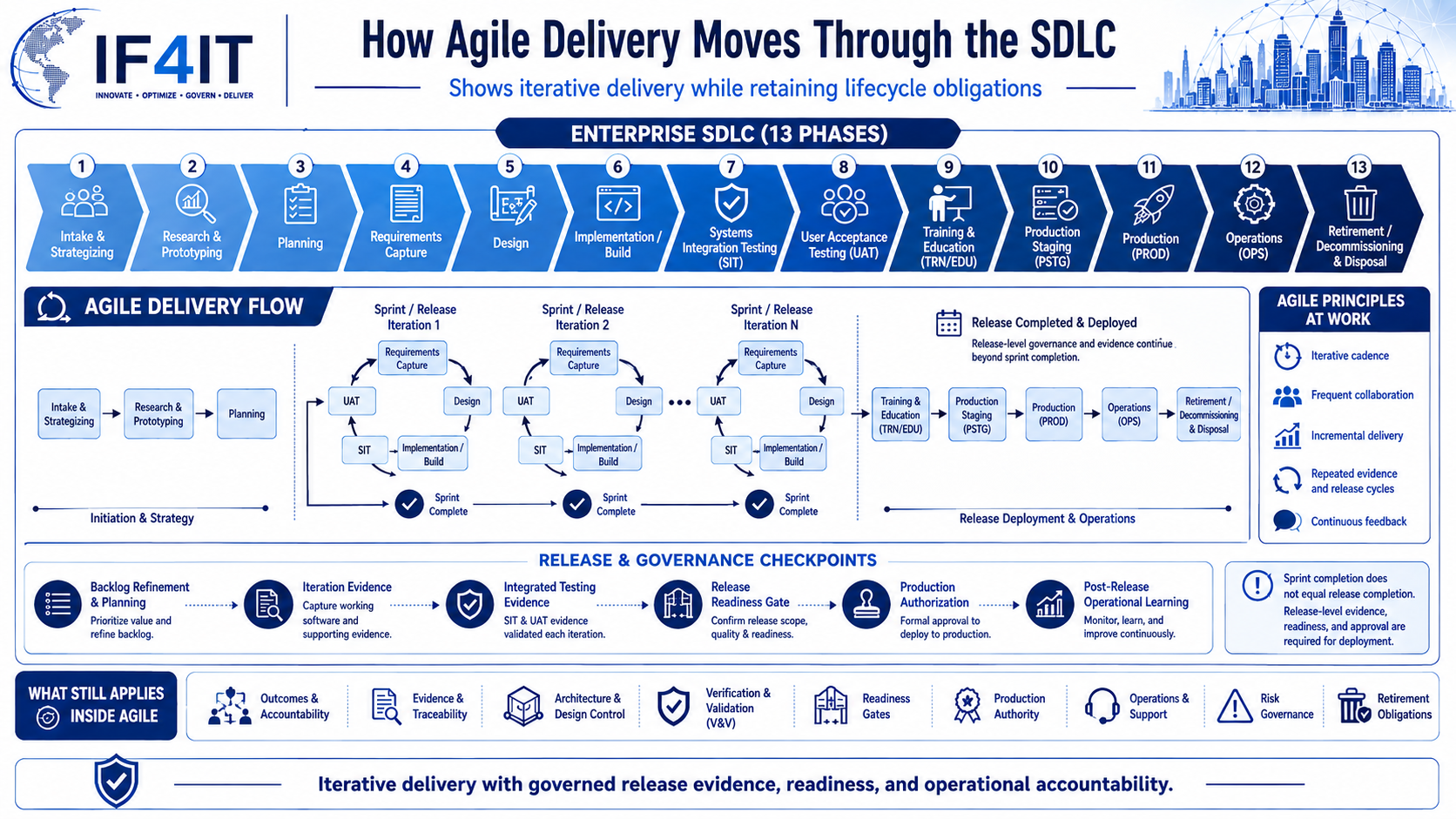
Agile delivery moves repeatedly through lifecycle work using short feedback cycles, prioritized backlogs, collaboration, and increments without replacing required evidence, authority, or Release accountability.
Required Lifecycle Treatment
| Area | Required treatment |
|---|---|
| Cadence | Sprints and iterations organize team work; they do not automatically define enterprise Releases or close lifecycle obligations. |
| Requirements and Design | Use evolving backlogs and living Architecture while preserving authoritative decisions, non-functional requirements, traceability, and change consequences. |
| Acceptance | Sprint Review may contribute to Validation, but it is not automatically User Acceptance Testing or Production authorization. |
| Definition of Done | Team completion criteria should contribute to, but not be confused with, complete Release readiness. |
| Continuous practices | Use CI/CD, automated evidence, frequent testing, observability, and controlled feature activation while retaining accountable decisions. |
Application Through the SDLC
This discipline spans the complete lifecycle. Planning establishes ownership and evidence needs; Design and Build turn it into testable requirements; SIT, UAT, and Staging generate representative evidence; Production and Operations verify and monitor compliance; Retirement closes it out with evidence of completion.
Governance and Evidence
Assign enduring ownership across the Solution, Release, and applicable discipline, plus evidence producers, reviewers, and a Risk Owner, scaling rigor to criticality and reversibility. Track Risks, exceptions, and Technical Debt authoritatively rather than informally. Automation and generative AI can support the work but should not make accountable decisions on their own.
Example
A product team completes six Sprints that incrementally build and test a customer portal. Each Sprint produces reviewed code, automated tests, and demonstrable functionality. The enterprise groups those increments into one governed Release. SIT verifies end-to-end integrations, UAT validates business outcomes, and PSTG confirms deployment and operational readiness. Release approval, production deployment, stabilization, and operational acceptance occur at the Release level. Agile delivery changes how work is organized and learned from; it does not remove lifecycle accountability or required enterprise outcomes.
Common Antipatterns
Enterprises should avoid treating every Sprint as automatically closing lifecycle obligations. A Sprint organizes team-level work into a cadence, but it does not by itself constitute an enterprise Release or satisfy Release-level evidence, acceptance, and closure obligations; treating Sprint completion as equivalent to lifecycle closure can leave genuine Release-level obligations quietly unmet.
| Antipattern | Why it fails |
|---|---|
| Treating every Sprint as automatically closing lifecycle obligations | A Sprint organizes team-level work into a cadence, but does not by itself constitute an enterprise Release or satisfy Release-level evidence and closure obligations. |
Connections to Related IF4IT Practices and Inventories
Use Technology Portfolio Management (TPM) Best Practices, the Software Technologies Inventory and Attributes, and IT Operating Environments Best Practices to connect the decisions and responsibilities addressed in this chapter to governed technology choices, platform lifecycle, and environment controls.
Use Agile, Waterfall, or Hybrid: An IF4IT Framework for Choosing Delivery Methodology to select and tailor the delivery approach according to consequence of failure, decomposability, incremental deliverability, and timing constraints.
Use the Non-Functional Requirements (NFRs) Framework for Software Systems to tie quality expectations to validation methods, test evidence, acceptance criteria, readiness gates, and Production assurance.
How to cite this page
When referencing this page in academic work, internal standards, or external publications, include the page title, IF4IT as author and publisher (The International Foundation for Information Technology (IF4IT), LLC), the URL, and your access date.
Example (informal web citation):
The International Foundation for Information Technology (IF4IT), LLC. How Agile Delivery Moves Through the SDLC | Systems Development Lifecycle (SDLC) Best Practices. https://if4it.org/best-practices/systems-development-lifecycle-sdlc/how-agile-delivery-moves-through-the-sdlc/ (accessed 2026-08-24).
See About Us for content governance and site-wide citation guidance.
Copyright for The International Foundation for Information Technology (IF4IT), LLC: 2008 - Present
Legal Disclaimers