How Hybrid Delivery Moves Through the SDLC - Systems Development Lifecycle (SDLC) Best Practices
How Hybrid Delivery Moves Through the SDLC
(Chapter 81 of Systems Development Lifecycle (SDLC) Best Practices)
Executive Summary: Chapter Overview
IF4ITThe Bottom Line
Core Concepts
| Concept | Definition & Strategic Role |
|---|---|
| Governing Principle | Hybrid delivery should be designed explicitly rather than emerge as an undocumented mixture of incompatible practices and authorities. |
| Lifecycle Accountability | Enduring ownership and Release-specific coordination remain explicit. |
| Evidence | Claims and decisions are supported by attributable, current, relevant, and sufficient evidence. |
| Risk-Based Tailoring | Depth changes with context; minimum outcomes and accountability remain. |
Quick Q&A
Question: What makes a delivery approach Hybrid?
Question: How should Hybrid work be governed?
Question: What is a common Hybrid failure?
Read More Below
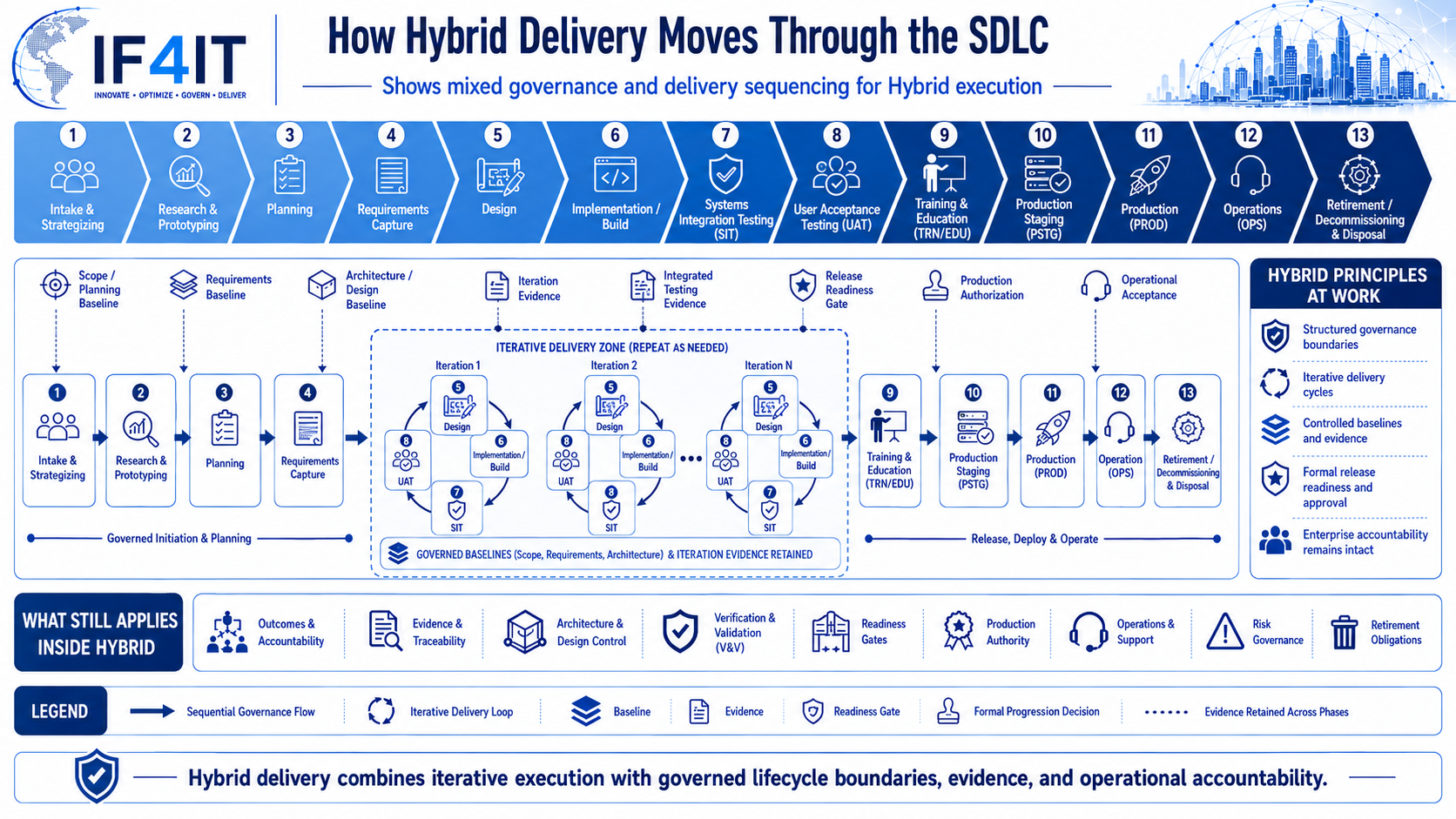
Explains how Hybrid delivery deliberately combines complementary methods through one governed lifecycle, Release model, evidence strategy, and accountability structure.
Governing Principle
Hybrid delivery should be designed explicitly rather than emerge as an undocumented mixture of incompatible practices and authorities.
Required Lifecycle Treatment
| Area | Required treatment |
|---|---|
| Method boundaries | Identify which work uses which method, why, and where handoffs or integration occur. |
| Common governance | Use shared requirements, baselines, identifiers, evidence, Environments, Gates, Release scope, and decision authority. |
| Typical patterns | Combine planned Architecture or migration with iterative implementation; Agile Build with formal Validation; supplier methods with enterprise controls; or continuous delivery with formal authorization. |
| Compatibility | Resolve differences in cadence, terminology, ownership, documentation, and completion criteria. |
| End-to-end outcome | Judge the integrated Solution and Release, not the isolated success of each method-specific workstream. |
Application Through the SDLC
Apply this discipline continuously from Intake through Retirement, translating the governing principle into testable requirements during Design and Build, generating decision-ready evidence through integration and acceptance testing, verifying the authorized state in Production and Operations, and closing remaining obligations at Retirement.
Governance and Evidence
Establish named ownership — Solution, Release, discipline, evidence, and Risk — proportionate to the work’s actual criticality and reversibility. Keep Risks, exceptions, and Technical Debt visible in authoritative systems, not buried in narrative updates. Generative AI may assist with analysis and drafting, but accountable decisions remain with named human authorities.
Common Antipatterns
Enterprises should avoid letting Hybrid delivery emerge as an undocumented mixture of practices. An undesigned blend of Waterfall and Agile practices tends to inherit the gaps of both without the discipline of either; without explicit method boundaries and shared governance, Hybrid delivery can quietly lose accountability at the seams between its component approaches.
| Antipattern | Why it fails |
|---|---|
| Letting Hybrid delivery emerge as an undocumented mixture of practices | An undesigned blend of Waterfall and Agile tends to inherit the gaps of both without the discipline of either, losing accountability at the seams between its component approaches. |
Connections to Related IF4IT Practices and Inventories
Use Technology Portfolio Management (TPM) Best Practices, the Software Technologies Inventory and Attributes, and IT Operating Environments Best Practices to connect the decisions and responsibilities addressed in this chapter to governed technology choices, platform lifecycle, and environment controls.
Use Agile, Waterfall, or Hybrid: An IF4IT Framework for Choosing Delivery Methodology to select and tailor the delivery approach according to consequence of failure, decomposability, incremental deliverability, and timing constraints.
Ground quality expectations in the Non-Functional Requirements (NFRs) Framework for Software Systems, connecting them to validation methods, test evidence, acceptance criteria, readiness gates, and Production assurance.
How to cite this page
When referencing this page in academic work, internal standards, or external publications, include the page title, IF4IT as author and publisher (The International Foundation for Information Technology (IF4IT), LLC), the URL, and your access date.
Example (informal web citation):
The International Foundation for Information Technology (IF4IT), LLC. How Hybrid Delivery Moves Through the SDLC | Systems Development Lifecycle (SDLC) Best Practices. https://if4it.org/best-practices/systems-development-lifecycle-sdlc/how-hybrid-delivery-moves-through-the-sdlc/ (accessed 2026-10-16).
See About Us for content governance and site-wide citation guidance.
Copyright for The International Foundation for Information Technology (IF4IT), LLC: 2008 - Present
Legal Disclaimers