How the IF4IT Systems Development Lifecycle (SDLC) Maps to the NIST SDLC - Systems Development Lifecycle (SDLC) Best Practices
How the IF4IT Systems Development Lifecycle (SDLC) Maps to the NIST SDLC
(Chapter 4 of Systems Development Lifecycle (SDLC) Best Practices)
Executive Summary: Chapter Overview
IF4ITThe Bottom Line
Core Concepts
| Concept | Definition & Strategic Role |
|---|---|
| Interpretive Crosswalk | An enterprise-developed mapping used to align frameworks without claiming official equivalence. |
| High-Level Lifecycle View | A concise representation of major lifecycle regions suitable for policy and executive communication. |
| Detailed Lifecycle View | A practitioner-oriented decomposition that defines focused work, roles, evidence, Environments, and decisions. |
Quick Q&A
Question: Are the 13 IF4IT phases official NIST subphases?
Question: Why maintain both high-level and detailed views?
Question: Can activities span mapping boundaries?
Read More Below
This chapter presents an IF4IT-developed interpretive crosswalk between the detailed 13-phase IF4IT SDLC and the traditional five high-level lifecycle regions associated with NIST guidance. It distinguishes framework compatibility from an official NIST decomposition.
Different Levels of Abstraction
NIST lifecycle guidance has historically described the system lifecycle through broad regions such as Initiation, Development/Acquisition, Implementation, Operations/Maintenance, and Disposition. The IF4IT SDLC uses 13 phases to decompose those broad regions into focused, practitioner-oriented areas of work.
The models operate at different levels of abstraction and can be used together. An enterprise may use concise NIST-oriented terminology for policy, executive governance, or external alignment while using detailed IF4IT phases for planning, daily execution, evidence, and traceability.
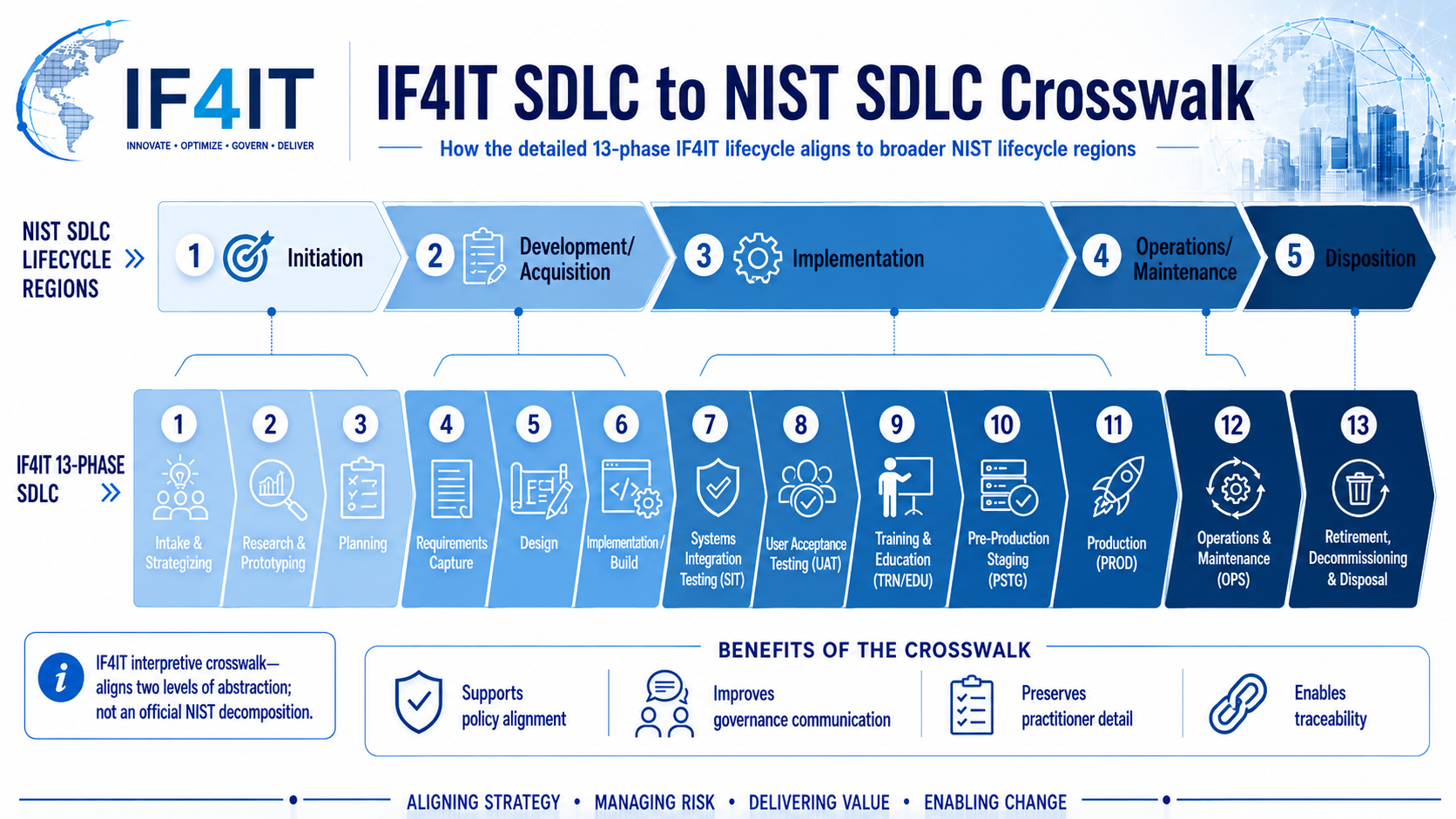
IF4IT Interpretive Crosswalk
| NIST High-Level Phase | Corresponding IF4IT SDLC Phases | Mapping Rationale |
|---|---|---|
| Initiation | Intake & Strategizing; Research & Prototyping; Planning | Identify and qualify the need, investigate feasibility and alternatives, establish alignment, and prepare the delivery approach. |
| Development/Acquisition | Requirements Capture; Design; Implementation/Build | Define needs, design the Solution, and build, acquire, configure, or integrate it. |
| Implementation | SIT; UAT; TRN/EDU; PSTG; PROD | Verify and validate the Solution, prepare people and operations, rehearse transition, deploy, and stabilize. |
| Operations/Maintenance | Operations & Maintenance | Operate, monitor, support, maintain, remediate, and improve the capability. |
| Disposition | Retirement, Decommissioning & Disposal | Retire the capability and resolve access, data, dependencies, infrastructure, contracts, and records. |
Important Qualification
This crosswalk is developed by IF4IT to demonstrate compatibility and aid interpretation. It is not an official NIST mapping and does not claim that NIST formally defines the 13 IF4IT phases as subphases.
Some lifecycle work spans category boundaries. Research may extend into early development, planning continues throughout the lifecycle, testing may be classified differently across enterprises, and retirement planning begins well before final disposition. The crosswalk is intended to support useful alignment rather than exact exclusivity.
Common Antipatterns
Enterprises should avoid treating the IF4IT-NIST crosswalk as an official NIST decomposition. This crosswalk is an IF4IT-developed interpretive mapping between two different levels of abstraction, not an authoritative NIST publication; treating it as an official NIST decomposition can create incorrect assumptions in a regulatory or contractual context that specifically requires NIST-sourced guidance.
| Antipattern | Why it fails |
|---|---|
| Treating the IF4IT-NIST crosswalk as an official NIST decomposition | This crosswalk is an IF4IT-developed interpretive mapping, not an authoritative NIST publication; treating it as official can create incorrect assumptions in a context that specifically requires NIST-sourced guidance. |
How to cite this page
When referencing this page in academic work, internal standards, or external publications, include the page title, IF4IT as author and publisher (The International Foundation for Information Technology (IF4IT), LLC), the URL, and your access date.
Example (informal web citation):
The International Foundation for Information Technology (IF4IT), LLC. How the IF4IT Systems Development Lifecycle (SDLC) Maps to the NIST SDLC | Systems Development Lifecycle (SDLC) Best Practices. https://if4it.org/best-practices/systems-development-lifecycle-sdlc/how-the-if4it-systems-development-lifecycle-sdlc-maps-to-the-nist-sdlc/ (accessed 2026-10-16).
See About Us for content governance and site-wide citation guidance.
Copyright for The International Foundation for Information Technology (IF4IT), LLC: 2008 - Present
Legal Disclaimers