How the SDLC Becomes the Backbone of an Enterprise Architecture Portal - Systems Development Lifecycle (SDLC) Best Practices
How the SDLC Becomes the Backbone of an Enterprise Architecture Portal
(Chapter 22 of Systems Development Lifecycle (SDLC) Best Practices)
Executive Summary: Chapter Overview
IF4ITThe Bottom Line
Core Concepts
| Concept | Definition & Strategic Role |
|---|---|
| Enterprise Architecture Portal | A contextual navigation layer connecting enterprise architecture and lifecycle knowledge. |
| Contextual Navigation | Finding authoritative resources through the work or governed object being considered. |
| Federated Knowledge | Content owned in multiple systems but presented coherently through common relationships. |
Quick Q&A
Question: Should the portal store every document?
Question: Can the portal support Incident response?
Read More Below
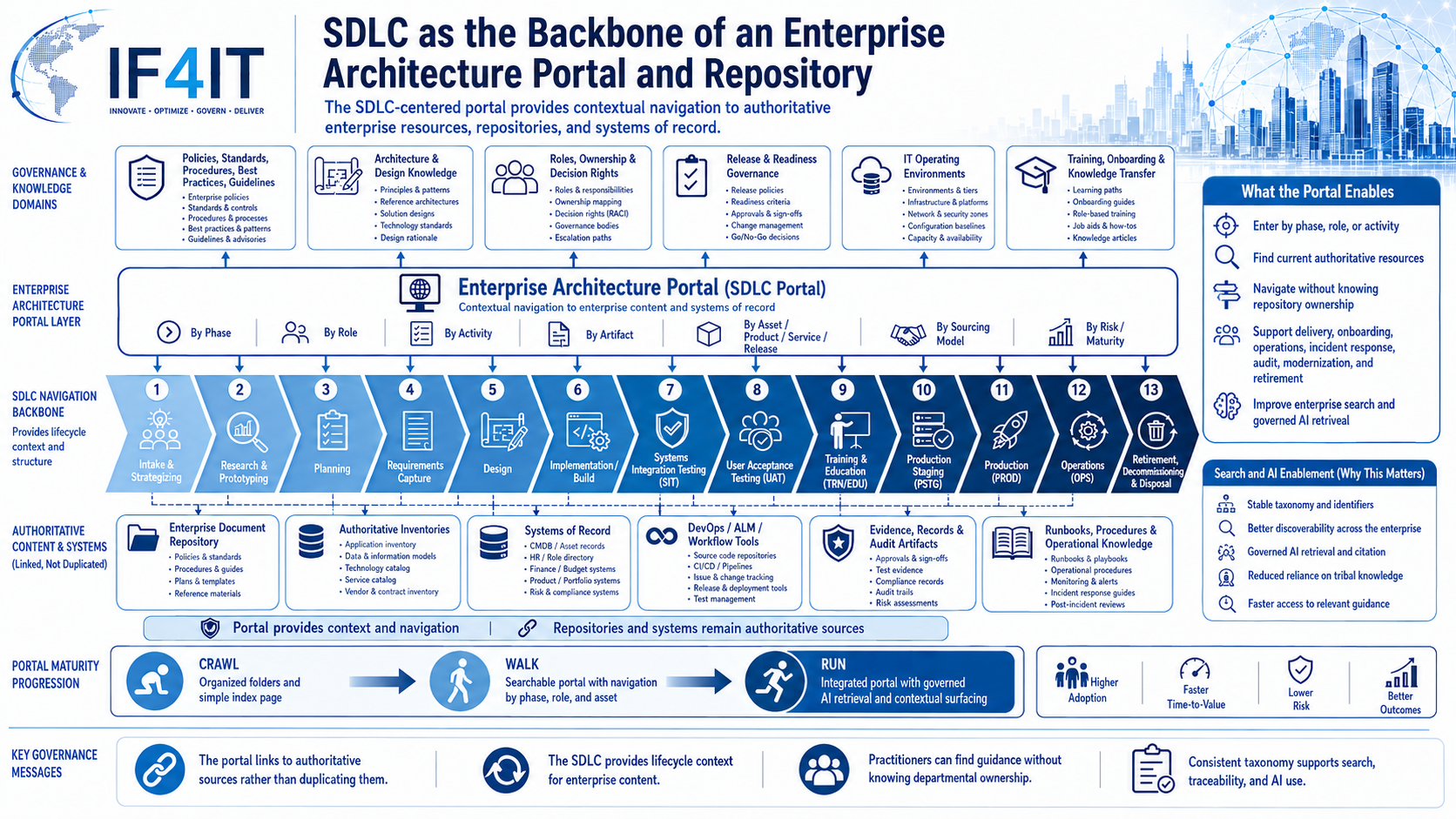
This chapter explains how an SDLC-centered portal provides contextual navigation across enterprise architecture, governance, documentation, and systems.
Portal as Contextual Navigation
The portal should let practitioners enter by phase, role, Activity, Artifact, discipline, Asset, Product, Service, Release, sourcing model, risk, or maturity. It should guide them to current authoritative resources without requiring knowledge of departmental ownership or repository locations.
Portal, Repository, and Systems of Record
The portal provides context and navigation. The Enterprise Document Repository governs documents. Authoritative inventories and transactional systems govern structured records. The portal should link these without duplicating their content.
Practitioner and Operational Uses
The same portal can support delivery, onboarding, Operations, Support, Incident response, audit, modernization, and retirement by connecting lifecycle context to architecture, dependencies, procedures, owners, and evidence.
Search and AI Enablement
Consistent taxonomy, metadata, stable identifiers, and relationship links make portal content easier for enterprise search and governed AI to discover, retrieve, cite, and analyze.
Common Antipatterns
Enterprises should avoid requiring practitioners to already know departmental ownership to find relevant guidance. A well-designed portal should let practitioners enter by phase, role, or Activity and be guided to current resources; requiring them to already know which department or repository owns a given piece of guidance defeats the portal’s purpose and pushes practitioners back toward relying on personal networks and institutional memory.
| Antipattern | Why it fails |
|---|---|
| Requiring practitioners to already know departmental ownership to find relevant guidance | A well-designed portal should guide practitioners to resources by phase, role, or Activity; requiring prior knowledge of departmental ownership defeats that purpose and pushes practitioners back toward institutional memory. |
Portal Sophistication by Maturity
Portal sophistication scales with maturity. A Crawl-maturity enterprise may rely on a well-organized folder structure and a simple index page rather than a dedicated portal tool. A Walk-maturity enterprise deploys a searchable portal with defined navigation by phase, role, and Asset. A Run-maturity enterprise integrates the portal with governed AI retrieval, automatically surfacing relevant guidance based on a practitioner’s current context.
Connections to Related IF4IT Practices and Inventories
Use Enterprise Capability Models and the Capabilities Inventory and Attributes to trace stakeholder needs and solution decisions to the enterprise capabilities they enable, change, protect, or retire. Use the Data and Information Inventory and Attributes and the Integrations Inventory and Attributes to identify authoritative data, semantics, interfaces, lineage, ownership, quality expectations, and integration dependencies before design decisions are finalized.
For How the SDLC Becomes the Backbone of an Enterprise Architecture Portal, IT leaders and managers should establish explicit decision rights, accountable ownership, proportional controls, evidence expectations, performance measures, and continuous-improvement feedback tied to enterprise value.
Apply Enterprise Inventory Management Best Practices so affected inventories, identifiers, relationships, ownership, status, evidence, configuration, and retirement information are updated as governed outputs of each Release.
How to cite this page
When referencing this page in academic work, internal standards, or external publications, include the page title, IF4IT as author and publisher (The International Foundation for Information Technology (IF4IT), LLC), the URL, and your access date.
Example (informal web citation):
The International Foundation for Information Technology (IF4IT), LLC. How the SDLC Becomes the Backbone of an Enterprise Architecture Portal | Systems Development Lifecycle (SDLC) Best Practices. https://if4it.org/best-practices/systems-development-lifecycle-sdlc/how-the-sdlc-becomes-the-backbone-of-an-enterprise-architecture-portal/ (accessed 2026-10-16).
See About Us for content governance and site-wide citation guidance.
Copyright for The International Foundation for Information Technology (IF4IT), LLC: 2008 - Present
Legal Disclaimers