How the Systems Development Lifecycle (SDLC) Relates to a Product or Service Lifecycle - Systems Development Lifecycle (SDLC) Best Practices
How the Systems Development Lifecycle (SDLC) Relates to a Product or Service Lifecycle
(Chapter 12 of Systems Development Lifecycle (SDLC) Best Practices)
Executive Summary: Chapter Overview
IF4ITThe Bottom Line
Core Concepts
| Concept | Definition & Strategic Role |
|---|---|
| Product Lifecycle | The continuing governed life of a Product from concept through retirement. |
| Service Lifecycle | The continuing governed life of a Service from need and design through termination and retirement. |
| Roadmap-to-SDLC Relationship | The conversion of planned Product outcomes into governed lifecycle work. |
| Service Commitment | A defined operating outcome or obligation that must influence requirements, design, validation, and operations. |
Quick Q&A
Question: Is a Product lifecycle the same as one Project?
Question: When should Service requirements be addressed?
Question: Does Production deployment complete Product or Service accountability?
Read More Below
This chapter explains how enduring Product and Service lifecycles relate to the SDLC, successive Releases, roadmaps, service commitments, ownership, Operations & Maintenance, supportability, obsolescence, and controlled retirement.
Canonical Definitions
A Product Lifecycle is the governed progression of a Product from initial concept and investment through development or acquisition, introduction, continuing evolution, operation, support, maturity, decline, replacement, and retirement.
A Service Lifecycle is the governed progression of a Service from initial need and design through introduction, delivery, operation, support, improvement, transition, termination, and retirement.
Product and Service Lifecycles Versus the SDLC
The Product or Service lifecycle describes the continuing life, value, ownership, operation, and evolution of the enduring capability. The SDLC provides the structured phases through which material changes are planned, developed or acquired, validated, deployed, operated, maintained, and retired.
The Product or Service lifecycle is continuous, while each Release follows a bounded approved SDLC Path that changes the enduring capability.
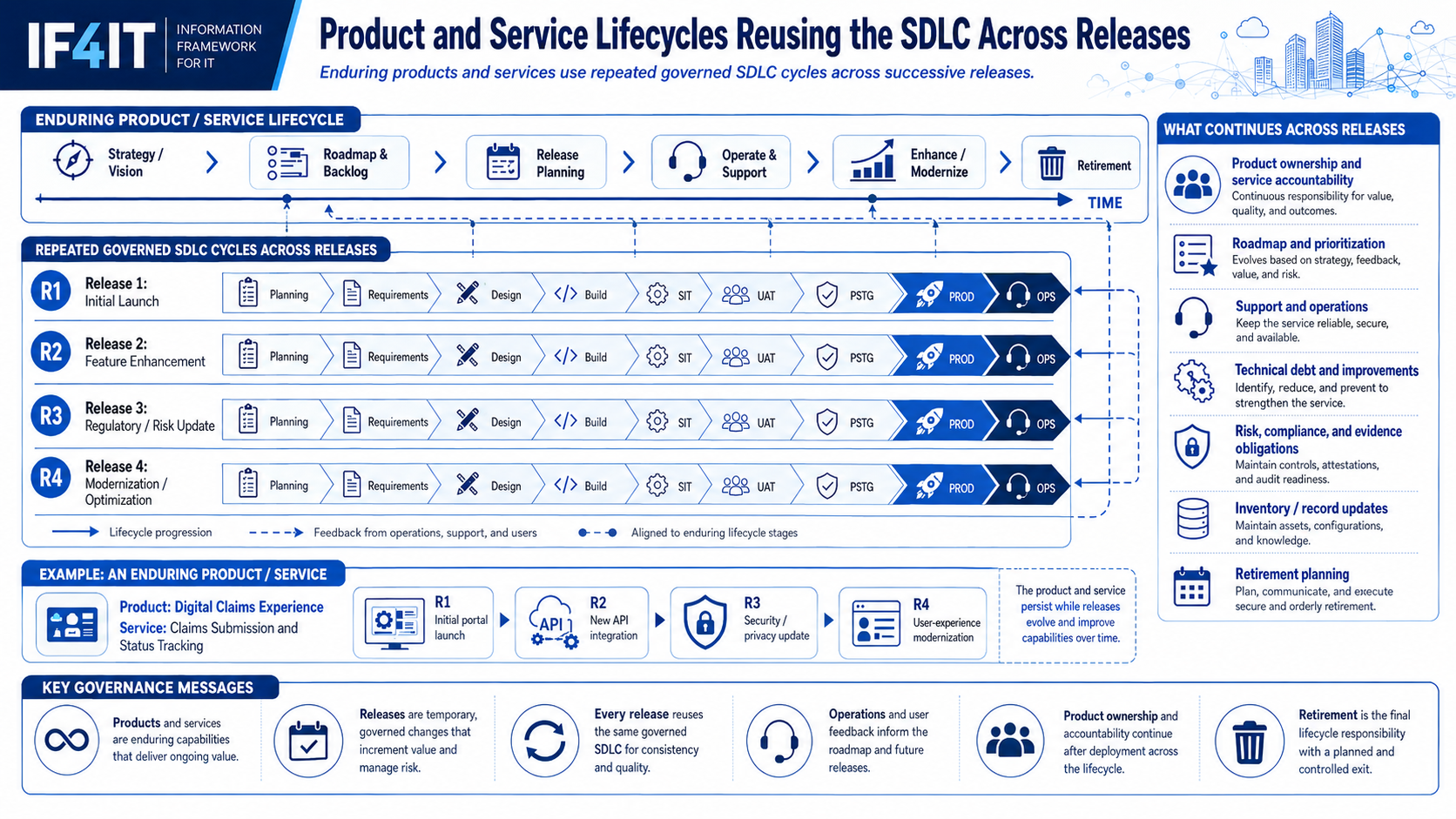
Roadmaps and Service Commitments
| Lifecycle Concern | SDLC Implication |
|---|---|
| Product capability or roadmap priority | May initiate Intake, Requirements, Design, Build, validation, and Production work. |
| Availability and recovery commitments | Influence architecture, resilience, testing, monitoring, staging, and operational evidence. |
| Support model | Influences requirements, training, documentation, staffing, and Production acceptance. |
| Supplier roadmap or support date | Influences acquisition, integration, supportability, replacement, and Release coordination. |
| Customer or user need | Influences Intake, Requirements Capture, UAT, adoption, and outcome measurement. |
Operations, Obsolescence, and Retirement
Operations & Maintenance is often the longest phase of a Product or Service lifecycle. It includes monitoring, incidents, support, patching, capacity, continuity, cost optimization, supplier management, feedback, technical-debt management, Release post-mortems, and future-Release planning.
Owners should monitor support dates, technology obsolescence, maintenance cost, declining usage, strategic fit, security exposure, supplier viability, skills availability, and regulatory change. Retirement planning should begin before the capability becomes unsupported or unsafe.
Common Antipatterns
Enterprises should avoid waiting until a capability becomes unsupported or unsafe before beginning retirement planning. Retirement planning that only starts once a support date has already passed or a security exposure has already materialized leaves the enterprise scrambling under pressure; the owner’s ongoing monitoring obligations exist specifically so retirement can begin well before the capability becomes genuinely risky to keep running.
| Antipattern | Why it fails |
|---|---|
| Waiting until a capability becomes unsupported or unsafe before beginning retirement planning | Retirement planning that only starts once a support date has passed or a security exposure has materialized leaves the enterprise scrambling under pressure, rather than acting on the early warning signs owners are meant to monitor. |
Connections to Related IF4IT Practices and Inventories
Use Application Portfolio Management (APM) Best Practices and the Applications Inventory and Attributes to clarify enduring ownership, lifecycle accountability, value, cost, risk, and dependency information.
Use Service Management Best Practices and Service Catalog Best Practices to connect lifecycle decisions to service ownership, operational readiness, support obligations, service levels, and continual improvement.
How to cite this page
When referencing this page in academic work, internal standards, or external publications, include the page title, IF4IT as author and publisher (The International Foundation for Information Technology (IF4IT), LLC), the URL, and your access date.
Example (informal web citation):
The International Foundation for Information Technology (IF4IT), LLC. How the Systems Development Lifecycle (SDLC) Relates to a Product or Service Lifecycle | Systems Development Lifecycle (SDLC) Best Practices. https://if4it.org/best-practices/systems-development-lifecycle-sdlc/how-the-systems-development-lifecycle-sdlc-relates-to-a-product-or-service-lifecycle/ (accessed 2026-10-16).
See About Us for content governance and site-wide citation guidance.
Copyright for The International Foundation for Information Technology (IF4IT), LLC: 2008 - Present
Legal Disclaimers