How to Pilot and Roll Out a New Enterprise SDLC - Systems Development Lifecycle (SDLC) Best Practices
How to Pilot and Roll Out a New Enterprise SDLC
(Chapter 55 of Systems Development Lifecycle (SDLC) Best Practices)
Executive Summary: Chapter Overview
IF4ITThe Bottom Line
Core Concepts
| Concept | Definition & Strategic Role |
|---|---|
| Enterprise SDLC Pilot | A controlled implementation used to validate the lifecycle operating model with representative work before broad adoption. |
| Pilot Success Criteria | Predefined evidence and measures used to determine whether the pilot operating model is usable and effective. |
| Rollout Increment | A bounded group of teams, Solution classes, business areas, or Releases brought into the Enterprise SDLC under one adoption plan. |
| Adoption Readiness | The demonstrated availability of governance, training, systems, support, roles, and evidence needed for responsible rollout. |
| Pilot Feedback Loop | The governed process for converting observed pilot outcomes into approved lifecycle improvements. |
Quick Q&A
Question: Should the first pilot use only low-risk work?
Question: When is the Enterprise SDLC ready for broader rollout?
Question: Should the enterprise automate the pilot immediately?
Read More Below
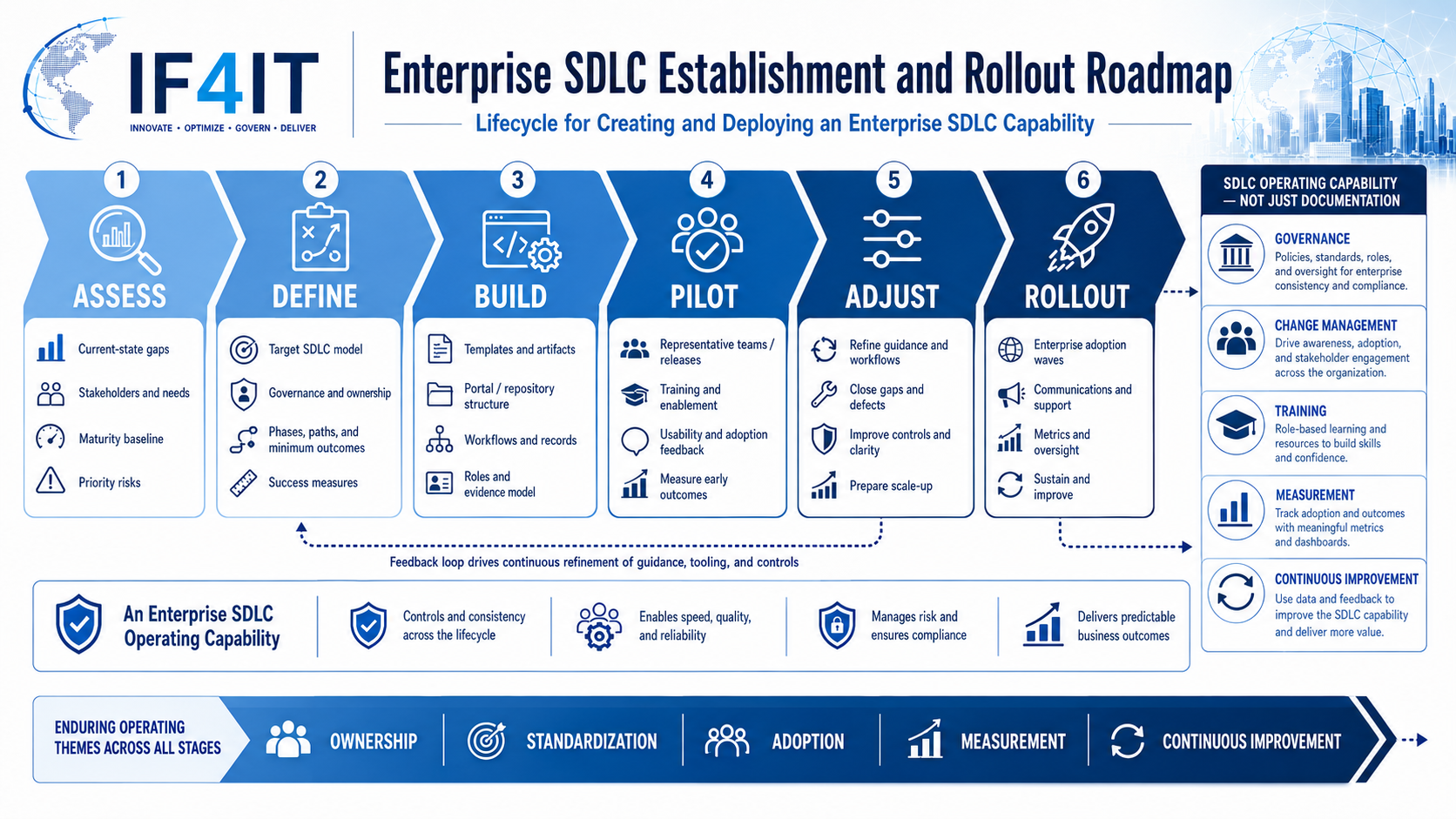
A new Enterprise Systems Development Lifecycle should be introduced as a governed operating-model change rather than as a document publication exercise. A pilot should prove that the lifecycle is understandable, usable, proportionate, integrated with existing systems, and capable of producing better decisions and evidence before broad rollout.
Best Practice: Define the Pilot Purpose and Success Criteria
State which lifecycle capabilities the pilot must prove, such as Release identification, SDLC Path selection, Utilization Profile use, role clarity, evidence traceability, Readiness Gates, inventory updates, exception governance, and operational closure. Define measurable success criteria before the pilot begins.
Benefits: Defining measurable success criteria before the pilot begins — naming exactly which capabilities it must prove — means the enterprise can actually judge whether the pilot succeeded, instead of relying on a subjective sense that things went fine.
Best Practice: Select Representative Pilot Work
Choose a small portfolio that represents meaningful variation without creating unmanageable scope. Include appropriate examples of Custom-Built, Acquired, or Composite Solutions; different delivery methodologies; differing risk levels; and at least one Release that proceeds through Production and Operations.
Benefits: Including genuine variation in sourcing model, risk level, and delivery methodology in the pilot portfolio is what proves the SDLC actually works across real conditions. A pilot limited to easy, low-risk work only proves the model handles easy, low-risk work.
Best Practice: Establish Pilot Governance
Assign an executive sponsor, Enterprise SDLC owner, pilot lead, participating Release Owners, discipline representatives, system owners, and decision authorities. Define how questions, defects, exceptions, and improvement proposals will be resolved during the pilot.
Benefits: Naming an executive sponsor and a pilot lead with clear authority to resolve questions during the pilot prevents ambiguous issues from stalling the pilot itself while everyone waits to find out who’s actually empowered to make a call.
Best Practice: Apply Prepare the Minimum Operating Model
Publish the pilot SDLC Path or Paths, Utilization Profile, role model, minimum Artifacts and evidence, Gate expectations, authoritative systems, training, support channels, and escalation process. Simplify the mechanism before eliminating any lifecycle obligation.
Benefits: Publishing a genuinely minimum operating model for the pilot — simplifying mechanisms without eliminating obligations — gives participating teams something concrete and lightweight enough to actually follow, rather than the full enterprise-scale model before it’s been proven.
Best Practice: Apply Run the Pilot With Active Coaching
Provide office hours, embedded coaching, templates, examples, and rapid issue resolution. Observe how teams actually perform the work rather than relying only on completed forms or self-reported status.
Benefits: Observing how teams actually perform the work, not just collecting self-reported status, is what reveals the real friction points. A team’s completed form can look fine while the actual experience of using the new SDLC was confusing or frustrating in ways the form never captured.
Best Practice: Apply Collect Evidence and Feedback
Measure cycle time, rework, evidence readiness, decision quality, user effort, exception patterns, system friction, stakeholder confidence, and Production outcomes. Separate defects in the SDLC design from adoption gaps, tool limitations, and Release-specific problems.
Benefits: Separating defects in the SDLC’s own design from adoption gaps and Release-specific problems means the pilot’s findings actually point to the right fix. Conflating the two risks redesigning a perfectly good SDLC because one team’s tooling was unrelated and broken.
Best Practice: Apply Refine Before Expansion
Update terminology, Paths, guidance, templates, integrations, training, and governance based on pilot evidence. Resolve ambiguous obligations before automating them. Preserve a controlled record of changes and the rationale for each change.
Benefits: Resolving ambiguous obligations before automating them — and preserving a record of what changed and why — prevents the enterprise from encoding an unclear requirement into automation that then enforces that ambiguity at scale during rollout.
Best Practice: Apply Roll Out in Controlled Increments
Expand by business area, Solution class, risk tier, or delivery community. Use readiness criteria for each rollout increment, maintain support capacity, and avoid forcing enterprise-wide adoption faster than governance and systems can sustain.
Benefits: Expanding by business area or risk tier, with readiness criteria for each increment, means support capacity and governance maturity can actually keep pace with adoption. Forcing enterprise-wide adoption faster than the organization can sustain tends to produce exactly the friction the pilot was meant to prevent.
Best Practice: Apply Make Adoption Accountable
Assign rollout ownership, adoption milestones, conformance measures, exception treatment, and executive reporting. Require new and active Releases to transition according to an approved plan while protecting critical delivery commitments from unmanaged process disruption.
Benefits: Assigning rollout ownership and conformance measures — while explicitly protecting critical delivery commitments from unmanaged disruption — keeps adoption progressing on an approved plan instead of stalling indefinitely while teams wait for a convenient moment that never arrives.
Example
An enterprise pilots its new SDLC on three initiatives. A low-risk SaaS change tests the lightweight path, a customer-portal enhancement tests the standard path, and a high-risk claims API tests enhanced security, integration, and readiness controls. The pilots reveal unclear decision rights, duplicated evidence, and missing supplier guidance. The SDLC owner corrects those issues before rollout, updates training and templates, and defines success measures. The varied pilot portfolio validates proportionality rather than proving only one path.
Best Practice: Avoid Common Antipatterns in How to Pilot and Roll Out a New Enterprise SDLC
Enterprises should avoid piloting only simple, low-risk work that doesn’t represent real variation. A pilot portfolio limited to easy cases proves the SDLC works for easy cases; it says nothing about whether the model holds up for Acquired Solutions, high-risk Releases, or the delivery methods and sourcing patterns the pilot never actually tested.
| Antipattern | Why it fails |
|---|---|
| Piloting only simple, low-risk work that doesn’t represent real variation | A pilot limited to easy cases proves the SDLC works for easy cases; it says nothing about whether the model holds up for the higher-risk, more varied work it will eventually need to govern. |
Benefits: Avoiding this antipattern means rollout confidence is actually earned across the range of work the SDLC will govern, not just its easiest slice. It surfaces gaps in handling Acquired Solutions or high-risk Releases while the pilot is still small enough to correct cheaply.
Connections to Related IF4IT Practices and Inventories
Connect the decisions and responsibilities addressed in this chapter to enterprise structure, capability ownership, and measurable business outcomes using the IF4IT Enterprise Model, Enterprise Capability Models, and the Capabilities Inventory and Attributes. Use Application Portfolio Management (APM) Best Practices and the Applications Inventory and Attributes to place this SDLC decision in the context of application ownership, portfolio value, lifecycle state, and dependencies.
For How to Pilot and Roll Out a New Enterprise SDLC, IT leaders and managers should establish explicit decision rights, accountable ownership, proportional controls, evidence expectations, performance measures, and continuous-improvement feedback tied to enterprise value.
Enterprise Inventory Management Best Practices require each Release to read authoritative lifecycle records and update affected inventories, identifiers, relationships, ownership, status, evidence, configuration, and retirement information as governed outputs.
How to cite this page
When referencing this page in academic work, internal standards, or external publications, include the page title, IF4IT as author and publisher (The International Foundation for Information Technology (IF4IT), LLC), the URL, and your access date.
Example (informal web citation):
The International Foundation for Information Technology (IF4IT), LLC. How to Pilot and Roll Out a New Enterprise SDLC | Systems Development Lifecycle (SDLC) Best Practices. https://if4it.org/best-practices/systems-development-lifecycle-sdlc/how-to-pilot-and-roll-out-a-new-enterprise-sdlc/ (accessed 2026-10-16).
See About Us for content governance and site-wide citation guidance.
Copyright for The International Foundation for Information Technology (IF4IT), LLC: 2008 - Present
Legal Disclaimers