How to Use This Systems Development Lifecycle (SDLC) Best Practices Document - Systems Development Lifecycle (SDLC) Best Practices
How to Use This Systems Development Lifecycle (SDLC) Best Practices Document
(Chapter 5 of Systems Development Lifecycle (SDLC) Best Practices)
Executive Summary: Chapter Overview
IF4ITThe Bottom Line
Core Concepts
| Concept | Definition & Strategic Role |
|---|---|
| Complete-Framework Use | Reviewing the entire document to design or improve an enterprise SDLC without leaving lifecycle gaps. |
| Standalone-Chapter Use | Applying an individual chapter to answer a focused lifecycle question while preserving foundational context. |
| Simplify the Mechanism Before Eliminating the Obligation | The principle that resource constraints should lead to lighter implementation, not invisible removal of necessary outcomes. |
Quick Q&A
Question: Must the document be read only from beginning to end?
Question: How should a small enterprise apply the guidance?
Question: What converts broad guidance into an actionable path?
Read More Below
This chapter explains how leaders, owners, practitioners, suppliers, governance functions, and resource-constrained enterprises should navigate and apply the document as both a complete enterprise framework and a collection of standalone practitioner chapters.
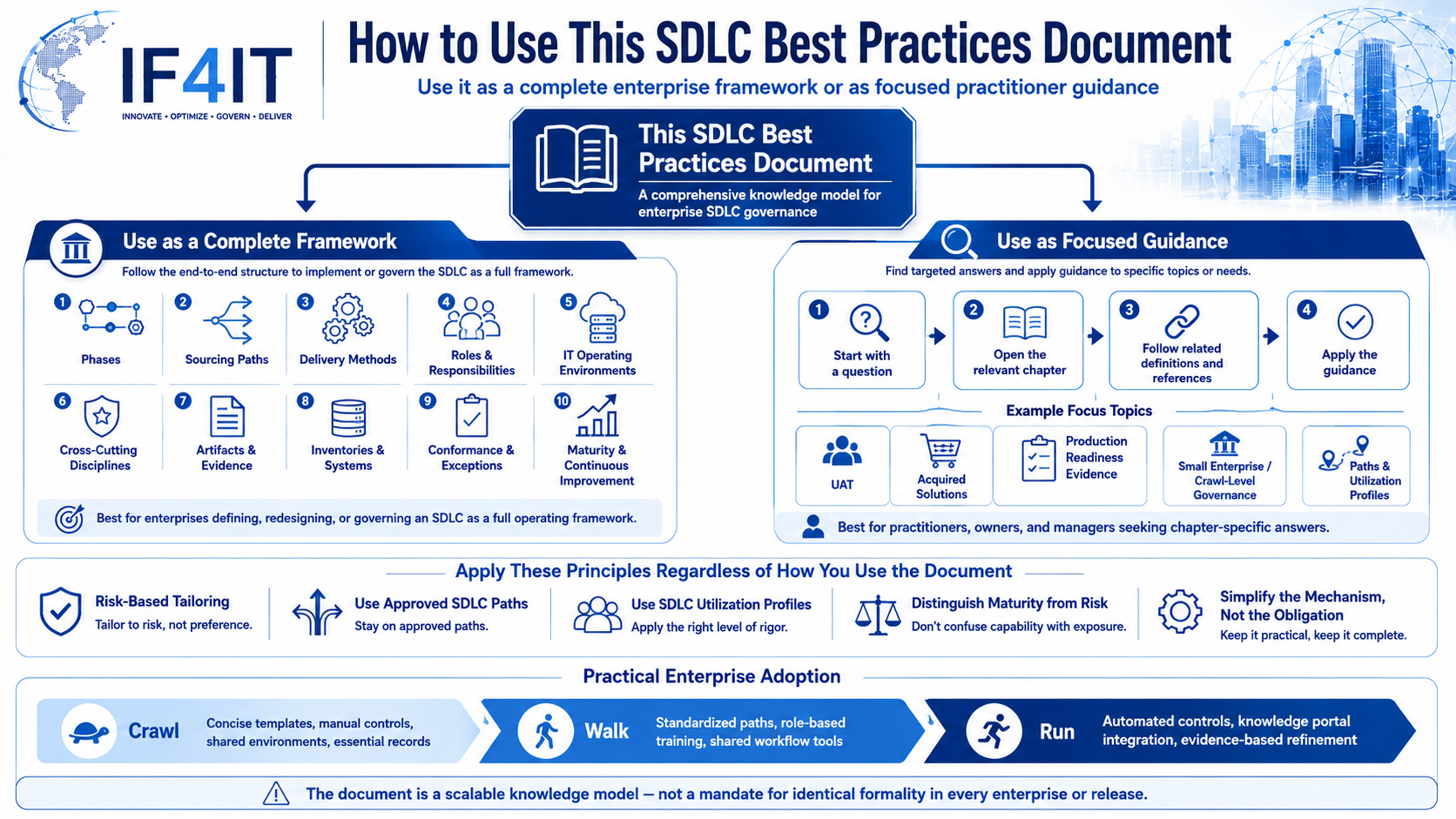
Use the Document as a Complete Framework
Enterprises defining or redesigning an SDLC should review the document as a complete body of guidance. The full framework covers phases, sourcing paths, delivery methods, roles, Environments, cross-cutting disciplines, artifacts, evidence, inventories, conformance, maturity, and continuous improvement.
The document defines a comprehensive knowledge model, not a requirement that every enterprise or Release implement every practice with identical formality.
Use Individual Chapters for Focused Guidance
Individual chapters are designed to answer focused questions, such as what should happen during UAT, how an Acquired Solution should move through the lifecycle, what evidence is needed before Production, or how a small enterprise can implement Crawl-level governance.
Readers using a standalone chapter should follow its references to foundational definitions and related concepts when broader context is required.
Practical Enterprise Adoption Sequence
| Step | Action |
|---|---|
| 1 | Understand the 13-phase SDLC and foundational definitions. |
| 2 | Assess current practices, risks, maturity, tools, and governance. |
| 3 | Define the authoritative enterprise SDLC and ownership. |
| 4 | Define Custom-Built, Acquired, and Composite paths. |
| 5 | Establish risk classifications and tailoring rules. |
| 6 | Define minimum non-negotiable outcomes. |
| 7 | Define phase roles, activities, artifacts, evidence, gates, and Environment mappings. |
| 8 | Integrate cross-cutting disciplines and enterprise-record updates. |
| 9 | Establish conformance, exception, and risk-acceptance processes. |
| 10 | Publish, train, measure, and execute a maturity roadmap. |
Use by Small and Resource-Constrained Enterprises
A small enterprise may combine roles, use concise templates, maintain controlled spreadsheets, perform manual inventory updates, share Environments, or use one review for several governance purposes. It should still assign ownership, identify risk, define requirements, perform appropriate verification and validation, maintain essential records, govern exceptions, and plan retirement.
The governing principle is to simplify the mechanism before eliminating the obligation.
Use by Walk- and Run-Maturity Enterprises
A Walk-maturity enterprise uses the document to standardize what a Crawl-level implementation left ad hoc: converting recurring practices into approved SDLC Paths, publishing role-based training drawn directly from the relevant chapters, and integrating chapter-level Artifact and evidence requirements into a shared workflow tool rather than individual team habits. A Run-maturity enterprise treats the document as a living reference embedded into automated tooling: encoding minimum non-negotiable outcomes as policy-as-code checks, connecting chapter guidance into the enterprise knowledge portal for AI-assisted retrieval, and using the continuous-improvement chapters to drive evidence-based refinement of Paths and Profiles that are already in active use.
Common Antipatterns
Enterprises should avoid treating this document as a rigid mandate rather than an adaptable knowledge model. This document defines a comprehensive knowledge model, not a requirement that every enterprise or Release implement every practice with identical formality; treating it as a rigid mandate can lead an enterprise to over-implement low-risk work or to abandon the framework entirely because it seems too heavy for its actual needs.
| Antipattern | Why it fails |
|---|---|
| Treating this document as a rigid mandate rather than an adaptable knowledge model | This document defines a comprehensive knowledge model, not a requirement to implement every practice with identical formality; treating it as a rigid mandate can lead to over-implementation or outright abandonment. |
How to cite this page
When referencing this page in academic work, internal standards, or external publications, include the page title, IF4IT as author and publisher (The International Foundation for Information Technology (IF4IT), LLC), the URL, and your access date.
Example (informal web citation):
The International Foundation for Information Technology (IF4IT), LLC. How to Use This Systems Development Lifecycle (SDLC) Best Practices Document | Systems Development Lifecycle (SDLC) Best Practices. https://if4it.org/best-practices/systems-development-lifecycle-sdlc/how-to-use-this-systems-development-lifecycle-sdlc-best-practices-document/ (accessed 2026-10-16).
See About Us for content governance and site-wide citation guidance.
Copyright for The International Foundation for Information Technology (IF4IT), LLC: 2008 - Present
Legal Disclaimers